Masayoshi Amamiya
Bank of Japan
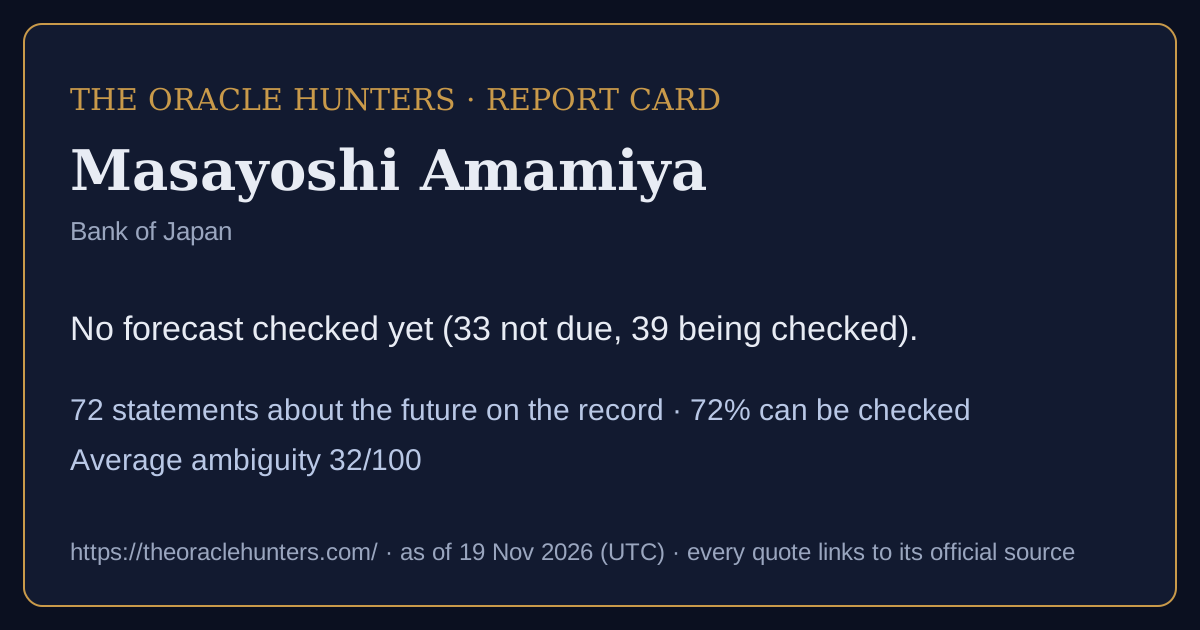
Track record: No forecast checked yet (33 not due, 39 being checked).
72forecasts & commitments on the record
72%can be checked as stated
32average ambiguity (0-100)
0goalpost moves recorded
0confirmed U-turns
Timeline
came true partly did not not due / being checked / too vague
Calibration score: shown after 10 checked forecasts with a stated likelihood (now 0).
How they speak about the future: based on data 58, educated guess 11, stated on authority 3.
Kinds of claim: forecast 53, scenario (if… then) 10, mixed claim 7, commitment 2. · Download this report card as a picture
In the nine words
πρόγνωσιςInference from evidence54 · 75%πρόνοιαPreparing for the future10 · 14%μαντείαInspired knowledge2 · 3%εἰκασίαConjecture2 · 3%προαναγγελίαPublic pre-announcement2 · 3%φρόνησιςPractical wisdom1 · 1%πρόβλεψιςSeeing the signs1 · 1%
How to read this
Each box is one sentence a public figure or institution said about the future, word for word, with a link to the official text. Can be checked means it names what will happen, by when, and how likely - so it can be compared with official figures later. Too vague to check means it does not. Ambiguity (0-100) is how many different ways the sentence can be read. When the date passes, the forecast is compared with official data and marked came true, partly or did not come true. Labels judge the sentence, never the person. Full guide and glossary.On the record (72)
Moreover, it has been pointed out that if climate change is not addressed, humanity will face unprecedented circumstances, and the negative economic impact may increase in a nonlinear fashion; however quantitative analysis of this is fraught with difficulties.
In principle, these Climate Response Financing Operations will be conducted twice a year, and funds were provided in December of last year and July of this year.
As I mentioned, GFANZ has estimated that the world will need to invest approximately $125 trillion to achieve net zero by 2050.
The Glasgow Financial Alliance for Net Zero (GFANZ) has estimated that the world will need to invest $125 trillion to achieve net zero by 2050.
Such improvement in employee income is projected to continue; supported by this, private consumption is expected to keep increasing steadily from fiscal 2023 onward, although the pace of materialization of pent-up demand is likely to slow.
That said, even in fiscal 2024, which is the end of the projection period, the rate of increase is expected to only be at around 1.5 percent.
As a result, the year-on-year rate of increase in the CPI for all items excluding fresh food is expected to decelerate from fiscal 2022 to 1.4 percent for fiscal 2023 and 1.3 percent for fiscal 2024.
Thus, the year-on-year rate of change in the CPI for all items excluding fresh food is likely to increase toward the end of this year due to rises in prices of such items as energy, food, and durable goods, and the average for fiscal 2022 is expected to exceed 2 percent, at 2.3 percent.
In terms of the medians of the Policy Board members' forecasts, Japan's real GDP growth rate is expected to be at 2.4 percent for fiscal 2022, 2.0 percent for fiscal 2023, and 1.3 percent for fiscal 2024 (Chart 5).
It should be noted, however, that the latest WEO forecasts show that global economic growth will remain positive at around 3 percent for both 2022 and 2023, indicating that the global economy is not expected to fall into recession.
If people use their income and savings to consume, for example, face-to-face services they had cut back, a virtuous cycle will operate in which such an increase in spending will bring about a sales increase at consumption-related firms and wage increases for those working there, and thereby encourage a further increase in consumption.
It will therefore persistently continue with powerful monetary easing under the current Quantitative and Qualitative Monetary Easing (QQE) with Yield Curve Control to achieve the price stability target of 2 percent.
Taking these points into account, it is projected as a baseline scenario that the recovery trend in the overall economy will gradually become evident through next year, as downward pressure stemming from supply-side constraints and COVID-19 wanes and the effects of the economic stimulus package materialize.
The Bank's Special Program is scheduled to be conducted until the end of March 2022, and the responses thereafter will be appropriately decided by examining developments in corporate financing and other factors based on, for example, the upcoming December Tankan .
That said, in the Bank's baseline scenario, the recovery trend in Japan's economy is likely to gradually become evident toward next year.
The Bank projects that the rate of increase in Japan's CPI will be only at around 1 percent even in fiscal 2023, which is the end of the current projection period.
The International Monetary Fund (IMF) projected last October that the growth rate of the global economy for 2021 would be 5.2 percent.
economy will grow at 4.4 percent for 2022, largely exceeding the past average of 3.5 percent.
The interest rate of 0 percent will be applied and the implementation period will last until the end of fiscal 2030.
In terms of the medians of the Policy Board members' forecasts in the July 2021 Outlook Report, the year-on-year rate of change in the CPI is projected to be 0.6 percent for fiscal 2021, 0.9 percent for fiscal 2022, and 1.0 percent for fiscal 2023.
In terms of the medians of the Policy Board members' forecasts, the real GDP growth rate is projected to be relatively high at 3.8 percent for fiscal 2021, and then be 2.7 percent for fiscal 2022 and 1.3 percent for fiscal 2023.
Since then, the projection has been revised upward twice, and the IMF forecasts in the latest projection made this April that the growth rate for this year will be 6.0 percent.
Without the backstop of the fallback provision, market participants are highly likely to face a chaotic situation in the execution of legacy contracts referencing yen LIBOR whose maturity date arrives after the end of this year.
On the other hand, major U.S. dollar LIBOR tenor settings that are most widely used will be ceased at the end of June 2023.
On that day, the future cessation and loss of representativeness of all the LIBOR currency tenor settings were formally determined. 1 Accordingly, the publication of LIBOR will be ceased for most of the currency tenor settings, including those of Japanese yen, at the end of this year.
The upward revisions to the forecasts for 2022 have continued even after the turn of the year, and there is no sign so far that the situation will reverse. 1
Due to a combination of dissipation of the effects of last year's reduction in mobile phone charges and a significant rise in energy prices caused in part by the situation surrounding Ukraine, the rate of increase in Japan's consumer price index (CPI) from April may be at around 2 percent.
Since the labor supply has a limitation, upward pressure on wages will increase if labor shortage continues.
In addition, the Bank will closely monitor the impact of COVID-19 and will not hesitate to take additional easing measures if necessary.
That said, it is unlikely that the inflation rate will approach the price stability target of 2 percent with momentum during the projection period since rapid recovery in demand can hardly be expected.
The real GDP growth rate for the January-March quarter of 2020 was minus 2.2 percent on an annualized quarter-on-quarter basis, and that for the April-June quarter also is likely to be substantially negative.
In the IMF's forecasts, the projected growth rate for the global economy registered a negative figure only once since 1970: minus 0.1 percent during the Global Financial Crisis.
According to the latest World Economic Outlook (WEO) Update released by the International Monetary Fund (IMF), global growth for 2020 is projected to be minus 4.9 percent.
The IMF projects that the global economy will recover from the second half of 2020 and the growth rate will be 5.4 percent for 2021.
According to the forecasts of the majority of the Policy Board members for the growth rates, the economy is projected to register significant negative growth in the range of minus 5.7 to minus 4.5 percent for fiscal 2020, but grow at a relatively high level ranging from 3.0 to 4.0 percent for fiscal 2021 and then
In today's forum, we will hold a session for each of these three topics, retail, wholesale, and cross-border payments.
- If interest rates rise, what will typically happen to bond prices?
And third, as the legal age of adulthood in Japan will be lowered in April 2022, young adults will be required to make decisions and assume responsibility as independent contracting parties from the age of 18, when most of them are still in high school.
his portrait will be printed on the new 10,000 yen Bank of Japan note to be issued from 2024.
## Expected discontinuation of LIBOR after end-2021
Following that, the aim is to publish "production rates" of the term reference rate no later than mid-2021, with an assumption that these will be used in actual transactions.
In taking the various measures mentioned to this point, it is very important for both the private and public sectors to keep in mind the timeline of when the discontinuation of LIBOR is expected; that is, up to the end of 2021.
Therefore, it is clear that interest rate benchmarks are extremely important, but it is very likely that LIBOR, which is widely used around the world, will be phased out at the end of 2021.
If the materialization of these risks leads to a longer delay in the timing of a pick-up in the global economic growth pace or to a further deceleration in the global economy, Japan's economy inevitably will be affected.
If a globally stable trade relationship is rebuilt, that will boost again the global trade, which has shrunk.
While it is expected to still take time to achieve the price stability target of 2 percent, the inflation rate is likely to increase gradually toward 2 percent.
- In a situation where downside risks to economic activity and prices, mainly regarding developments in overseas economies, are significant, the Bank will not hesitate to take additional easing measures if there is a greater possibility that the momentum toward achieving the price stability target will be lost.
The Bank projects that, although it is subject to considerable uncertainties, the growth rate will rise moderately through mid-2020.
According to the latest World Economic Outlook (WEO) released by the IMF, the global growth rate for 2019 is projected to decline to 3.0 percent and thereafter recover to 3.4 percent for 2020, which is around the past average (Chart 1).
In addition, LIBOR will most likely be permanently discontinued after the end of 2021 judging from the announcement by the U.K. Financial Conduct Authority in July 2017 that the survival of LIBOR cannot be guaranteed.
Showing the newest 50 - the ledger has all 72.
Also said - not checkable as stated (12 newest)
Remarks about the future with no date, figure or likelihood that could be checked. They are kept on the record and shown here, but not scored.
I hope that the Bank will continue to share its research and practical expertise widely and carry on with the mutual exchange of ideas between the Bank and academia, and that academia continues to deepen its analyses of these issues, allowing the Bank to incorporate the insights obtained into its own work.
Next, I would like to consider how climate change will affect the financial system.
The Committee published a statement entitled "Preparations for the discontinuation of LIBOR in the JPY interest rate swaps market" in late March this year. 7 It requested that market participants should cease the initiation of new transactions of yen LIBOR swaps by no later than the end of this September, and they should do so as early as possible, if …
- The issuance of new transactions for loans and bonds referencing yen LIBOR needs to be ceased by the end of June 2021
First, according to the Roadmap, the issuance of new transactions for loans and bonds referencing yen LIBOR needs to be ceased by the end of this June (Chart 3).
For an ex ample of a debate among academic economists and central bank economists, see Furman, J., 'Why Did A lmost Nobody See Inflation Coming?' Project Syndicate, January 17, 2022,www.project-syndicate.org/commentary/2021-us-inflation-forecasting-errors-economic-models-by-jasonfurman-2022-01. 1
Therefore, there is a reasonable likelihood that, once the impact of COVID-19 wanes and supply-side constraints and demand shifts subside, economies will return to a low inflation regime.
Second, the current phase has once again brought to the fore the 'norm' in Japan - that is, the Japanese-specific behavior of firms based on the assumption that prices will not increase easily (Chart 7).
Third, issues concerning the measurement of price indexes may also have a non-negligible impact on Japan's inflation rate (Chart 8).
The Bank will continue to contribute to the recovery of the affected areas.
That said, COVID-19 has continued to have a significant impact on social and economic activities, and economic activity and prices are projected to remain under downward pressure for a prolonged period.
As for the outlook, the year-on-year rate of change in the CPI is likely to continue to be negative for the time being, but thereafter is expected to increase with the effects of temporary factors that push down prices dissipating and the economy improving.