Martyn Oliver
Ofsted · GBR
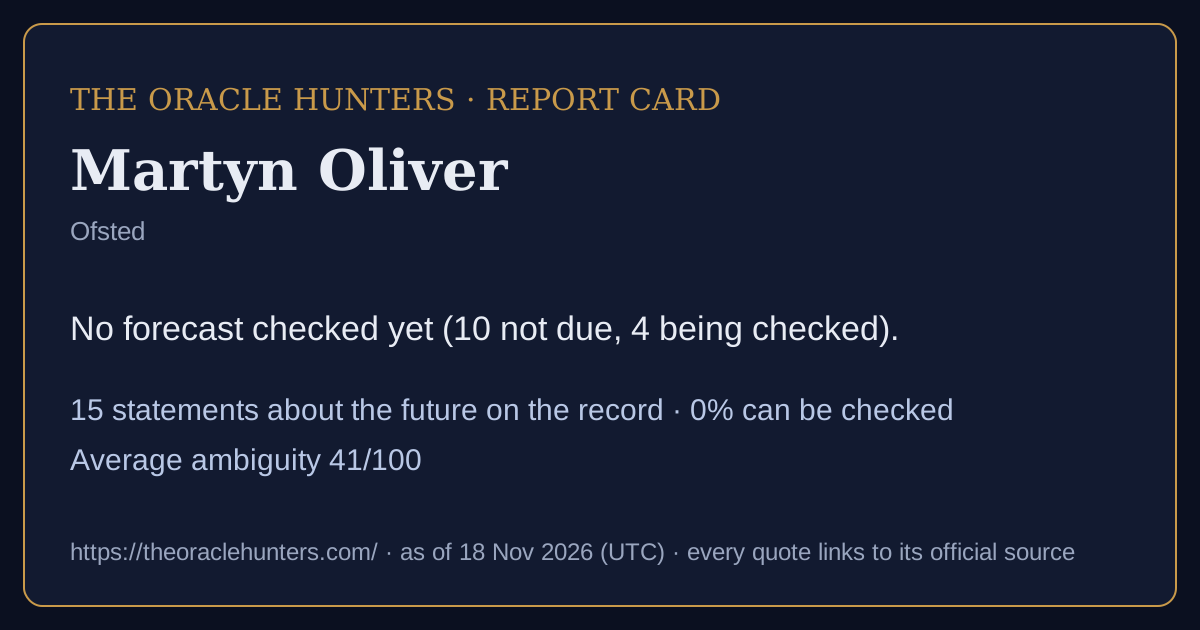
Track record: No forecast checked yet (10 not due, 4 being checked).
15forecasts & commitments on the record
0%can be checked as stated
41average ambiguity (0-100)
0goalpost moves recorded
0confirmed U-turns
Timeline
came true partly did not not due / being checked / too vague
Calibration score: shown after 10 checked forecasts with a stated likelihood (now 0).
How they speak about the future: stated on authority 7, based on data 7, educated guess 1.
Kinds of claim: forecast 8, mixed claim 6, speculation 1. · Download this report card as a picture
In the nine words
How to read this
Each box is one sentence a public figure or institution said about the future, word for word, with a link to the official text. Can be checked means it names what will happen, by when, and how likely - so it can be compared with official figures later. Too vague to check means it does not. Ambiguity (0-100) is how many different ways the sentence can be read. When the date passes, the forecast is compared with official data and marked came true, partly or did not come true. Labels judge the sentence, never the person. Full guide and glossary.On the record (15)
We expect all ILACS changes to be implemented from spring 2027.
Until then, our current expectation is that every local area partnership will have been inspected at least once under the current Area SEND framework by the end of 2027.
You may have seen that we also had our first successful prosecution this year.
We will publish our response to the consultation early next year, followed by our new inspection materials.
These changes, alongside our commitment to keep children’s progress and experiences front and centre, will strengthen ILACS for 2026, and they will form a solid foundation as we look to craft a renewed children and families services inspection framework for 2027.
First I’ll linger for a moment on what to expect in April 2026.
For inspections of local authority children’s services, we will do this in April 2026.
And for phase 2, we will consult on how to build our strong, existing foundations and bring all the best bits of ILACS into a renewed framework: a children and families services inspection framework for 2027 that sets new expectations and higher ambitions.
So, next year, when we make the next updates to the ILACS framework in April, we will remove the overall effectiveness grade for good.
In phase one next year, as I’ve just said, we will remove the one-word judgement and make important revisions to the ILACS framework.
It seems that there is always a commentator keen to tell us how AI will either transform learning or destroy it; how it presents an existential challenge to the traditional approach to education that we’ve all grown up with.
But we will extend that to all education remits for September 2025 and expect to do the same for inspecting local authority children’s services (ILACS) in 2026.
Exactly what they will look like will depend on what comes out of next year’s consultation.
Now, you might be thinking that all this talk about next year is all well and good, but I am in the window for inspection now, so how can I prepare my team for that?
That consultation will launch early next year and it will be your opportunity to share your views on what we are proposing.
Also said - not checkable as stated (12 newest)
Remarks about the future with no date, figure or likelihood that could be checked. They are kept on the record and shown here, but not scored.
When this pilot ends, we will work with the trade unions to decide what happens next.
In the New Year we will be using our podcast to speak to schools who have received an ‘exceptional’ grade.
We will dive into how they use additional funding like the pupil premium, how they build really strong relationships with parents, and how they help children return to mainstream classrooms when they’re ready to do so.
That is why we will recognise your context fully, through data and through what we see and discuss with you on inspection.
We will continue to focus first on applications where they’re needed while we chip away at the rest of the backlog.
We will want to see that you’re doing all you can to stop using unregistered provision and that you are making progress away from it.
So I completely agree with her when she said to you that ‘accountability is an essential part of sustained improvement.’ We will work together – and with CST and its members and trade unions – on how Ofsted, as part of the accountability system, can keep getting better.
We are working closely with the Department for Education on a package of changes that we will be speaking to you about in the weeks and months to come.
The reviewing organisation will be a full member of the Ombudsman Association and must operate strictly in compliance with their high standards for case handling and impartiality.
And we will judge the success of this pilot very carefully.
As we have done since I took on the role of HMCI, we will work openly and transparently, sharing the good, the bad and the more complex!
Yours is a difficult job – and you need confidence that Ofsted is going to treat your schools fairly without creating undue additional pressure.