Martin Redrado
Central Bank of Argentina
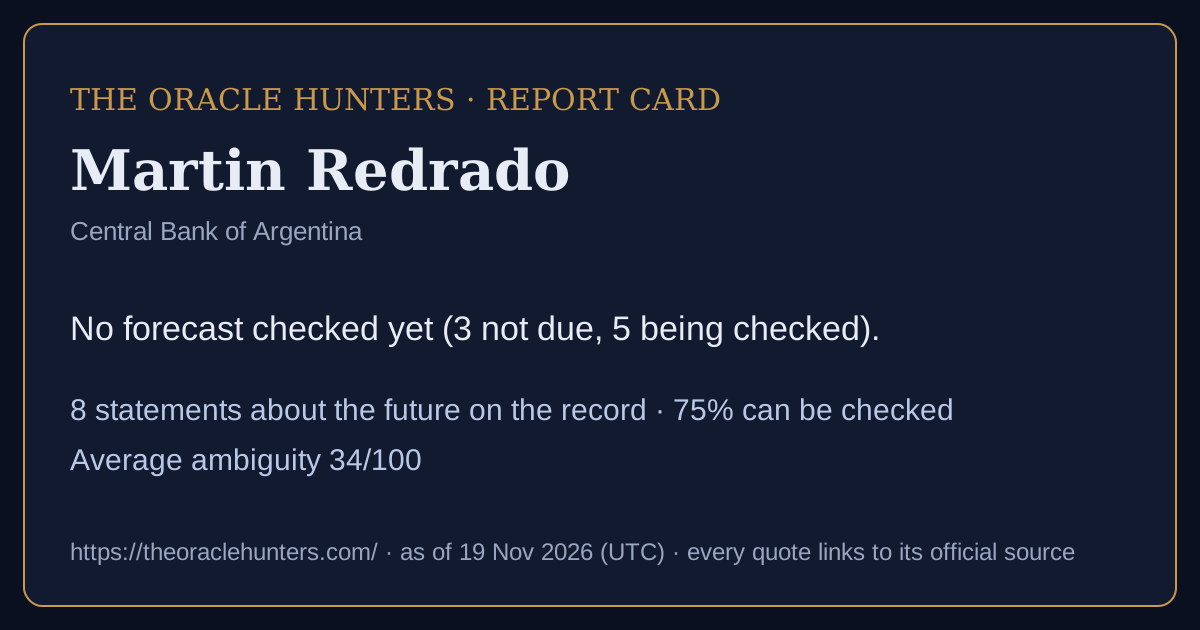
Track record: No forecast checked yet (3 not due, 5 being checked).
8forecasts & commitments on the record
75%can be checked as stated
34average ambiguity (0-100)
0goalpost moves recorded
0confirmed U-turns
Timeline
came true partly did not not due / being checked / too vague
Calibration score: shown after 10 checked forecasts with a stated likelihood (now 0).
How they speak about the future: based on data 6, educated guess 1, stated on authority 1.
Kinds of claim: forecast 7, mixed claim 1. · Download this report card as a picture
In the nine words
How to read this
Each box is one sentence a public figure or institution said about the future, word for word, with a link to the official text. Can be checked means it names what will happen, by when, and how likely - so it can be compared with official figures later. Too vague to check means it does not. Ambiguity (0-100) is how many different ways the sentence can be read. When the date passes, the forecast is compared with official data and marked came true, partly or did not come true. Labels judge the sentence, never the person. Full guide and glossary.On the record (8)
distribution bar chart of the Argentine GDP in the last 25 years would show that it is equally probable to grow or fall at a 10 percent rate, so there are empirical problems to project the trend of fundamental variables.
A frequency distribution bar chart of the Argentine GDP in the last 25 years would show that it is equally probable to grow or fall at a 10 percent rate, so there are empirical problems to project the trend of fundamental variables.
For the first time, all the regions in the world are growing, both the US, at a 4% rate, the EU, at a 2% rate, Latin America, whose economy has begun to pick up again at a 3.5% rate, and Japan, which after a long recession is growing at a 4% rate, although this may prove unsustainable over time.
In May this year, owing to tax due dates, especially income tax, many companies had to borrow money from the interbanking market, which led to a significant cash demand.
The range we have included here, which also appears in the 3-year Program as agreed upon with the International Monetary Fund for next year, is between 5% and 8%, and 7.9% as per the budget.
With a current account surplus, Argentina's exports this year will be worth US$ 11.5 billion more than its imports.
I cannot say when or how this will occur, but I can say that there will be an increase in interest rates, and that next year's scenario will be one of growth.
And when we complete our office on September 23, 2010, we will be judged by two factors - the maintenance of currency stability, real wages, and the purchasing power, and our contribution to Argentina's growth through the creation of a medium- and long-term credit market, which is still non-existent in our country.
Also said - not checkable as stated (12 newest)
Remarks about the future with no date, figure or likelihood that could be checked. They are kept on the record and shown here, but not scored.
However the fund is letting aside most vulnerable economies, a situation that should be taken into account because other way those economies could be putted in the front line of speculative actions.
We must recall that 75% of global economic growth between 2003 and 2007 (measured at PPP) is explained by developing economies, which grew at a remarkable average rate of almost 7% during that period.
This flight to supposed 'safer heavens' could be very costly as it could trigger a run against the domestic banking system or the local currency, given the natural tendency towards financial instability in emerging economies.
In my opinion, as the world economy slows down further it will drive prices of primary products down, even though structural factors like the demand for food by the emerging regions and the development of bio-fuels, added to the demand to rebuild the reduced current inventory levels, will provide price support.
I therefore feel that although volatility may continue the prices of commodities have already experienced most of their adjustment to the new international economic scenario.
In Latin America central banks from Brazil and Mexico provided liquidity in foreign currencies that amounted to around 10% of foreign reserves in just one month, however some distinctions should be made in terms of the way in which those intervention were carried on.
In policy design, monetary authorities should explicitly try to avoid ex ante the emergence of imbalances that could lead to financial instability.
Because of its critical role in the process of credit generation, and for being involved in a complex network of financial transactions, the eventual bankruptcy of an investment bank in a context of generalized leverage was expected to cause systemic events.
This new prominence of market-based intermediaries will have long lasting effect on the creation of the theoretical schemes behind monetary policy.
As regards the rules implemented via the interest rate channel, in the past 15 years the conventional wisdom was that short-term interest rates could be used to change the whole yield curve and thus affect economic agents' decisions.
Naturally, beyond any attempt to mitigate this trade-off, the strategy and policy choice will crucially depend on the attitudes of the government and its people towards risk.
Therefore, a prudent fiscal strategy of building up excess savings in good times should be a natural consequence of this asymmetric approach to shocks.