Mark Lowcock
Department for International Development · GBR
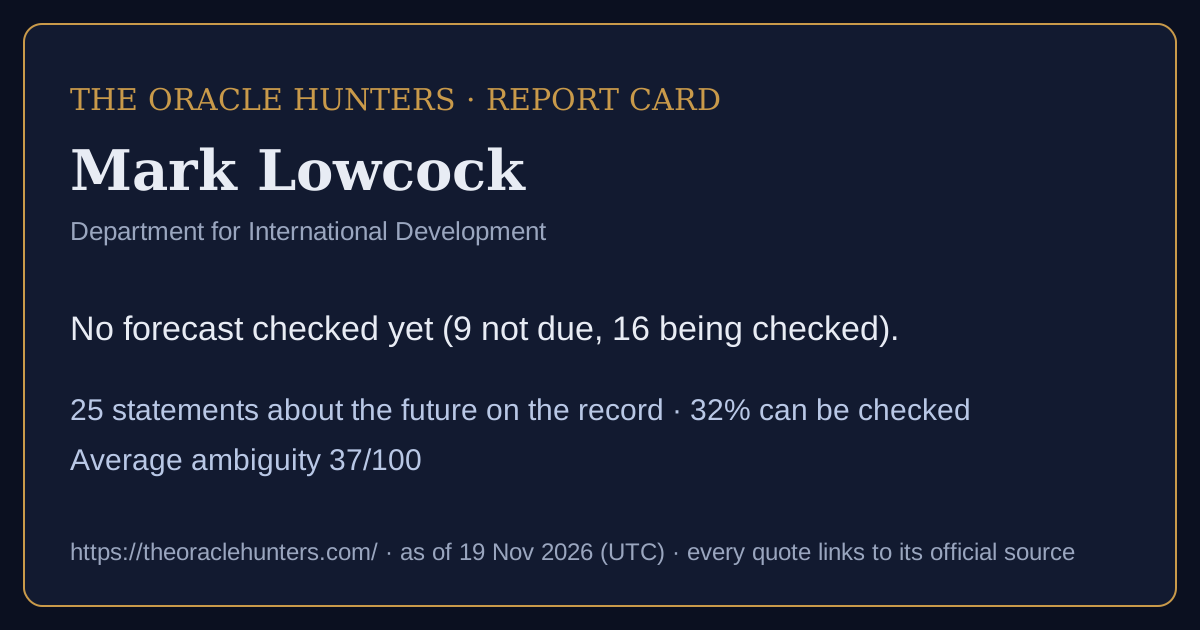
Track record: No forecast checked yet (9 not due, 16 being checked).
25forecasts & commitments on the record
32%can be checked as stated
37average ambiguity (0-100)
0goalpost moves recorded
0confirmed U-turns
Timeline
came true partly did not not due / being checked / too vague
Calibration score: shown after 10 checked forecasts with a stated likelihood (now 0).
How they speak about the future: based on data 21, stated on authority 4.
Kinds of claim: forecast 14, mixed claim 5, commitment 5, scenario (if… then) 1. · Download this report card as a picture
In the nine words
πρόγνωσιςInference from evidence18 · 72%προαναγγελίαPublic pre-announcement5 · 20%πρόνοιαPreparing for the future1 · 4%μαντείαInspired knowledge1 · 4%
How to read this
Each box is one sentence a public figure or institution said about the future, word for word, with a link to the official text. Can be checked means it names what will happen, by when, and how likely - so it can be compared with official figures later. Too vague to check means it does not. Ambiguity (0-100) is how many different ways the sentence can be read. When the date passes, the forecast is compared with official data and marked came true, partly or did not come true. Labels judge the sentence, never the person. Full guide and glossary.On the record (25)
If the current momentum continues, more than half of sub-Saharan African countries will be middle income by 2025.
This year will probably see the moment when most adults on the planet can use a smart phone, bringing within their reach more information than was available in any library in the world 20 years ago.
By 2020, there will be access to electricity for all Kenyans.
We will spend 0.7% of our national income on official development assistance every year.
By the end of next year, the programme will have helped increase Kenya’s exports by at least 10%, which is worth $800 million a year.
And there is a worrying trend: the OECD Outlook on Aid, a survey on donors’ forward spending plans 2013-2016, states that while overall aid levels are expected to bounce back in 2013, there is no additional money for the poorest countries.
Formal recognition in October 1970 in UN General Assembly: “each economically advanced country will progressively increase its official development assistance to the developing countries and will exert its best efforts to reach a minimum net amount of 0.7% of its gross national product at market prices by the middle of the decade.”
UK will hit 0.7% this year – as the first G8 member to honour our promise to spend 0.7 per cent of Gross National Income on development.
One conclusion is that we will do a lot more on growth, job creation and supporting the key role of the private sector in promoting economic development.
The UK looks forward co-chairing with Afghan Government the 2014 Ministerial meeting; we expect this will take place three to six months after the formation of the next government.
The panel observe that by 2015 most of the people in the world whose lives are mired in extreme poverty will reside in places troubled by conflict and violence.
I know that as Australia takes on Presidency of the G20 later this year, you will be considering how to shape this agenda.
The G8 summit in Britain we are hosting next month will focus on three ways in which we can support the development of open economies, open governments and open societies.
The International Energy Agency have a baseline scenario predicting the global demand for energy will increase by over a third up to 2035.
All recognise that without sustained growth at around 7%, not enough jobs will be created for the growing population.
We will increase our support for growth and jobs.
We know that in some sub-Saharan African countries’ outputs could increase by 20% if women had equal access to agricultural resources.
Expect to hear more about that during our G8 presidency next year.
But we will also finance programmes on a growing scale to accelerate economic growth.
Between 2011 and 2015 we will finance a basic education for millions of girls and boys across the continent.
Next year we will reach this - the first G8 country to do so.
But after 2015 we will need a new framework, building on and taking forward the MDGs.
This panel had its first meeting in New York in September; its second meeting will be in London next month.
In Britain, the Coalition Government has decided that despite the global downturn we will press ahead with plans to spend 0.7% of our national income on development.
And next year we will reach this longstanding UN target, the first G8 country to do so.
Also said - not checkable as stated (12 newest)
Remarks about the future with no date, figure or likelihood that could be checked. They are kept on the record and shown here, but not scored.
We will continue to support – as we have for decades - progress on health, education, social protection and other basic social services.
Secondly, linked to my earlier point on macroeconomic stability, savers will need to be reassured that their deposits are safe through positive real interest rates.
The theme of my talk today is what drives inclusive growth and how to best manage the transitions that growth may bring over the next 10 years.
Mindful that in the long run it will be the private sector development that will lead the process of job creation and provide the tax base for social spending and public investment by future generations.
There’s a booming services sector, to which energy exports could soon become a major contributor.
Whilst some may have experienced periods of high inflation – Korea in the 70s, for instance, or China in the mid-90s – it’s clear that the countries of east Asia took action in the face of these episodes, even though this may have been unpopular at the time.
Savers might not want to defer spending today if inflation means those savings are actually worth less tomorrow.
Need to be clear what behaviour we will incentivise.
We must meet ODA commitments and build a re-invigorated system for the post-2015 world.
It should become more comprehensive and serve as a catalyst for promoting trade, investment and technology transfer for development.
And as the ratio of people of working age to dependents rises, economic growth could get a further boost, a trend that can be accelerated by urbanisation.
Green Africa Power will soon provide long term support including capital and guarantees to cover construction costs and risks for renewable energy projects.