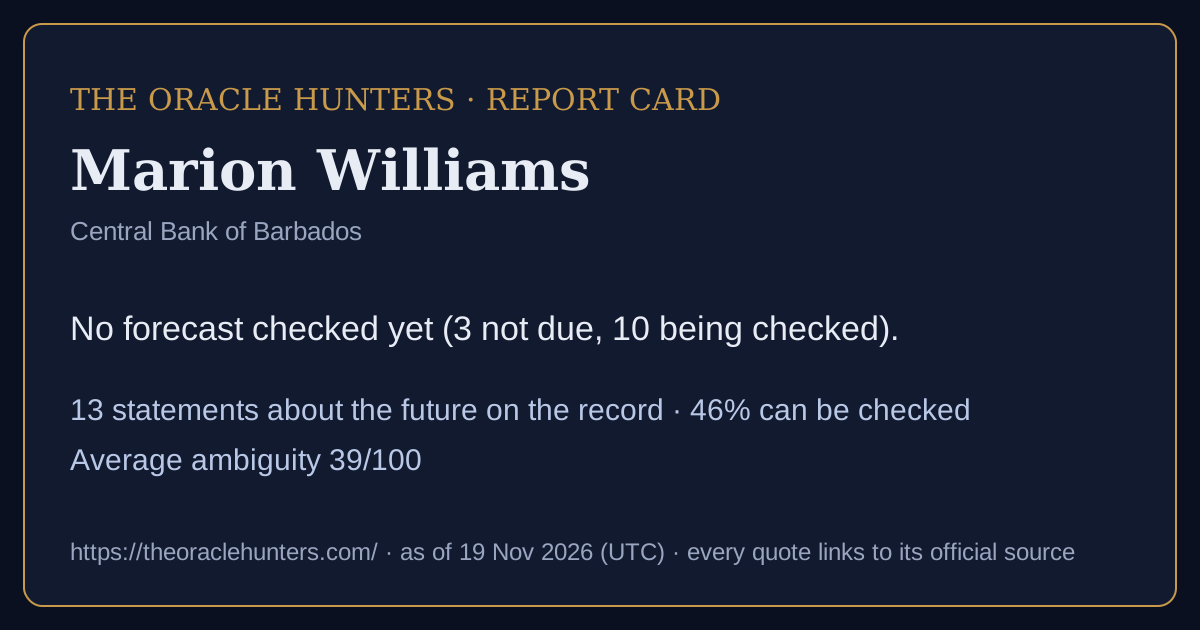
Marion Williams
Central Bank of Barbados
Track record: No forecast checked yet (3 not due, 10 being checked).
13forecasts & commitments on the record
46%can be checked as stated
39average ambiguity (0-100)
0goalpost moves recorded
0confirmed U-turns
Timeline
came true partly did not not due / being checked / too vague
Calibration score: shown after 10 checked forecasts with a stated likelihood (now 0).
How they speak about the future: based on data 10, stated on authority 2, educated guess 1.
Kinds of claim: forecast 11, mixed claim 1, scenario (if… then) 1. · Download this report card as a picture
In the nine words
πρόγνωσιςInference from evidence10 · 77%μαντείαInspired knowledge2 · 15%πρόνοιαPreparing for the future1 · 8%
How to read this
Each box is one sentence a public figure or institution said about the future, word for word, with a link to the official text. Can be checked means it names what will happen, by when, and how likely - so it can be compared with official figures later. Too vague to check means it does not. Ambiguity (0-100) is how many different ways the sentence can be read. When the date passes, the forecast is compared with official data and marked came true, partly or did not come true. Labels judge the sentence, never the person. Full guide and glossary.On the record (13)
What is particularly clear is that the period of aggressive expansion in the financial sector will be put on pause and that the year 2009 and possibly 2010 will be years of consolidation and grounding, and of more circumspect activity by the financial sector.
With the slowing of economic activity in Barbados' main trading partners expected to continue through the end of 2009, and possibly beyond, a downturn in the domestic economy is anticipated.
In order to lessen the impact of the global recession, keeping employment up will be important, since, if we cannot do so, spending will decline and a decline in spending means a worsening of the impact of the recession.
Let me welcome all of you once more to the Central Bank and may your deliberations be fruitful and rewarding as you discuss this year's topic: "GOING BACK TO BASICS: BUILDING STRATEGIC ALLIANCES TOWARD IMPROVED GOVERNANCE AND PRODUCTIVITY".
It is our hope that with oil and other commodity prices falling, the region will be a beneficiary of a substantially lower inflation rate in 2009.
Market volatility will undoubtedly lead to sharp downward growth revisions for 2008 and 2009, as the decline in global demand will tend to reduce regional exports of goods and services.
Over the longer term and into 2009, given the size of the bailout by the US government, we can expect larger US fiscal deficits, possibly a further depreciation in the US dollar and a likelihood of a longer US recession than was anticipated.
Over the same period, private building activity (which includes projects like this one) grew by 21% more than GDP.
It is expected at minimum the simpler approaches will be adopted by institutions by the 2009 deadline - however, the domestic banks are expected to move to transition to Advanced IRB by 2012.
Hopefully, within the next year or two, we will see greater harmonisation of the stock exchanges in the region, where there are similar listing rules, similar take-over criteria and, most importantly, trading from a single book.
Not withstanding some rebound since last February, World Economic Outlook, an IMF Report, notes that the US dollar depreciated by 3 1/4 percent in trade weighted terms since September 2003 and by 16 ½ percent since its peak in February 2002.
The US economy is projected to grow by 4.6% in 2004 and 3.9% in 2005, the euro area by 1.7% in 2004 and 2.3% in 2005, and Canada by 2.6% in 2004 and 3.1% in 2005.
This industry is expected to reach the 800,000 mark this year, and so far this year cruise arrivals have grown almost 30%.
Also said - not checkable as stated (12 newest)
Remarks about the future with no date, figure or likelihood that could be checked. They are kept on the record and shown here, but not scored.
I am sure that we will get some early indications from our speakers on how this is likely to develop.
I am sure that we will learn about the new European Risk Council and European System of Financial Supervision, as well as the debate on whether to expand the powers of the Federal Reserve.
Fortunately, in the Barbados case there were significant liquidity buffers, but generally, policy makers in instituting new requirements may need to set longer-term strategies rather than attempt overnight correction.
Without doubt there will be changes in global rules as we have already seen and in global crossborder movement of funds, ownership structures and similar types of arrangements.
Research and discussion is needed on important subject areas that will be discussed today.
Such a change is necessary to enable us to withstand and rally against future shocks and developing a framework for macro-prudential regulation will be an important step.
We will commence with presentations on Budgeting and Saving .
We have identified at least six topics that we will be addressing on a phased basis through face-to-face interaction with these groups.
We will seek to accommodate you where ever possible.
I must add, that while we welcome the participation and involvement of partners we will not be promoting any company's products and services.
It is therefore a very important occasion for us at the Bank and I hope that every Barbadian will find the programme useful and timely.
Over the next three (3) to six (6) months, the programme will promote Budgeting and Saving as key elements of proper financial management.