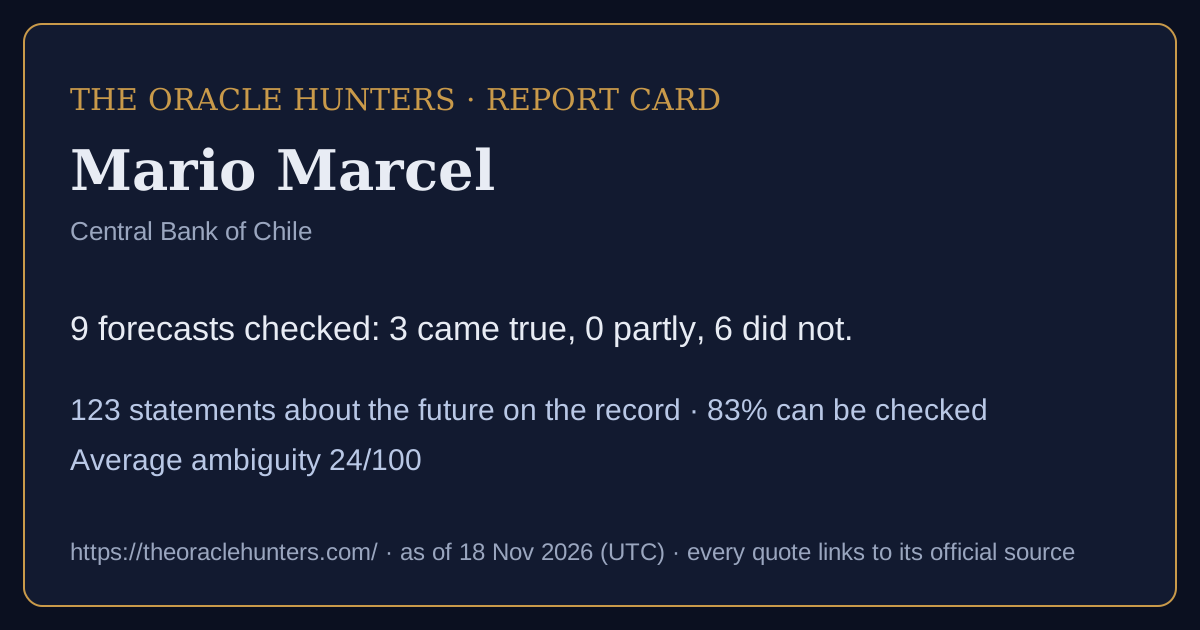
Mario Marcel
Central Bank of Chile
Track record: 9 forecasts checked: 3 came true, 0 partly, 6 did not.
123forecasts & commitments on the record
83%can be checked as stated
24average ambiguity (0-100)
0goalpost moves recorded
0confirmed U-turns
Timeline
came true partly did not not due / being checked / too vague
Calibration score: shown after 10 checked forecasts with a stated likelihood (now 9).
How they speak about the future: based on data 114, stated on authority 8, educated guess 1.
Kinds of claim: forecast 101, mixed claim 21, commitment 1. · Download this report card as a picture
In the nine words
πρόγνωσιςInference from evidence111 · 90%μαντείαInspired knowledge8 · 7%πρόβλεψιςSeeing the signs1 · 1%εἰκασίαConjecture1 · 1%φρόνησιςPractical wisdom1 · 1%προαναγγελίαPublic pre-announcement1 · 1%
How to read this
Each box is one sentence a public figure or institution said about the future, word for word, with a link to the official text. Can be checked means it names what will happen, by when, and how likely - so it can be compared with official figures later. Too vague to check means it does not. Ambiguity (0-100) is how many different ways the sentence can be read. When the date passes, the forecast is compared with official data and marked came true, partly or did not come true. Labels judge the sentence, never the person. Full guide and glossary.Checked
In line with this, after the strong recovery of 2021, GDP is expected to grow 2-3% in 2022, and 1.75-2.75% in 2023.
Came true. Said: economic growth between 2% and 3% in 2022. Official figure for Chile: 2.1% (World Bank open data). On target. official data · checked 14 Nov 2026 · automatic check against official data (rules v3)
In the central scenario, GDP will increase between 2 and 3 percent in 2022, and between 1.75 and 2.75 percent in 2023.
Came true. Said: economic growth between 2% and 3% in 2022. Official figure for Chile: 2.1% (World Bank open data). On target. official data · checked 14 Nov 2026 · automatic check against official data (rules v3)
Accordingly, Chile's trading partners are expected to see a GDP contraction of 3.5% in 2020 and an expansion of 4.7% in 2021.
Did not come true. Said: economic growth around 4.7% in 2021. Official figure for Chile: 11.3% (World Bank open data). Missed. Off by 6.6 points. official data · checked 14 Nov 2026 · automatic check against official data (rules v3)
All in all, the CBC Board estimates that this year Chile's GDP will contract between 1.5% and 2.5%.
Did not come true. Said: economic growth between 1.5% and 2.5% in 2020. Official figure for Chile: -6.1% (World Bank open data). Missed. Off by 7.6 points. official data · checked 14 Nov 2026 · automatic check against official data (rules v3)
With this, the economy will grow 4% this year and between 3.25% and 4.25% in 2019.
Did not come true. Said: economic growth between 3.25% and 4.25% in 2019. Official figure for Chile: 0.6% (World Bank open data). Missed. Off by 2.6 points. official data · checked 14 Nov 2026 · automatic check against official data (rules v3)
Thus, GDP will grow between 3.25% and 4.25% next year, and between 2.75% and 3.75% in 2020 (Figure 4).
Did not come true. Said: economic growth between 2.75% and 3.75% in 2020. Official figure for Chile: -6.1% (World Bank open data). Missed. Off by 8.9 points. official data · checked 14 Nov 2026 · automatic check against official data (rules v3)
Thus, we continue to expect that in 2019 the economy will grow between 3.25% and 4.25%, and between 3% and 4% in 2020 (Figure 4).
Did not come true. Said: economic growth between 3.25% and 4.25% in 2019. Official figure for Chile: 0.6% (World Bank open data). Missed. Off by 2.6 points. official data · checked 14 Nov 2026 · automatic check against official data (rules v3)
Certainly this impulse will be withdrawn as the gaps close and inflation converges to 3%, but when will this withdrawal begin will depend on the evolution of our macroeconomy, which we do not see happening before the end of this year.
Came true. Said: inflation at the end of the year around 3% in 2018. Official figure for Chile: 2.6% (BIS consumer prices (December, year on year)). On target. Off by 0.4 points. official data · checked 17 Nov 2026 · automatic check against official data (rules v4)
Actually, in this Report we present our first growth forecast for the years 2019 and 2020, 1 which indicates that the economy should grow between 3.25% and 4.25% next year, and between 3% and 4% in 2020.
Did not come true. Said: economic growth between 3.25% and 4.25% in 2019. Official figure for Chile: 0.6% (World Bank open data). Missed. Off by 2.6 points. official data · checked 14 Nov 2026 · automatic check against official data (rules v3)
On the record (123)
In the case of Chile, where the target is precisely defined as inflation forecasts at a two-year horizon, we have also seen some deviation from the 3% target in recent months.
While this might have played a role in anchoring expectations upwards after a long period of inflation forecasts below the 2% objective -by signaling more tolerance towards inflation--, it is not clear that such ambiguity is contributing positively to the current environment.
Core inflation-CPI minus volatile prices-is also revised upwards from June, projected to stand at 4.7% by the end of this year and peak in mid-2022, as its annual variation approaches 5.5% (Figure 13).
The slowdown in demand resulting from the withdrawal of fiscal and monetary stimulus policies will help inflation to begin its convergence to the target next year, to be below 4% by the end of 2022 and at 3% by the end of 2023.
With this, annual CPI inflation will end the year at 5.7% (4.4% in June) and will remain above 5% during the first half of 2022.
The information from the latest Public Finance Report and Government announcements leads us to estimate that, in nominal terms, fiscal spending will increase by more than 35% annually during this year, with an effective deficit of more than 7% of GDP.
The need to avoid the accumulation of macroeconomic imbalances which, among other consequences, could lead to a more persistent rise in inflation, exceeding the 24-month target of 3%, has led the Board to alter the monetary policy stance.
In the central scenario, we estimate that the convergence of inflation to the target will require continuing to withdraw the monetary impulse, so we will bring the MPR to levels around its neutral value by the middle of the first half of 2022.
The Constitutional process will unfold throughout most of next year.
Inflation has performed as expected, with annual headline inflation at 3.8% annually in June 2021.
A number of factors may impact the economy positively in the second half of the year, including: (a) progress in the vaccination program (72% of the population, including 65% fully vaccinated);
If the SA IMACEC of June held constant for the rest of the year, annual growth would already fall withing the CB forecast of 8.5%-9.5%.
In line with this, after the strong recovery of 2021, GDP is expected to grow 2-3% in 2022, and 1.75-2.75% in 2023.
Came true. Said: economic growth between 2% and 3% in 2022. Official figure for Chile: 2.1% (World Bank open data). On target. official data · checked 14 Nov 2026 · automatic check against official data (rules v3)
Core CPI stands at 3.2%, but it is likely to accelerate to nearly 4% in the next few months due to supply and demand-side pressures.
For 2022 and 2023, expected growth ranges are revised downward, given the higher base of comparison, the gradual decline in the consumption impulse and limited investment dynamism .
the improved outlook for activity, this year's fiscal impulse will not only exceed the forecast but will be significantly higher than in 2020.
In 2022 and 2023, as fiscal and monetary impulses normalize, inflation will converge to 3 percent and remain there until the end of the policy horizon, that is, the second quarter of 2023 (Figure 17).
In the central scenario, GDP will increase between 2 and 3 percent in 2022, and between 1.75 and 2.75 percent in 2023.
Came true. Said: economic growth between 2% and 3% in 2022. Official figure for Chile: 2.1% (World Bank open data). On target. official data · checked 14 Nov 2026 · automatic check against official data (rules v3)
Expected growth for this year substantially increases in the central scenario, to a range between 8.5 and 9.5 percent .
In the projections I will be sharing with you in a few moments, we see a significant upward correction in growth for this year, to between 8.5 and 9.5 percent.
Accordingly, Chile's trading partners are expected to see a GDP contraction of 3.5% in 2020 and an expansion of 4.7% in 2021.
Did not come true. Said: economic growth around 4.7% in 2021. Official figure for Chile: 11.3% (World Bank open data). Missed. Off by 6.6 points. official data · checked 14 Nov 2026 · automatic check against official data (rules v3)
The region is one of the hardest hits in terms of lost activity and employment, with a projected contraction of more than 9% this year.
As for spending, after contracting by 4.2% this year, total consumption will resume positive growth in 2021 and 2022, consistent with a recovery in employment and household income, and with the positive short-term effect of the withdrawal of pension savings.
By 2021, GDP will grow between 4 and 5% (between 4.75 and 6.25% in the June MP Report ), and in 2022 it will grow between 3 and 4% (same as in MP Report ), respectively.
Thus, it is estimated that this year GDP will fall between -4.5 and -5.5% (between -5.5 and -7.5% in the June MP Report ).
As I will show later, based on known activity data and short-term perspectives, we estimate that GDP will end 2020 with a fall of between -4.5 and -5.5%, which compares to the -5.5 to -7.5% range estimated in the June MP Report and which implies a significant recovery in the second half of the year.
- The current projection is that the Peso will go live before the end of the second quarter of 2022.
Credit measures amount to some 15% of GDP, mainly around a medium-term liquidity facility to banks conditional on credit expansion.
FCIC funds are provided over a 4-year horizon, and even short-term liquidity facilities will remain in place until early 2021.
Private consumption and Investment are expected to drop 6% and 12% this year.
Assuming that constraints will begin to roll back in the third quarter, we estimate GDP to grow between 4.75% to 6.25% in 2021, and 3%-4% in 2022.
Global GDP is likely to lose some 8% to the crisis this year, which will take long to recoverif ever.
Although this will not avoid a contraction in annual terms in that period, it will be the turning point for a significant rebound of year-on-year growth rates in the fourth quarter of 2020 and all of 2021.
All in all, the CBC Board estimates that this year Chile's GDP will contract between 1.5% and 2.5%.
Did not come true. Said: economic growth between 1.5% and 2.5% in 2020. Official figure for Chile: -6.1% (World Bank open data). Missed. Off by 7.6 points. official data · checked 14 Nov 2026 · automatic check against official data (rules v3)
This vision is consistent with expectations for the rest of the world next year, when the United States will regain growth a little above 3% and China will approach 7%, thus driving world and trading partners growth of more than 3.5%.
At our Monetary Policy Meeting yesterday we also communicated that we will raise the amount of this bank bond purchase program to up to USD 8 billion.
China will grow this year by 3%, its lowest since 1990, with important repercussions in the rest of the world, both because of its integration in the value chains and because of its weight in the trade of some countries, including Chile.
Accordingly, our projections show a very significant drop-in activity in the second quarter, but from there on we foresee a recovery that is expressed in the projected growth rebound in 2021, when the Chilean economy will grow between 3.75 and 4.75%.
The results of these projects will be included in the release of the 2018 benchmark compilation, scheduled for 2021.
This TR, called Integrated System of Derivatives Information (SIID, in Spanish), will be owned and operated by the central and, after a transition process, will be in full operation by 2021.
This change of policy will be put out for public consultation by the end of this year.
* The specific transactions that will be authorized to be denominated in CLP and the related conditions are being assessed and should be put out for public consultation by the end of this year.
Deviations of long-term forecasts of headline inflation from target have been less than 0.1%-being the lowest for a sample of emerging countries, and even lower a benchmark group of advanced economies.
On the expenditure side, compared with March, the biggest adjustments are seen in gross fixed capital formation (GFCF), a component that, instead of growing 6.2% this year as projected, will grow only 4.5%.
The high basis for comparison of the same period in 2018 anticipated that first-quarter growth this year would underperform that of 2018, but the result was lower than expected.
As for global growth, the baseline scenario adjusts slightly the expected expansion of our trading partners during this year, to 3.2% (3.3% in March).
For the time being, the lower basis for comparison that the adjustment will leave in its 2019 growth will help to raise the 2020 record, the year for which the baseline scenario estimates a 5.1% growth in GFCF.
Regarding the latter, we estimate that in the period 2019-2021 it will be around 3.4% (around 3.2% was the previous estimate), somewhat below its trend growth (Table 2).
Going forward, activity will grow above potential over the next two years and inflation will converge to 3% during 2020.
Several indicators suggest that the lower growth of early this year will be a rather limited phenomenon.
Showing the newest 50 - the ledger has all 123.
Also said - not checkable as stated (12 newest)
Remarks about the future with no date, figure or likelihood that could be checked. They are kept on the record and shown here, but not scored.
While one may argue that it is more important to anchor expectations of households and firms, these measurements are still lacking in many countries, so traditional metrics will have to do in the meantime.
While a recession recovery scenario may make the first particularly relevant and also the source of political pressures, on the other hand central banks are starting from record expansionary policies, so there should be a rather long phase of reduction in MP impulse before policy becomes truly restraining.
covid-related expansionary policies will revert swiftly, and (e) that inflation expectations are well anchored.
Thus, just as the increased globalization trend since the early 2000s is often given as a reason behind the declining trend in inflation around the world, the reverse of this process is likely to contribute to higher inflation in the medium-term.
Therefore, and given the necessary actions, investments, and transformations to connect to the system, the banks must join during this budget period to carry out the implementation process during next year.
New business opportunities should gain further attention when banking is unlikely to go back to business-as-usual.
- The timely involvement of banks in the process is essential, considering the start of the implementation phase by the end of this year.
Additionally, upon the enactment of this regulation, non-residents will be able to open and hold an account in Pesos as well as ask for loans denominated in our currency, whether in the form of mutual, lines of credit, or other.
- Conversely, the FX changes should impact on the FX activity involving the Peso, increasing the systemic risk of settlement.
While the drop in GDP in 2020 will be the deepest in 35 years, prospects remain better than in other Latin American and Caribbean (LAC) countries.
Finally, we will learn about the estimation of the contribution of the digital economy to the GDP of the US.
We will learn about the experience of Mexico and the US in the development of new national accounts statistics.