Mari Pangestu
World Bank Group
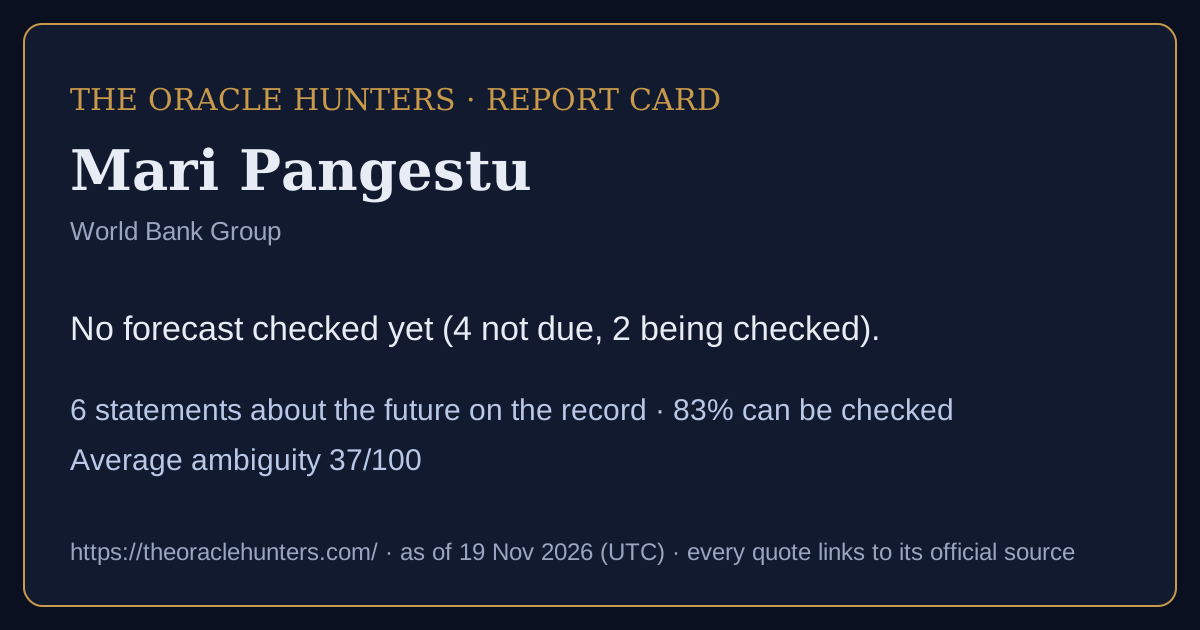
Track record: No forecast checked yet (4 not due, 2 being checked).
6forecasts & commitments on the record
83%can be checked as stated
37average ambiguity (0-100)
0goalpost moves recorded
0confirmed U-turns
Timeline
came true partly did not not due / being checked / too vague
Calibration score: shown after 10 checked forecasts with a stated likelihood (now 0).
How they speak about the future: based on data 6.
Kinds of claim: forecast 4, mixed claim 2. · Download this report card as a picture
In the nine words
How to read this
Each box is one sentence a public figure or institution said about the future, word for word, with a link to the official text. Can be checked means it names what will happen, by when, and how likely - so it can be compared with official figures later. Too vague to check means it does not. Ambiguity (0-100) is how many different ways the sentence can be read. When the date passes, the forecast is compared with official data and marked came true, partly or did not come true. Labels judge the sentence, never the person. Full guide and glossary.On the record (6)
At the World Bank Group we are making up to $30 billion available over the next 15 months for food security projects.
The World Bank’s preliminary projections, in line with the World Trade Organization (WTO), show that global trade growth may rebound to 9.2% in 2021 and could slow down to 6.7% in 2022.
And we are backing that up with more finance – over the next five years, 35% of all our financing, on average, will go towards climate action.
We are making good progress, and our investments will help transform livelihoods across the Sahel, where over 27 million people are likely to become climate migrants by 2050 if we don’t do anything.
Over the next four years, we will be investing in the Sahel region $5.6 billion in 61 projects in climate-smart agriculture, environment, water, resilient infrastructure, energy access, renewable energy, financial inclusion, and jobs.
Our assessment on the impact of the COVID-19 pandemic indicates that by the end of 2021, up to 150 million more people could be pushed into extreme poverty.
Also said - not checkable as stated (12 newest)
Remarks about the future with no date, figure or likelihood that could be checked. They are kept on the record and shown here, but not scored.
These projects are expected to cushion the effects of higher food prices and support an agriculture supply response by countries.
The World Bank will continue its support to Italy as we further our dialogue with the UN agencies based in Rome.
Critical decisions need to be made swiftly, as crises’ impacts may spread beyond national borders and trigger significant economic, social and environmental effects.
Let me outline three key areas for action that will help us move towards better governance and institutions: First, we must enhance public trust.
The devastation caused by the war in Ukraine is likely to significantly erode near-term global economic prospects.
When the pandemic hit, they were able to pivot to online and hybrid learning easily so schooling could continue.
The pandemic also underscored the need to address the digital divide, so that citizens who lack digital access and skills are not left behind. 2.9 billion people still remain offline and 43% in the developing world are not using the internet.
Every government needs to build out its capability of long-range risk forecasting to improve their capacity to deal with future crises.
Most importantly we will be working to support countries to integrate climate and development objectives, including through Country Climate and Development Reports which will become a core diagnostic for the WBG and inform engagements with clients.
This is the kind of paradigm shift embodied our Climate Change Action Plan for 2021-2025: moving from investing in "green" projects to greening entire economies, and from inputs to measuring impacts.
There is a need to create robust pipelines of high impact climate projects that can meaningfully reduce Greenhouse gas emissions.
There is the wake up call to do better and to do more, but for developing countries it is about shifting urgently and at scale to a long-term low carbon development path that will bring green, resilient and inclusive development, and go towards net zero.