Manuel Sánchez
Bank of Mexico
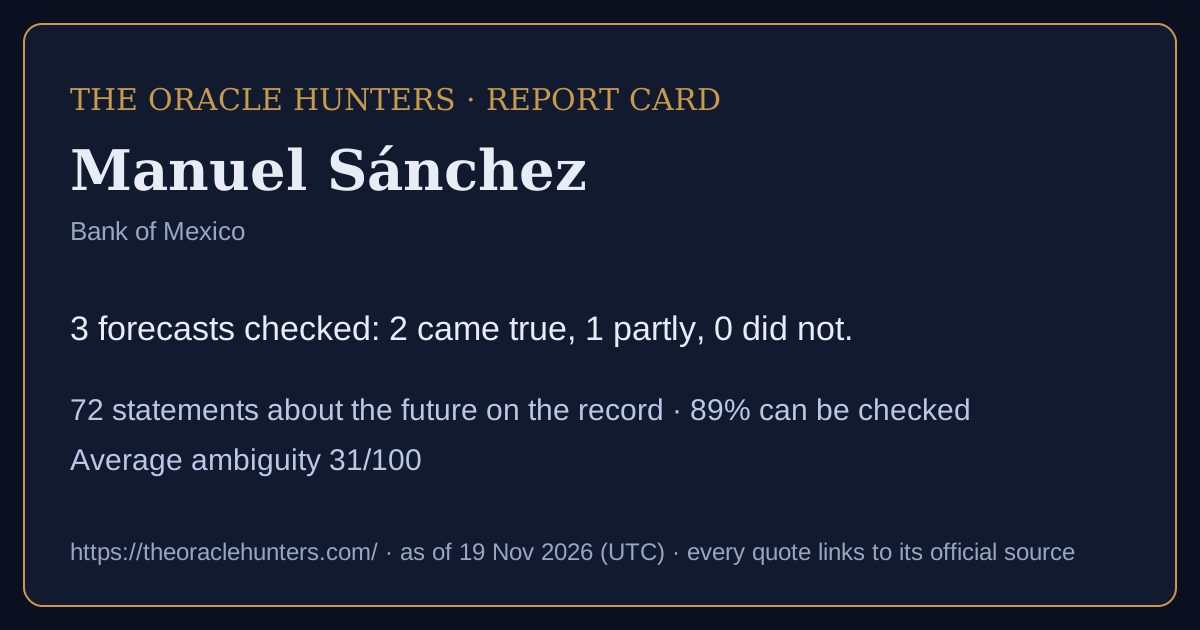
Track record: 3 forecasts checked: 2 came true, 1 partly, 0 did not.
72forecasts & commitments on the record
89%can be checked as stated
31average ambiguity (0-100)
0goalpost moves recorded
0confirmed U-turns
Timeline
came true partly did not not due / being checked / too vague
Calibration score: shown after 10 checked forecasts with a stated likelihood (now 3).
How they speak about the future: based on data 60, stated on authority 7, educated guess 5.
Kinds of claim: forecast 60, scenario (if… then) 6, mixed claim 6. · Download this report card as a picture
In the nine words
πρόγνωσιςInference from evidence56 · 78%μαντείαInspired knowledge7 · 10%πρόνοιαPreparing for the future6 · 8%πρόβλεψιςSeeing the signs2 · 3%εἰκασίαConjecture1 · 1%
How to read this
Each box is one sentence a public figure or institution said about the future, word for word, with a link to the official text. Can be checked means it names what will happen, by when, and how likely - so it can be compared with official figures later. Too vague to check means it does not. Ambiguity (0-100) is how many different ways the sentence can be read. When the date passes, the forecast is compared with official data and marked came true, partly or did not come true. Labels judge the sentence, never the person. Full guide and glossary.Checked
The Bank of Mexico estimates that GDP will grow between 2 and 2.8 percent in 2014 and between 3.2 and 4.2 percent in 2015.
Partly came true. Said: economic growth between 3.2% and 4.2% in 2015. Official figure for Mexico: 2.7% (World Bank open data). Close: outside the margin, but within one more half point. Off by 0.5 points. official data · checked 14 Nov 2026 · automatic check against official data (rules v3)
The Bank of Mexico expects inflation to return to the convergence path towards 3 percent by next year.
Came true. Said: inflation around 3% in 2015. Official figure for Mexico: 2.7% (World Bank open data). On target. Off by 0.3 points. official data · checked 14 Nov 2026 · automatic check against official data (rules v3)
Finally, the Bank of Mexico estimates that GDP growth will settle between 3.5 percent and 4 percent in 2011 and between 3 percent and 4 percent in 2012.
Came true. Said: economic growth between 3% and 4% in 2012. Official figure for Mexico: 3.6% (World Bank open data). On target. official data · checked 14 Nov 2026 · automatic check against official data (rules v3)
On the record (72)
Especially given the time it has taken to reach the 3 percent permanent inflation target, policy will be on the alert to avert any problems that would prevent consolidation of convergence of inflation to this target.
Recently, break-even inflation breached the 3 percent target, which may indicate possible future price pressures.
Analysts' consensus forecasts are for moderate economic improvement in 2017 for the world and U.S. economies, and to a lesser extent for Mexico, where growth is foreseen rising from an estimated 2.1 percent this year to 2.2 percent in the next.
Analysts' consensus forecasts are for a transitory loss of vigor in the Mexican economy this year, followed by a growth figure slightly below the historical average in 2017.
As is the case in the United States, Mexico is expected to face a slowdown this year, while growth next year should pick up moderately. 4
Short- and medium-term inflation expectations, as reflected in analysts' surveys, are gradually moving towards the 3 percent permanent target, while those extracted from market instruments seem to have converged to the target, a significant advance in light of a history of high inflation. 6
Finally, Mexico's potential growth will increase if improvements to the rule of law and public security are attained.
5 Analysts' forecasts for U.S. industrial production and Mexico's GDP are, respectively, 0.3 and 2.4 percent for 2016, and 2.3 and 2.8 percent for 2017; see Blue Chip Indicators 2016, April.
The Bank of Mexico forecasts growth of 1.7 to 2.5 percent this year, and 2.5 to 3.5 percent in 2016. 8
The Bank of Mexico expects inflation to remain around the target in 2015 and 2016. 9 Nevertheless, upside risks should be monitored, especially given the possibility of secondround effects.
In view of the most likely scenario that oil prices remain low for some time to come and the decreasing oil production trend, the federal government recently sent investors a sign of fiscal responsibility by announcing cuts to 2015 budgeted spending, amounting to 0.7 percent of GDP, despite the fact that oil revenue for the year is almost fully hedged. …
Consensus analysts' forecasts suggest that along with the United States, Mexico will see a gradual economic recovery this year and next.
The dollar is poised to keep appreciating for some time, supported by a continued favorable outlook for U.S. growth this year and growing divergence in monetary policy among key central banks.
The Bank of Mexico forecasts growth of 3 to 4 percent for 2015, and 3.2 to 4.2 percent for 2016. 5
The Bank of Mexico expects inflation to approach 3 percent throughout this year. 8
An extrapolation of this trend would suggest that unemployment may approach 5 percent, a rate consistent with long-term trends, perhaps as early as this year.
Inflation is expected to be lower in 2015, on a path of convergence to the permanent target.
5 Analysts estimate that GDP for Mexico will grow 2.2 percent in 2014, 3.5 percent in 2015 and 4.0 percent in 2016.
Inflation will likely post levels above 4 percent during most of the current year.
Pulled by the U.S. economy, Mexico is expected to post a gradual economic recovery during this and the next two years.
The expected convergence of inflation to the 3 percent permanent target should contribute to the strong fundamentals needed for the country to face a potentially more difficult financial environment ahead.
7 Analysts estimate that GDP for Mexico will grow 2.3 percent in 2014, 3.7 percent in 2015 and 4.1 percent in 2016.
It is essential that inflation converge to the 3 percent target next year, especially in view of the need for monetary fundamentals to help shield the economy against financial volatility.
The upside risks are especially significant as annual headline inflation will probably surpass 4 percent most of this year, and analysts' inflation expectations for all time frames remain above the permanent target.
The possible persistence of these adverse factors makes it likely that inflation will remain above or near 4 percent during the second half of the year.
Geographical areas for oil and gas exploration and production have already been allocated to Pemex, and the first round of auctions for the private sector will take place early next year.
Futures markets predict that U.S. and British policy rates will begin to rise next year, although uncertainty still reigns over the exact timing and pace of the tighter policies.
The Bank of Mexico estimates that GDP will grow between 2 and 2.8 percent in 2014 and between 3.2 and 4.2 percent in 2015.
Partly came true. Said: economic growth between 3.2% and 4.2% in 2015. Official figure for Mexico: 2.7% (World Bank open data). Close: outside the margin, but within one more half point. Off by 0.5 points. official data · checked 14 Nov 2026 · automatic check against official data (rules v3)
Some conditions should contribute to a decrease in inflation next year, such as base effects from the 2014 fiscal reform, lower rises in government-administered gasoline prices, and a possible drop in some telephony charges due to new regulations.
Second-round effects from possible minimum wage hikes, unfavorable shocks to noncore inflation and volatility in global financial markets may make convergence of inflation to the 3 percent permanent target challenging.
On the back of expected higher U.S. growth, a gradual recovery of the Mexican economy this year and next is predicted.
The Bank of Mexico's GDP interval forecast is for 2- to 2.8percent growth in 2014, and 3.2- to 4.2-percent growth for next year.
Annual inflation in the first half of February declined, although still above 4 percent, which could lend support to the expectation that these price pressures will fade.
6 Consensus forecasts for Mexico GDP growth are 3.4 and 4.0 percent for 2014 and 2015, respectively.
The Bank of Mexico expects inflation to renew its convergence towards the 3 percent permanent target by the beginning of next year.
Some developments that should be monitored include: a recent upward revision in analysts' short-term inflation forecasts, the possibility that inflation could exceed 4 percent several months this year, and potential second-round effects, which cannot be ruled out.
5 Consensus forecasts for Mexico GDP growth are 3.4 and 4.0 percent for 2014 and 2015, respectively.
The Bank of Mexico expects inflation to return to the convergence path towards 3 percent by next year.
Came true. Said: inflation around 3% in 2015. Official figure for Mexico: 2.7% (World Bank open data). On target. Off by 0.3 points. official data · checked 14 Nov 2026 · automatic check against official data (rules v3)
Some factors to watch are the fact that analysts' short-term inflation expectations have recently risen, inflation will likely exceed 4 percent for several months this year, and second-round effects cannot be ruled out.
From May to mid-September of this year, ten-year government
The Bank of Mexico expects inflation to return to the variability interval in the second half of this year, and to be very close to the permanent target in 2014.
Nevertheless, core inflation has remained around 3 percent during the last few months and is expected to stay around this level during the rest of this year and next.
Even though downside risks to near-term growth forecasts appear to have increased for this year, for next year upside risks may remain.
1 Consensus forecasts for U.S. GDP growth are 1.9 and 2.7 percent for 2013 and 2014, respectively.
2 Economic growth expectations for Mexico in 2013 dropped from 3.6 to 3.0 percent between January and May 2013, while those for 2014 have remained at 4.0 percent during the same period.
The world economic growth forecast for 2013 dropped from 2.6 to 2.5 percent between January and June 2013, while estimates for 2014 have remained at 3.2 percent during the same period.
Given the expected slowdown in the U.S. economy largely due to fiscal consolidation, analysts predict that Mexico's economic growth in 2013 will be slightly lower than that of the previous year, with a recovery occurring in 2014. 2 There are both downside as well as upside risks to this scenario.
2 Expected growth is 3.6 percent for 2013 and 4.0 percent for 2014.
Further deceleration of EU growth could hurt Mexico's economic prospects, indirectly if the U.S. economy slows as a result, but also directly through less dynamic exports of goods and services to Europe, especially in vehicle shipments which are the most important export item, and lower European investment, likely in manufacturing and financial services, which have been the leading recipient sectors.
According to private-sector forecasts, annual inflation could remain above 4 percent for the rest of the year.
Showing the newest 50 - the ledger has all 72.
Also said - not checkable as stated (12 newest)
Remarks about the future with no date, figure or likelihood that could be checked. They are kept on the record and shown here, but not scored.
Markets should be convinced that authorities will do what it takes to stabilize the ratio of public debt to GDP.
I will then analyze the impact of global risk factors on financial markets and why it is important to fortify macroeconomic fundamentals in a context of worldwide uncertainty.
In the short term, there is the potential for a greater slowdown in the global and U.S. economies, particularly manufacturing, as well as a larger-than-expected fall in crude oil output, and further deterioration in consumer and producer confidence.
Also, given a context of greater risk aversion, which could become worse, Mexico needs to reinforce its fiscal stance.
Third, I will examine recent economic developments and the outlook, and finally, discuss inflation and monetary policy in Mexico.
Several factors may be behind this phenomenon, including falling fertility rates and cyclical factors, such as low growth in U.S. economic sectors which typically have been Mexican labor absorbers - for example, construction - as well as rising employment in Mexico. 2
Mexico's fiscal finances may be on an unsustainable path, and the public debt ratio appears to have reached a limit, at levels that may not be healthy.
A second contributing factor to peso depreciation may be markets' disappointment on lowerthan-expected growth in Mexico.
But this may change, and monetary policy should remain vigilant.
I will follow with a focus on growth and financial developments for the Mexican economy, in conjunction with these close ties.
And finally, I will make some comments on inflation and monetary policy in Mexico.
Furthermore, the advantages they bring could very well be enhanced down the road through a more effective rule of law, better public security, and improvement to Mexico's physical infrastructure.