Malcolm Edey
Reserve Bank of Australia
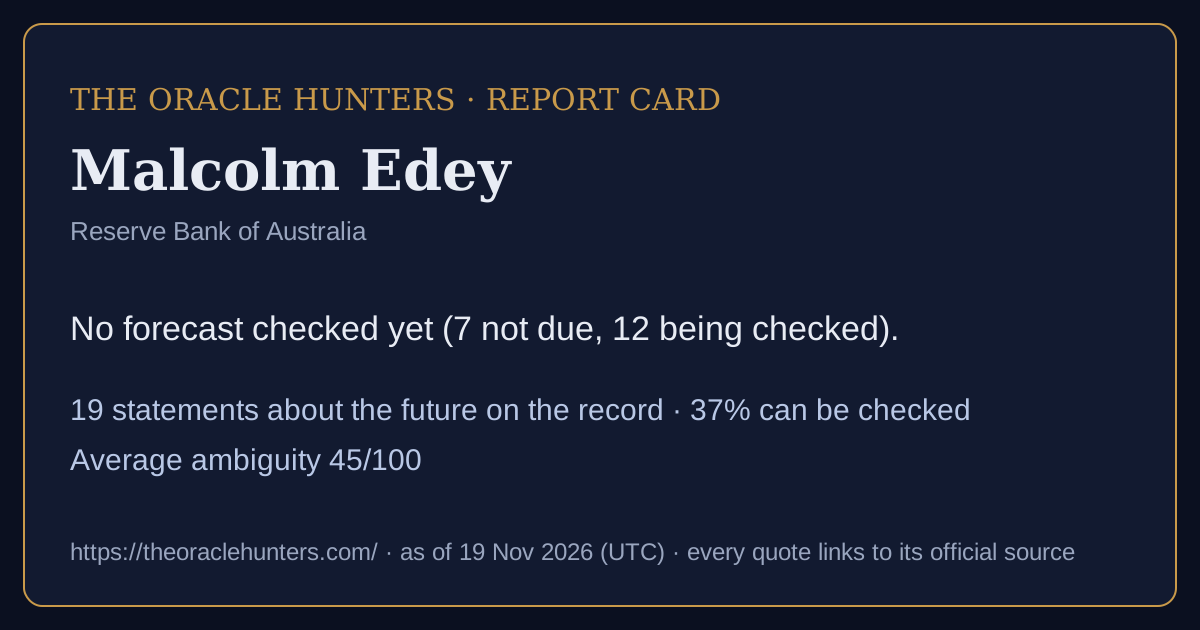
Track record: No forecast checked yet (7 not due, 12 being checked).
19forecasts & commitments on the record
37%can be checked as stated
45average ambiguity (0-100)
0goalpost moves recorded
0confirmed U-turns
Timeline
came true partly did not not due / being checked / too vague
Calibration score: shown after 10 checked forecasts with a stated likelihood (now 0).
How they speak about the future: based on data 11, educated guess 4, stated on authority 4.
Kinds of claim: forecast 15, scenario (if… then) 3, mixed claim 1. · Download this report card as a picture
In the nine words
πρόγνωσιςInference from evidence11 · 58%μαντείαInspired knowledge4 · 21%πρόνοιαPreparing for the future3 · 16%εἰκασίαConjecture1 · 5%
How to read this
Each box is one sentence a public figure or institution said about the future, word for word, with a link to the official text. Can be checked means it names what will happen, by when, and how likely - so it can be compared with official figures later. Too vague to check means it does not. Ambiguity (0-100) is how many different ways the sentence can be read. When the date passes, the forecast is compared with official data and marked came true, partly or did not come true. Labels judge the sentence, never the person. Full guide and glossary.On the record (19)
The May package of reforms provides a simpler measure of the allowable surcharge, which is already in force for large merchants and will take effect for other merchants from September next year.
A limit of 0.8 per cent will apply to credit cards and 15 cents (or 0.2 per cent) to debit cards.
This led us to initiate a review of cards regulation in 2015, which was completed in May this year.
again this year, but it seems a safe bet that there will be a further, probably quite large, decline in cash use. 2
From July 2017 the Bank will now cap interchange fees and other payments to issuers in an equivalent fashion across American Express companion, MasterCard and Visa cards.
The current 2 per cent interchange fees applying to some super-premium cards will no longer be possible from July 2017.
If growth were to fall further from its high recent rates, past excesses might be exposed, and leverage is always harder to manage in a slower growth environment.
If the nominal growth rate were to fall further from its high recent rates, any past excesses might be exposed - leverage is always harder to manage in a slower growth environment.
This is one of the topics that will be considered in the regulators' latest OTC derivatives market assessment report, due to published early next month.
These rules will set out further details of the mandatory clearing requirement including how the mandate will apply to cross-border transactions, the use of overseas CCPs to meet the mandate, and the effective commencement date in 2016.
On current scheduling the NPP will deliver a fast payments service with rich information and addressing capabilities in the second half of 2017.
As a result, it could be well into next year before any mandate is actually in force.
The Australian agencies currently anticipate that additional assessments will be undertaken over the next year or so, in order to monitor the Australian market's progress in making the transition to central clearing, along with the other G-20 commitments around OTC derivatives reforms.
It is anticipated that the framework will be in place by year-end.
In the United States, the Dodd-Frank regulations on OTC clearing are likely to start taking effect around the second quarter of next year, and in Europe the corresponding regulations under EMIR 5 are likely to take effect by around 2013.
If those trends continue, I think it will be good for financial stability, but it will also mean that our lending institutions have to get used to lower rates of expansion than were typical in the pre-crisis years.
The Australian government's gross debt to GDP ratio is not much more than 10 per cent, compared with numbers of the order of 80 to 100 per cent projected in the next few years in the United States and the major European economies.
This is the business model that used to be referred to, only half jokingly, as 3-6-3 banking - borrow at 3 per cent, lend at 6 per cent and be on the golf course by 3 o'clock - although even then the joke was probably well past its use-by date.
As I said before, in conventional markets, competition puts downward pressure on prices, because if you raise your price you will lose market share.
Also said - not checkable as stated (12 newest)
Remarks about the future with no date, figure or likelihood that could be checked. They are kept on the record and shown here, but not scored.
For reasons that I have already outlined, differentials in interchange-like payments can have an important influence on the incentives to use particular payment methods, and these developments in companion card usage suggest that the different regulatory treatments for the two arrangements may have been a factor in shaping the development of the market.
- The Bank's standard continues to stipulate that schemes may not have nosurcharge rules.
Under the Payment Systems (REGULATION) Act 1998 , any standards or access regimes that the Bank might propose to apply cannot be implemented without appropriate public consultation.
The Bank received over 40 substantive submissions in this second round and held more than 50 further stakeholder meetings, all of which will be considered in the Board's final assessment.
All up, it will have taken a bit over two years from the time when the Bank first signalled its intent to undertake this review until its completion.
Malcolm E (2013), 'The Financial Stability Role of Central Banks', speech at the Thomson Reuters' Australian Regulatory Summit, Sydney, 1 May.
- the combination of lower equity and commodity prices might be signaling a weaker global outlook;
- Second, there seems to have been relatively little new economic data in the early part of this year to trigger a significant reassessment of the global outlook.
While an oil supply expansion could be expected to have a range of complicated effects on producers, consumers and holders of energy assets, it would normally be considered a net positive for the world as a whole.
Of course, none of this guarantees that Australian banks will be immune to international shocks in the future.
In doing so, I will be making some longer run observations as well as drawing on the analysis recently published by the Reserve Bank in our half-yearly Financial Stability Review .
But it suggests that the main effects from the risks I've been describing are likely to be indirect, working through the impact of factors like commodity prices, trade flows, and confidence, on the broader economy.