Makoto Sakurai
Bank of Japan
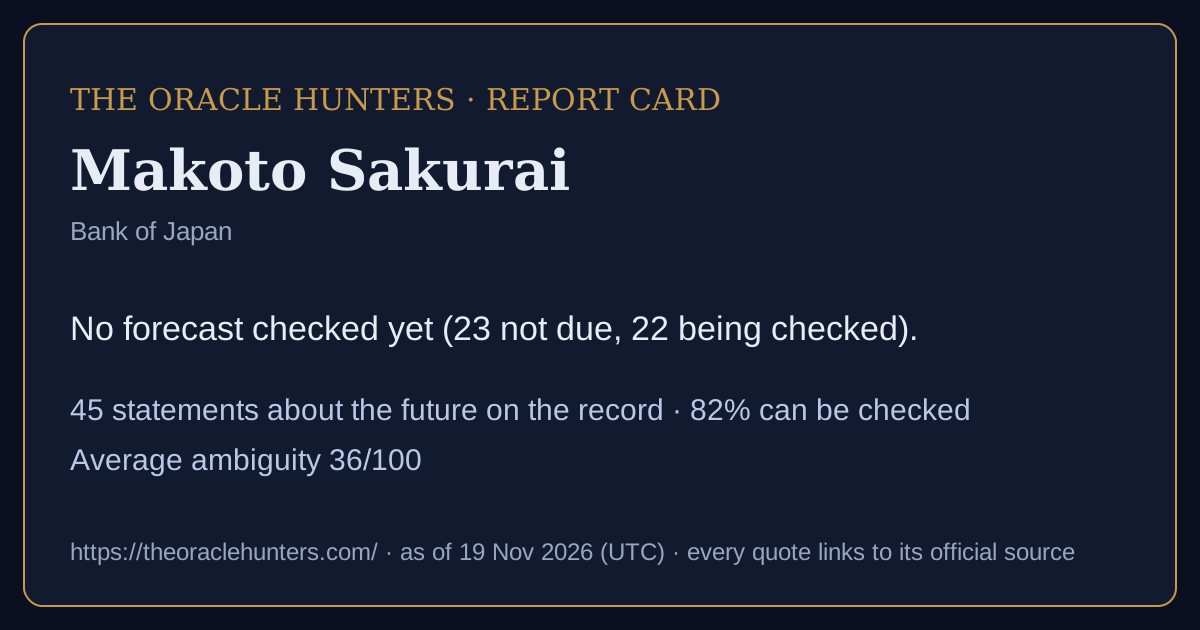
Track record: No forecast checked yet (23 not due, 22 being checked).
45forecasts & commitments on the record
82%can be checked as stated
36average ambiguity (0-100)
0goalpost moves recorded
0confirmed U-turns
Timeline
came true partly did not not due / being checked / too vague
Calibration score: shown after 10 checked forecasts with a stated likelihood (now 0).
How they speak about the future: based on data 35, educated guess 8, stated on authority 2.
Kinds of claim: forecast 32, scenario (if… then) 9, mixed claim 2, commitment 2. · Download this report card as a picture
In the nine words
πρόγνωσιςInference from evidence34 · 76%πρόνοιαPreparing for the future8 · 18%προαναγγελίαPublic pre-announcement2 · 4%φρόνησιςPractical wisdom1 · 2%
How to read this
Each box is one sentence a public figure or institution said about the future, word for word, with a link to the official text. Can be checked means it names what will happen, by when, and how likely - so it can be compared with official figures later. Too vague to check means it does not. Ambiguity (0-100) is how many different ways the sentence can be read. When the date passes, the forecast is compared with official data and marked came true, partly or did not come true. Labels judge the sentence, never the person. Full guide and glossary.On the record (45)
For instance, a country with relatively weak monetary easing will experience upward pressure on its currency, and if this country is highly dependent on external demand, the currency appreciation will put downward pressure on the economy through a decline in exports.
If firms can maintain their supply capacity, this will allow global supply chains, which for many years have supported global economic growth, to also be maintained without major disruptions.
The real GDP is expected to register substantial negative growth ranging from minus 5.7 to minus 4.5 percent for fiscal 2020.
According to the October 2020 World Economic Outlook released by the International Monetary Fund, the global growth rate for 2020 is projected to be minus 4.4 percent.
Based on the assumption that Japan's economy will improve gradually from the second half of 2020, forecasts of the majority of the Policy Board members presented in the July 2020 Outlook for Economic Activity and Prices are as follows.
In fiscal 2022, it is assumed that the economy will more or less normalize and that the virtuous cycle from income to spending will resume, with growth expected to be firm in the range of 1.3-1.6 percent (Chart 6).
However, this is expected to be followed by relatively high growth in the range of 3.0-4.0 percent in fiscal 2021, considerably above the potential growth rate.
Together with an increase in R&D investment with an eye toward promoting innovation, if the potential growth rate rises in the future -- in which case the natural rate of interest will also rise, causing real interest rates to fall below the natural rate of interest -- the same level of policy rate will have a greater easing effect.
On the other hand, if the slowdown in overseas economies stemming from trade issues remains moderate, the speed with which it spreads to Japan's economy will also be moderate.
Turning to public investment, investments associated with disaster-related restoration and reconstruction as well as with national resilience have begun to increase and are expected to compensate for a peak-out of demand for construction related to the 2020 Tokyo Olympic Games (Chart 6).
According to the October 2019 World Economic Outlook released by the International Monetary Fund, the global growth rate for 2019 is projected to be 3.0 percent, a lower rate compared to 3.8 percent for 2017 and 3.6 percent for 2018 (Chart 1).
According to the Outlook for Economic Activity and Prices released by the Bank of Japan in October 2019, the medians of the Policy Board members' forecasts for the real GDP growth rate are 0.6 percent for fiscal 2019, 0.7 percent for fiscal 2020, and 1.0 percent for fiscal 2021 (Chart 8).
For example, economic measures implemented so far may show a greater influence in the first half of 2020 than initially anticipated, and the reorganization of supply chains in response to the trade conflict may accelerate.
If the output gap remains positive and the economy continues to grow moderately until wage increases act sufficiently as a factor in raising prices, this eventually will lead to achievement of the price stability target.
For example, if labor market conditions remain tight and the number of people who wish to work as non-regular employees -- whose increase has caused a slackening of the labor market -- begins to decrease, it is likely that wage growth will accelerate, leading to a rise in prices through the passing of cost increases on to sales prices.
It is my hope that the government will proceed with efforts toward structural reform and that this will produce synergy effects with the structural changes already being observed in the private sector, thereby leading to a further increase in productivity and a rise in the potential growth rate.
Alongside the implementation of these policy measures, the Bank will continue with largescale monetary easing.
Furthermore, at the Monetary Policy Meeting held in April 2019, members of the Policy Board shared the view that uncertainties regarding the outlook for economic activity and prices, including developments in overseas economies, remained high and that it was highly likely that the price stability target would not be achieved during the projection period, that is, through fiscal 2021.
According to the Bank's April 2019 Outlook for Economic Activity and Prices , the medians of the Policy Board members' forecasts for the real GDP growth rate are 0.8 percent for fiscal 2019, 0.9 percent for fiscal 2020, and 1.2 percent for fiscal 2021.
3 Referring to firms' reactions to job applicants' résumés, Kroft and Lange (2012) showed that, if unemployment exceeds a certain period of time, this will make it harder for the applicant to find employment because of stigmatization and other factors.
If a rising trend in prices strengthens, inflation is expected to accelerate gradually toward the 2 percent that the Bank is committed to achieving, accompanied by a rise in the public's inflation expectations brought about through the adaptive formation mechanism.
8 The Cabinet decided that the projected tax gains accrued from the consumption tax hike scheduled to take place in October 2019 will in part be used to raise monthly wages for nursing care workers who have been in service for more than 10 years by an equivalent of 80 thousand yen on average.
revisions to regulations on the remuneration system for nursing care in fiscal 2019. 8 Even more of these proactive initiatives and efforts are expected to be made by the government and the private sector.
In relation to this, the fact that the Bank deleted the description on the projected timing of reaching around 2 percent inflation in the April 2018 Outlook Report became an issue for the public.
The year-on-year rate of change in the consumer price index (CPI) for all items less fresh food for April, which was released on May 18, 2018, was 0.7 percent.
According to the April 2018 Outlook Report, the medians of the Policy Board members' forecasts of the year-on-year rate of change in the CPI for all items less fresh food were 1.3 percent for fiscal 2018 and 1.8 percent for fiscal 2019 and 2020, excluding the effects of the consumption tax hike.
I believe that the impact of the consumption tax hike scheduled for 2019 is highly uncertain, yet most likely to be smaller than the impact of the tax hike in 2014.
In fiscal 2019 and 2020, the growth rate is expected to decline to around 0.8 percent, a level close to the potential growth rate, because of such factors as a cyclical slowdown in business fixed investment and a fallback in Olympic Games-related demand.
According to the April 2018 World Economic Outlook (WEO) released by the International Monetary Fund (IMF), the global growth rate was projected at 3.9 percent in each of 2018 and 2019, up slightly from 3.8 percent in 2017.
It will gradually become difficult for firms to absorb increases in labor costs even if they are reluctant to raise prices.
Pursuing the same rate of inflation at 2 percent will contribute to the stability of foreign exchange rates in the long run, as well as price stability.
Under such a cyclical mechanism, the uptrend in the inflation rate is likely to gradually strengthen toward the 2 percent price stability target.
According to the October 2017 World Economic Outlook (WEO) released by the International Monetary Fund (IMF), the global growth projection represents an upward revision from the previous estimate made in July 2017; global growth is now expected to rise from 3.2 percent in 2016 to 3.6 percent in 2017 and 3.7 percent in 2018, picking up pace.
I feel comfortable with this outlook and believe that the momentum toward achieving the price stability target of 2 percent is intact.
Even if forcibly boosting short-term demand might succeed in achieving 2 percent inflation, such inflation would not be sustainable.
Let me emphasize that the Bank will work toward the formation of the yield curve that is deemed appropriate for maintaining the momentum toward achieving the 2 percent price stability target.
In terms of the median of Policy Board members' forecasts in the April 2017 Outlook Report, the rate of increase in the CPI for all items less fresh food is projected to steadily accelerate to 1.4 percent for fiscal 2017 and 1.7 percent for fiscal 2018.
In the Bank's April 2017 Outlook for Economic Activity and Prices (hereafter the Outlook Report), the median of Policy Board members' forecast of real GDP growth was 1.6 percent for fiscal 2017 and 1.3 percent for fiscal 2018.
According to the April 2017 World Economic Outlook (WEO) released by the International Monetary Fund (IMF), global growth is expected to rise from 3.1 percent in 2016 to 3.5 percent in 2017, and 3.6 percent in 2018, picking up pace for the first time in three years.
If the outlook for prices and economic growth in Japan brightens, the effects of monetary easing will heighten through a decline in real interest rates and a rise in the natural interest rate.
While the entering administration's policy management and the Federal Reserve's monetary policy conduct have been attracting much attention, I expect the economy to continue to grow for the time being at a rate of around 1.5 to 2.0 percent on a year-on-year basis -- which is close to its potential growth rate -- in a situation where accommodative financial conditions …
Going forward, the effects of the decline in energy prices are likely to dissipate through the beginning of 2017 and those of the yen's appreciation are also expected to gradually wane.
Reflecting such recovery in emerging economies, the global economy is projected to grow at 3.1 percent for 2016, 3.4 percent for 2017, and gradually accelerate its pace thereafter.
According to the medians of the Policy Board members' forecasts in the October 2016 Outlook Report, the CPI for all items less fresh food is projected to see a steady acceleration in its rate of increase from minus 0.1 percent for fiscal 2016 to 1.5 percent for fiscal 2017, and 1.7 percent for fiscal 2018.
According to the October 2016 World Economic Outlook (WEO) released by the International Monetary Fund (IMF), emerging economies are projected to register relatively high growth of 4.2 percent for 2016 and 4.6 percent for 2017 and continue to moderately increase their pace of growth thereafter.
Also said - not checkable as stated (9 newest)
Remarks about the future with no date, figure or likelihood that could be checked. They are kept on the record and shown here, but not scored.
This means that, even if the expected rise in inflation does not materialize, central banks should avoid implementing aggressive policy measures in the short run and instead respond gradually over time.
It will need to continue to cooperate closely with the government and other central banks to implement flexible and bold policies in a timely and appropriate manner.
Furthermore, since the money demand function became unstable with growth expectations declining as deflationary sentiment took hold and interest rates approaching the zero lower bound, the effectiveness of accommodative monetary policies may have declined accordingly.
On the other hand, keeping interest rates at a low level has the side effect that it may impede the functioning of financial intermediation by reducing financial institutions' profitability through the narrowing of lending margins (i.e., there may be a so-called "reversal interest rate" effect, where the impact of low interest rates is reversed).
Meanwhile, in most major economies, the expected acceleration in inflation so far has not occurred.
Given that it could take some time to reverse hysteresis, the Bank needs to conduct monetary policy while closely monitoring the economic and financial conditions so that no severe distortion will be created under the prolonged accommodative financial condition.
This article will examine some factors that have restrained growth in wages and prices in Japan, and discuss the desired policy responses to address this issue.
Although economic activity in the United States is likely to be temporarily slowed by the effects of the recent powerful hurricanes, experience suggests that the economy will maintain its momentum toward recovery, underpinned in part by demand for reconstruction.
In terms of the outlook, moderate growth in overseas economies as a whole is projected to continue.