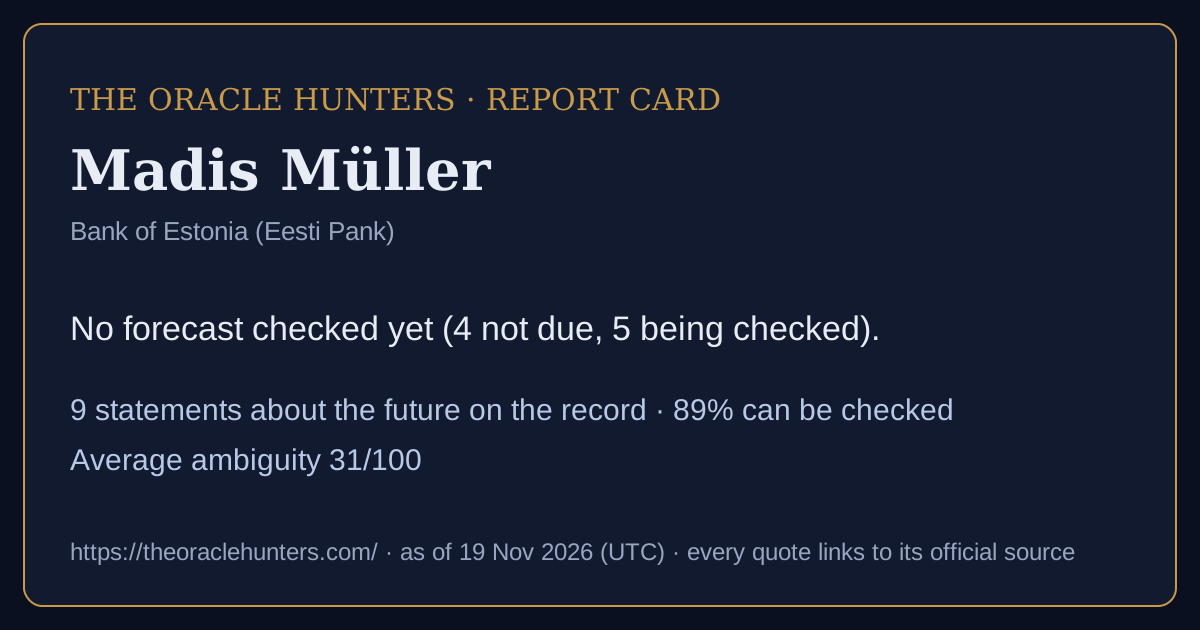
Madis Müller
Bank of Estonia (Eesti Pank)
Track record: No forecast checked yet (4 not due, 5 being checked).
9forecasts & commitments on the record
89%can be checked as stated
31average ambiguity (0-100)
0goalpost moves recorded
0confirmed U-turns
Timeline
came true partly did not not due / being checked / too vague
Calibration score: shown after 10 checked forecasts with a stated likelihood (now 0).
How they speak about the future: based on data 4, stated on authority 3, educated guess 2.
Kinds of claim: forecast 7, scenario (if… then) 2. · Download this report card as a picture
In the nine words
πρόγνωσιςInference from evidence4 · 44%μαντείαInspired knowledge3 · 33%πρόνοιαPreparing for the future2 · 22%
How to read this
Each box is one sentence a public figure or institution said about the future, word for word, with a link to the official text. Can be checked means it names what will happen, by when, and how likely - so it can be compared with official figures later. Too vague to check means it does not. Ambiguity (0-100) is how many different ways the sentence can be read. When the date passes, the forecast is compared with official data and marked came true, partly or did not come true. Labels judge the sentence, never the person. Full guide and glossary.On the record (9)
The second report by the expert group was presented to the Riigikogu in June this year, and on 24 September an international seminar based on report will be held.
Orderly state finances means more than having a fiscal deficit that is lower than planned for one-off or temporary reasons, as happened last year and is highly likely to happen again this year.
They may be expected to do so from next year, when the tax-free threshold is extended to all taxpayers and as inflation falls.
Real incomes will not increase this year, because the rise in the average wage will only just exceed inflation in the consumer basket, while the income tax rate rose at the start of this year.
The cost of living rose last year by around 3.5%, but inflation in Estonia this year is expected to be 5-6%, of which about a third will come from tax rises.
If they do, they could cause a wage-price spiral, which would then stop inflation from falling back to its medium-term target level after the temporary shocks have faded.
If such shocks do not last for long, it might be appropriate to wait and see whether inflationary pressures will recede by themselves without any additional strain being put on the economy by higher interest rates.
This also applies to Estonia, where preliminary data suggest that the fiscal deficit for 2022 will be around 1.2 per cent of GDP.
When we started to sketch out the policy normalisation, the financial markets did not expect policy rates in the euro area to rise at all until 2024.
Also said - not checkable as stated (5 newest)
Remarks about the future with no date, figure or likelihood that could be checked. They are kept on the record and shown here, but not scored.
We must be aware that geopolitical tensions causing a new recession in the economy could increase the amount of problem loans.
It is most likely this will not be the last rate rise in this cycle, and it is quite possible that interest rates will need to stay high for quite some time so that we can be sure that inflation will come back to, and remain at, close to two per cent.
If we hesitate, we may later have to raise interest rates much higher, and keep them high for much longer, in order to get inflation down to its target of two per cent and to keep it there.
The initial smoothing of the shock may have been even more costly as it resulted in a higher level of public debt.
Some countries have chosen to delay the pain and take only gradual steps with their structural reforms, but this has in fact resulted in a reduction of the overall economic activity to the extent that might be no less than the shortterm cost of a quicker adjustment.