M R Chatu Mongol Sonakul
Bank of Thailand
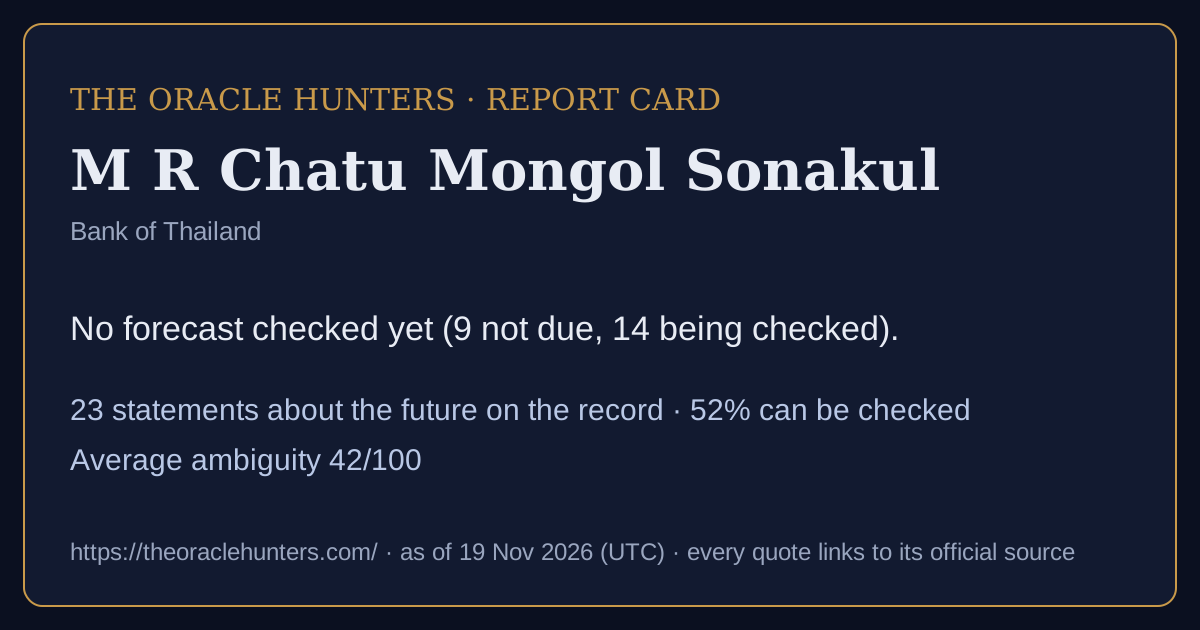
Track record: No forecast checked yet (9 not due, 14 being checked).
23forecasts & commitments on the record
52%can be checked as stated
42average ambiguity (0-100)
0goalpost moves recorded
0confirmed U-turns
Timeline
came true partly did not not due / being checked / too vague
Calibration score: shown after 10 checked forecasts with a stated likelihood (now 0).
How they speak about the future: stated on authority 10, based on data 8, educated guess 5.
Kinds of claim: forecast 13, scenario (if… then) 5, mixed claim 4, commitment 1. · Download this report card as a picture
In the nine words
μαντείαInspired knowledge9 · 39%πρόγνωσιςInference from evidence8 · 35%πρόνοιαPreparing for the future5 · 22%προαναγγελίαPublic pre-announcement1 · 4%
How to read this
Each box is one sentence a public figure or institution said about the future, word for word, with a link to the official text. Can be checked means it names what will happen, by when, and how likely - so it can be compared with official figures later. Too vague to check means it does not. Ambiguity (0-100) is how many different ways the sentence can be read. When the date passes, the forecast is compared with official data and marked came true, partly or did not come true. Labels judge the sentence, never the person. Full guide and glossary.On the record (23)
Inflation remained subdued and will stay within the target range during the next two years.
By year-end, we will launch the Director's Handbook for the financial community and further encouraging increased transparency of appointment and compensations.
Next year, the Bank of Thailand will start a new salary structure to be consistent with job evaluation, and to set out a clear work target and plan for each group.
In addition, by the end of next year, the Bank of Thailand will introduce BAHTNET II, which is the large value payments system that meets international standards and will serve both domestic and overseas financial institutions.
losses is currently estimated at B880 billion, with the first lot of government guaranteed FIDF bonds expected to be issued in the first quarter of next year.
This would also be a good opportunity to raise a number of issues, which the private sector may find important for consideration in the next year.
It is quite pleasing that the work, which has been undertaken, has begun to bear fruit, and we will have by the end this year a strengthened financial institution system.
All banks are expected to meet full 100 % loss provision requirement by end of the year as required by the Bank of Thailand.
In the modern world, it is now normally agreed that each national economy is so vast and complex that central banks could be considered to have done very well if it just keeps the country stable and let government build infrastructure and help the poor and private sector trade and invest to economically develop the nation.
Another aspect to the whole thing is that people do cash in paper notes at times and banks have to hold large reserves sometimes up to 30% of their liabilities in order to make sure that they have adequate liquidity that may be used in case of unforeseen events.
If this were to happen the debt to GDP ratio might not increase significantly due to the resulting increase in GDP over the long term.
But most forces in the country, especially the political ones, are directed towards higher growth rather than the sustainability or stable growth, even if in the end stability would probably lead to a better and higher level of the economy than the roller coaster growth of the past.
If the central bank could keep the economy stable, that would be a major achievement.
Risk management supervision will be instituted from the first of January next year.
Let us hope we will have a good new government, with new ideas to bring Thailand into the future and take Thailand into that most important next level of development, a more comfortable life, and a more stable growth.
If the inflation rate in a country far exceeds those in its trading partners, it will erode that country's competitiveness over time.
The Bank of Thailand last year announced our explicit intention to control inflation, and the range of 0 to 3.5% of core inflation was announced in 23 May 2000.
In the more difficult areas of manpower, recruitment and pay structure, work has just begun or will begin early next year as this requires that the restructure of organization and work processes be rather complete.
Another achievement of our own doing, this time towards transparency is that we are now qualified in the Special Data Dissemination Standard of the IMF, the 21st country to do so in May this year.
I expect that the NPL at the end of this year will be in the teens - a quite manageable level compared to the high of 48% at the beginning of the year.
Seeing that it could be done or how it could be done, we expect the remaining private commercial banks to follow suit in next year's annual shareholders' meeting or at other relevant times.
On the average, banks are now back into the positive spread, actually of 1.28% last month, which is low by traditional standards and still not profitable but still over half of the spread that we expect banks to be operating in under the new competitive and transparent conditions that we will see in the future.
Upon completion of the data warehouse, we have a plan to make economic information available on our webpage over a 20-year historical time-span, and this will be done in the next two years.
Also said - not checkable as stated (12 newest)
Remarks about the future with no date, figure or likelihood that could be checked. They are kept on the record and shown here, but not scored.
Bank directors are now required to have no more than 3 directorships in other profitseeking institutions, so that they will have more time to carry out the required duties, as directors should do.
By so doing, we will be ready for the intensified battles of globalization.
We have to move beyond the financial side of the corporations, move beyond the balance sheet cleaning up, and start to address the real issues that will determine the long-term competitiveness of the corporate sector and thus consolidate the economic recovery achieved thus far.
Speech by M R Chatu Mongol Sonakul, Governor of the Bank of Thailand, at the Annual Business Awards Gala Dinner of the Netherlands-Thai Chamber of Commerce held in Bangkok, 17 May 2001.
New legislations, both in the central bank act and financial institution act will empower the central bank to have much more ability to manage the nature of commercial banks and will follow the principle of transparency when we shall
Of course, the important powers of the world say that the country should behave itself better, but one has to ask a question why important powers of the world try to make sure that each country behaves itself, yet allows the international monetary system to behave totally as it wishes without due regard to responsibility or the misery and famine …
So I truly hope that whenever the opportunity arise we will do our part to try and put up a better world monetary system at which tasks the emerging countries are so powerless.
Of course the single reserves might be sufficient under normal circumstances but when things get out of hand, it may not be sufficient, and banks do shut down.
We must go on to the philosophy of transparency where offences and important financial ratios or numbers are publicised, and peer or investor pressure could be used to reduce the flow of resources to wrong-doers.
The economy will also have to generate enough jobs to accommodate the new workers entering the labor force yearly.
To set the right tone for the seminar, I want to start with a question: what does the general public expect from the central bank?
The people can rightly expect the central bank to have an important role in this: giving them the good life.