Mário Centeno
Banco de Portugal
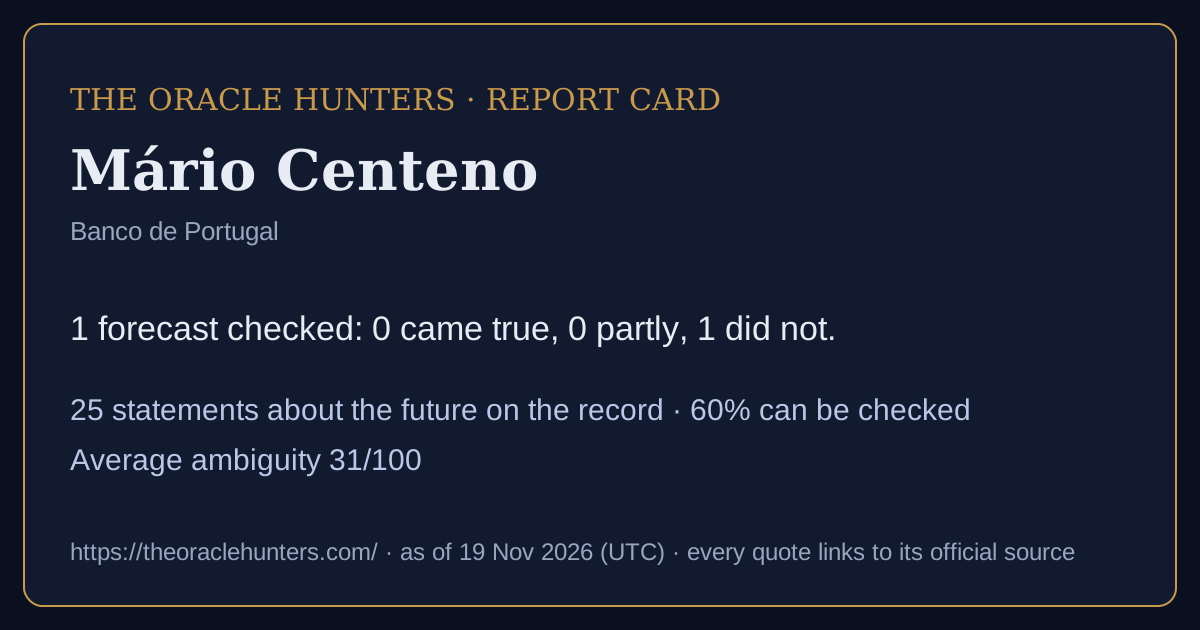
Track record: 1 forecast checked: 0 came true, 0 partly, 1 did not.
25forecasts & commitments on the record
60%can be checked as stated
31average ambiguity (0-100)
0goalpost moves recorded
0confirmed U-turns
Timeline
came true partly did not not due / being checked / too vague
Calibration score: shown after 10 checked forecasts with a stated likelihood (now 1).
How they speak about the future: based on data 20, stated on authority 4, educated guess 1.
Kinds of claim: forecast 21, commitment 2, mixed claim 2. · Download this report card as a picture
In the nine words
πρόγνωσιςInference from evidence20 · 80%μαντείαInspired knowledge2 · 8%προαναγγελίαPublic pre-announcement2 · 8%εἰκασίαConjecture1 · 4%
How to read this
Each box is one sentence a public figure or institution said about the future, word for word, with a link to the official text. Can be checked means it names what will happen, by when, and how likely - so it can be compared with official figures later. Too vague to check means it does not. Ambiguity (0-100) is how many different ways the sentence can be read. When the date passes, the forecast is compared with official data and marked came true, partly or did not come true. Labels judge the sentence, never the person. Full guide and glossary.Checked
Inflation is expected to edge down to 5.5% in 2023 and to 2.3% in 2024.
Did not come true. Said: inflation around 5.5% in 2023. Official figure for Portugal: 4.3% (World Bank open data). Missed. Off by 1.2 points. official data · checked 14 Nov 2026 · automatic check against official data (rules v3)
On the record (25)
And today, we have the assurance that the Eurosystem stands ready to stabilise inflation at its 2% target over the medium term.
They expect policy interest rates to increase towards relatively low levels and inflation to fall to 2%.
Of course, we cannot take for granted that EU inflation expectations will remain anchored under every circumstance; that is why we should be ready for a strong response if inflation expectations de-anchor.
With high inflation expected for next year and low nominal interest rates, real interest rates will remain negative.
Portugal complied with the temporarily suspended 3% deficit rule already in 2021; in 2022, the deficit will be well below 1.8% and, in 2023, it could come close to balance.
They expect policy interest rates slowly increasing towards relatively low levels and inflation falling to 2%.
High expected inflation (the case for next year) and nominal rates at low levels is equivalent to low real rates.
The ECB projects annual growth of euro area GDP to slow down from 3.1% in 2022 to 0.9% in 2023, before picking up to 1.9% in 2024.
Inflation is expected to edge down to 5.5% in 2023 and to 2.3% in 2024.
Did not come true. Said: inflation around 5.5% in 2023. Official figure for Portugal: 4.3% (World Bank open data). Missed. Off by 1.2 points. official data · checked 14 Nov 2026 · automatic check against official data (rules v3)
In Portugal, around 38% of the €16.4 billion will be invested in strategic areas, such as the sea, sustainable mobility, decarbonising industry, energy efficiency in buildings and renewable energy.
We are also taking part in the project coordinated by the Portuguese Environment Agency to assess the vulnerability of the Portuguese territory to climate change in the 21st century, the results of which will be presented in 2023.
In turn, the McKinsey Global Institute has projected that the same net zero target by 2050 will require an effort that is likely to peak between 2026 and 2035, with additional investments which, by then, will be equivalent to 1.6% of global GDP.
The European Investment Bank has estimated that, in order to achieve the objective of reducing greenhouse gas emissions by 55% by 2030, the European Union will need additional investments amounting to 2.1% of GDP per year.
Moreover, the trajectory projected before the pandemic is expected to be reached by 2023.
Our Bank should be an inclusive institution and, as such, the key moment that marks these 175 years will be shared with the entire population in May next year.
Remember that we will rest on higher debt, employment is still to recover with a lot of reallocation going on, and inequality can be harder to curb.
Moreover, the trajectory projected before the pandemic is expected to be reached by the end of 2023.
Buffer capital flexibility will be maintained, until at least the end of 2022.
The trajectory projected before the pandemic is expected to be reached by the end of 2023.
Inflation is expected to return to levels below the 2% target by 2022.
Such a definition would convey the idea that we will act proportionally either when inflation is above or below the objective.
If we take for good the numbers of the IMF, we see that the fiscal stimulus in the Euro Area, computed by the projected fiscal deficits up to 2024, is only slightly smaller than that of the US, less 0,5pp of GDP.
The same is true for the unemployment rate, at 6.8% in 2020 - a much lower figure than in our recent December forecast.
We continue to expect that GDP will go back to its pre-crisis level at the end of 2022.
It comprises 750 billion euros in grants and loans, financed by common European debt with issuances expected to have maturities up to 30 years.
Also said - not checkable as stated (12 newest)
Remarks about the future with no date, figure or likelihood that could be checked. They are kept on the record and shown here, but not scored.
We need to move forward and pull efforts to continue with the Banking Union and develop the EU capital Markets.
People need to understand what is happening in the economy and in the financial world, especially now that high inflation is present and interest rates are increasing.
We will not hesitate one single moment in order to achieve those; it is the price, the trade-offs, that we have to face that must be discussed and minimized.
A faster than warranted increase in policy rates may backslash in two ways.
First, it may dampen investment in a period in which we need it so badly to restore supply chains and redesign globalization.
Second, it may imply a backtrack in policy direction if at end we did not need such a strong action to cope with medium term inflation expectations, that I do not see de-anchored, as we speak.
In any case, as monetary policy normalises, higher interest rates are going to put pressure on debt service costs, diminishing the fiscal policy room to adapt its macroeconomic stabilisation stance.
The ongoing normalisation of monetary policy cannot - will not - be constrained by fiscal space considerations.
These will always be achieved; it is the price that we have to pay that must be discussed and minimized.
In addition, governments should not neglect the fact that any fiscal stimulus may feed the inflationary process.
Their effectiveness will be ultimately conditional on channelling funds towards high-quality, productive investment, ensuring a transition to greener and more digital economies, while also strengthening long-term growth prospects.
We will use all instruments in our toolkit to guarantee price stability in a context of financial stability and a proper functioning of the transmission mechanisms across the euro area.