Lynne Featherstone
Department for Digital, Culture, Media & Sport (2017 to 2023) · GBR
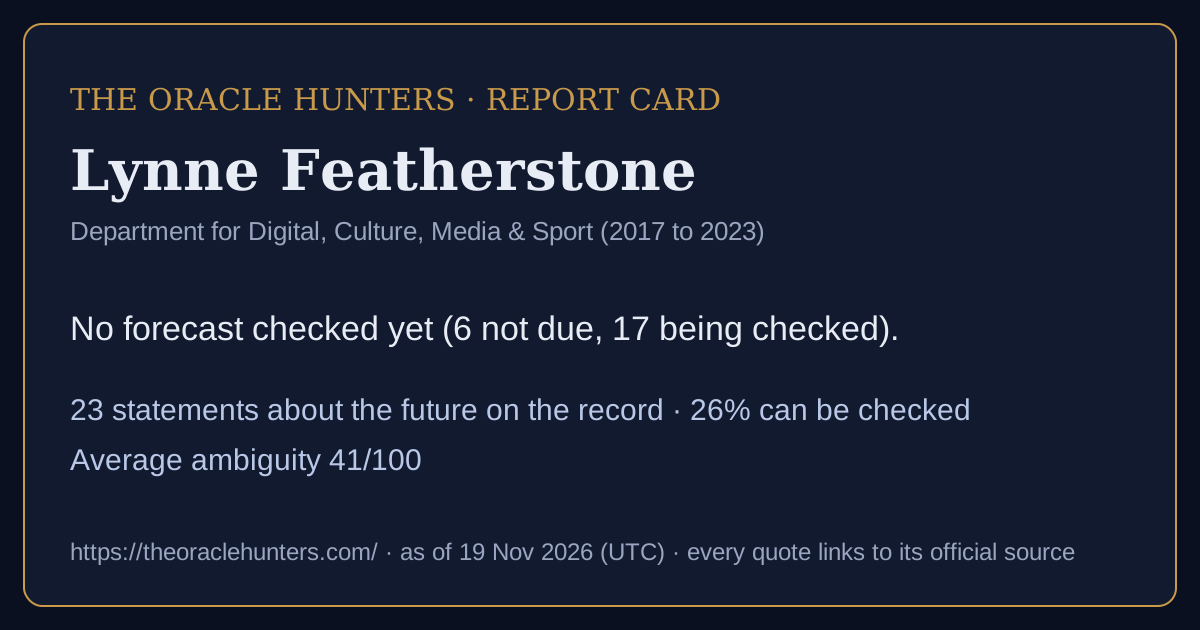
Track record: No forecast checked yet (6 not due, 17 being checked).
23forecasts & commitments on the record
26%can be checked as stated
41average ambiguity (0-100)
0goalpost moves recorded
0confirmed U-turns
Timeline
came true partly did not not due / being checked / too vague
Calibration score: shown after 10 checked forecasts with a stated likelihood (now 0).
How they speak about the future: based on data 12, stated on authority 11.
Kinds of claim: forecast 11, mixed claim 8, commitment 4. · Download this report card as a picture
In the nine words
πρόγνωσιςInference from evidence10 · 43%μαντείαInspired knowledge9 · 39%προαναγγελίαPublic pre-announcement4 · 17%
How to read this
Each box is one sentence a public figure or institution said about the future, word for word, with a link to the official text. Can be checked means it names what will happen, by when, and how likely - so it can be compared with official figures later. Too vague to check means it does not. Ambiguity (0-100) is how many different ways the sentence can be read. When the date passes, the forecast is compared with official data and marked came true, partly or did not come true. Labels judge the sentence, never the person. Full guide and glossary.On the record (23)
The UK is determined to lead by example for transparency and therefore will apply to join the Extractive Industries Transparency Initiative later this year.
If the current momentum continues, more than half of sub-Saharan African countries will be middle income by 2025.
We will support the key pipelines, including through a £16m contribution to the World Food Programme.
And I know Radha will set out her vision in a few moments for how we get to clean cookstoves in more than 100 million households by 2020.
Later this year, we will launch a major new project called Future Climate for Africa with the Natural Environment Research Council.
An extra year of primary schooling for girls can increase their wages by up to 20%, most of which is likely to be reinvested in her family and community.
In the post-2015 framework, we want to see a set of compelling goals and targets that will catalyse the action needed to eradicate poverty within a generation.
In addition, I am delighted to announce today we will be increasing our annual core contribution to UNAIDS by 50% to £15 million in 2013/14 and 2014/15.
This will increase access to health services and the Health Extension Workers will provide this package of basic health services to 5 million people.
The Forum will be an excellent opportunity to highlight that human resources for health are critical for universal health coverage and the post-2015 development agenda, and to inspire greater engagement in solutions to the health workforce crisis.
Over the next 18 months the world’s leaders will consider and negotiate the final post-2015 framework and the UK will be doing everything possible to push the UN to take up the core commitment to leave no one behind - I hope you will do the same.
The UN’s High Level Panel reported on what these goals could look like earlier this year.
I very much hope that by the end of this year the reform process set out in the Global Political Agreement will have been concluded, and peaceful and credible elections held.
I hope that the conversations today will focus on the future and recognise the importance of looking ahead to what our relationship with Zimbabwe should look like on the other side of peaceful and credible elections later this year.
The Council met for the first time this May and will come back to us with specific recommendations by May 2013.
Later this year, we will be involved in a national programme of small business events produced in partnership with the british chamber of commerce.
This is why we recently announced that we will be establishing a Women’s Business Council, to provide advice to the Home Secretary, to the Chancellor and to the Business Secretary on what can be done to maximise women’s contribution to our future economic growth.
This year we have granted funding for 54 Multi-Agency Risk Assessment Conference coordinator posts and I hope that this will enable a more child-focused approach to domestic violence.
We’re providing more than £10 million over three years to support their work and we will open new centres where there are gaps in provision.
The first is we have announced next year that the government will commence the positive action provisions in recruitment and promotion contained in the Equality Act.
And so the question is how can we ensure that next year, and even in five, ten, twenty years time we will see the number of women in the boardroom continue to rise, and rise somewhat more rapidly?
And why we will be working with campaigners to help us develop a new programme of action to improve the lives of transsexual people, which we want to publish next year.
We will be introducing a fairer tax system which will benefit those on low incomes - sadly the majority of whom are women because women are more likely to work part-time and be employed in lower-paid jobs.
Also said - not checkable as stated (12 newest)
Remarks about the future with no date, figure or likelihood that could be checked. They are kept on the record and shown here, but not scored.
In the next few months it will start to identify priorities and actions.
Develop a national plan of action by the end of 2014
So what does poverty reduction have to do with mining, you might ask?
We now know that resource wealth will not translate into broad economic growth without a concerted effort from all stakeholders.
In many African countries where you operate you will be the biggest taxpayers, the most important employers, and probably the ones who build and maintain roads and other essential infrastructure for the local economy.
Investors need to maximise job opportunities for local people and strengthen linkages with local markets and supply chains.
That vision has to transcend the political cycle and needs to engage all of society to resolve the many difficult trade-offs, for example spending revenues now versus investing them in long-term development.
And there is growing optimism that the benefits of this growth will filter down to Africans at all levels.
This might seem like a surprise to some of you, who associate DFID more with health, education and sanitation.
This programme will help increase trade and reduce transport costs and time.
If we want to drive sustainable growth across Africa then it is essential that this growth benefits all Africans, particularly as 10 million young people are entering the job market each year.
I don’t need to tell this audience that driving growth and jobs in Africa has the potential to also benefit the UK.