Luke Pollard
Ministry of Defence · GBR
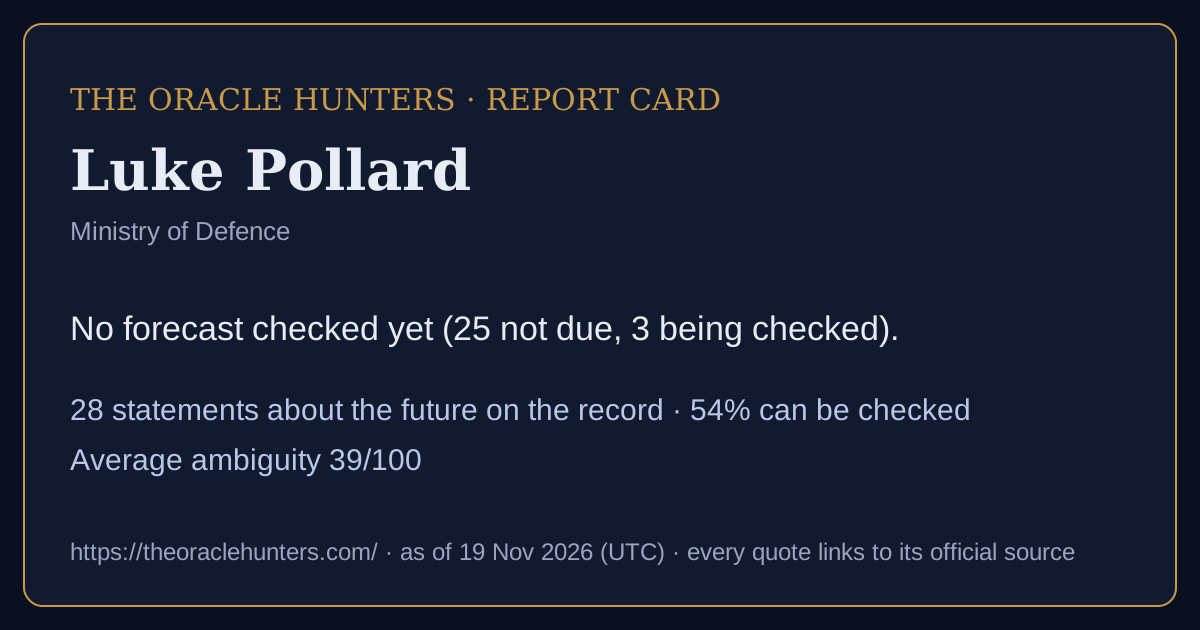
Track record: No forecast checked yet (25 not due, 3 being checked).
28forecasts & commitments on the record
54%can be checked as stated
39average ambiguity (0-100)
0goalpost moves recorded
0confirmed U-turns
Timeline
came true partly did not not due / being checked / too vague
Calibration score: shown after 10 checked forecasts with a stated likelihood (now 0).
How they speak about the future: based on data 15, stated on authority 13.
Kinds of claim: forecast 17, commitment 7, mixed claim 4. · Download this report card as a picture
In the nine words
πρόγνωσιςInference from evidence14 · 50%μαντείαInspired knowledge7 · 25%προαναγγελίαPublic pre-announcement7 · 25%
How to read this
Each box is one sentence a public figure or institution said about the future, word for word, with a link to the official text. Can be checked means it names what will happen, by when, and how likely - so it can be compared with official figures later. Too vague to check means it does not. Ambiguity (0-100) is how many different ways the sentence can be read. When the date passes, the forecast is compared with official data and marked came true, partly or did not come true. Labels judge the sentence, never the person. Full guide and glossary.On the record (28)
This investment will allow us to make Atlantic Net operational from next year.
That’s not only about long range fire, but if you took long range fire as the example of the upgrades over the next four years, we’re investing £190 million in short range ballistic missiles, £400 million in inexpensive one-way attack drones and weapons, and £220 million in Project Nyx to build an advanced armed autonomous drones to fly alongside our …
The Defence Finance and Investment Strategy will be published just after the budget this year.
In May, 13 British startups were awarded contracts of up to £4 million as part of the Defence Unicorn Fund programme.
Today we will not only get a clearer view of the potential on offer in the growing defence industry in the UK, and advice on how you can access more of that market.
And in December, we will also hold a defence investment summit to turn strategy into delivery and bring together government, industry and investors to accelerate the flow of capital into priority defence capabilities.
Following the autumn budget this year, we will publish the Defence Finance Investment Strategy to set a clear framework for how government and responsible private capital can work together in support of security, resilience and growth.
We’re backing British with 94 percent of the major defence contracts awarded since we came to office going to UK-based firms and we’re investing £182 million pounds in defence skills.
It will support our small businesses and around 60 skilled jobs in Bedfordshire and inject £2 million pounds into the supply chain including into multiple UK SMEs that will benefit.
Now, you will have seen the DIP was backed by £298 billion pound down payment over the next four years to deliver the 62 recommendations of the Strategic Defence Review.
Through new initiatives like our Defence Industrial Joint Council, we will be forging new partnerships to accelerate the flow of information from the front line to the drawing board to the production line, partnerships that are compressing innovation and procurement cycles, because it currently takes too long to procure.
This government has set out an ambitious target to increase MOD spending with SMEs by £2.5 billion by May 2028.
Over the coming years I want our SMEs to provide the agility defence needs to be warfighting ready, to be mission ready by 2030, spreading jobs, opportunity and wealth across all parts of the UK, and this government is on a mission to help them grow.
This is an investment alongside the £5 billion which we’re investing in drones and other advanced uncrewed systems that will nourish our defence innovation ecosystem.
A further £1.1 billion to upgrade and sustain our Typhoon combat force well into the 2040s, and more than £4.5 billion invested in our transporter fleet of A400 Air Voyager and C-17s, and more than £2 billion to lay the ground for our first F-35As that will enable the RAF to join NATO’s tactical nuclear mission, providing a long overdue …
Supported by our new Defence Export Strategy, that will come later this year, that will focus on the whole range of options that British industry are good at, that your air forces also benefit from as well.
And we will all see how space has become a domain of growing competition that is central to war fighting.
Since the general election over 1200 contracts signed, 86 percent of those going to British companies.
With a stated of ambition to increase our SMEs spend by 50% of direct spend between the Ministry of Defence and small businesses by May 2028.
And we’ve gone well beyond our pledge to spend 2.5% of GDP on defence by next year setting out a pathway to 3% in the next parliament, and promising a historic rise to spend 5% of GDP on national security by 2035, by far the largest sustained increase in defence spending since the end of the Cold War.
In its entirety, the programme is expected to secure between 3,000 and 6,000 jobs in the UK and it will position the UK at the forefront of a tech revolution as we transition to hybrid naval power in a sector worth £350 billion globally.
The defence investment plan later this year sets out some of those lessons learned and how we’re adapting to those capabilities, but you will already be able to see some of those and the commitments made in the SDR, in particular, the massive increase in spending on autonomy that seeks to learn the lessons and the importance of increasing lethality …
It is how we will drive growth in all our communities.
Now that is a big challenge, and as we implement not just the Strategic Defence Review the Defence Industrial Strategy for Monday but look ahead to the defence Investment plan that we will publish later this year, setting out what we will be buying.
We will deliver £1 billion in an integrated Targeting Web.
We will reform defence to improve decision making, strengthen industrial resilience, improve morale, and deliver better value for money.
We must, and we will fulfil all our obligations as a member and strengthen Britain’s leadership within the alliance.We will also seek to strengthen European security by negotiating a new security pact with the EU – seeking a new bilateral defence agreement with Germany, refreshing the Lancaster House agreement with France, and stronger defence partnerships with our Joint Expeditionary Force …
That collaborative approach will mean that the Strategic Defence Review will report in the first half of 2025.
Also said - not checkable as stated (12 newest)
Remarks about the future with no date, figure or likelihood that could be checked. They are kept on the record and shown here, but not scored.
And if we’re going to fight together we should be designing and delivering side by side too.
The Bastion programme. and the hybrid navy are delivering naval warfare tech revolution that will secure the North Atlantic against Russian threats, spanning autonomous surface and underwater vessels, cutting-edge digital infrastructure and world-class warships.
And by investing in British businesses and skilled jobs, most of its platforms and systems are going to be delivered by British small and medium-sized suppliers, with strengthening both our national security and our defence industrial base.
Now the answers to these questions will dictate how well our countries, how well JEF and NATO can deter threats, protect our peoples and our seas tomorrow and for the years to come.
And that’s why we need to forge new partnerships that go beyond our forces, to join up more of our industrial bases and supply chains across northern Europe.
There’s three priorities that defence has for the next quarter that you’ll hear the new Defence Secretary, Wes Streeting, talk about frequently.
And as we reform defence procurement to be faster, because I think it’s fair to say that everyone in this room, regardless of what kind of clothing you are wearing today, will know that defence procurement is not as fast as we would all like it to be.
And some of the examples I’m going to talk about today are good examples of how we’re accelerating procurements, so we can get more kit and equipment faster and deliver greater value for that increased defence spending.
Now, these are just three procurements that will not only demonstrate how we’re evolving operationally in response to the lessons from Ukraine, but they’re programmes that demonstrate how we have reformed our procurement processes in response to what we’ve learned from our friends in Ukraine.
So that’s why the Defence Investment Plan sets out the priority areas that we will invest in both now, and later to provide the certainty for investors to understand what type of technologies, what areas of defence will the government invest in, where we also seek investment from the private sector.
We are moving towards warfighting readiness and in doing so we must discard the warm comfort blanket that we are used to in Britain, of polishing old things and pretending that that will protect us.
And on a more personal note, for those that have seen me do media interviews on the Defence Investment Plan for the last year, it means I never have to say we’re working flat out to deliver it ever again, which will be a joy for everyone that has to listen to me and me for having to say it.