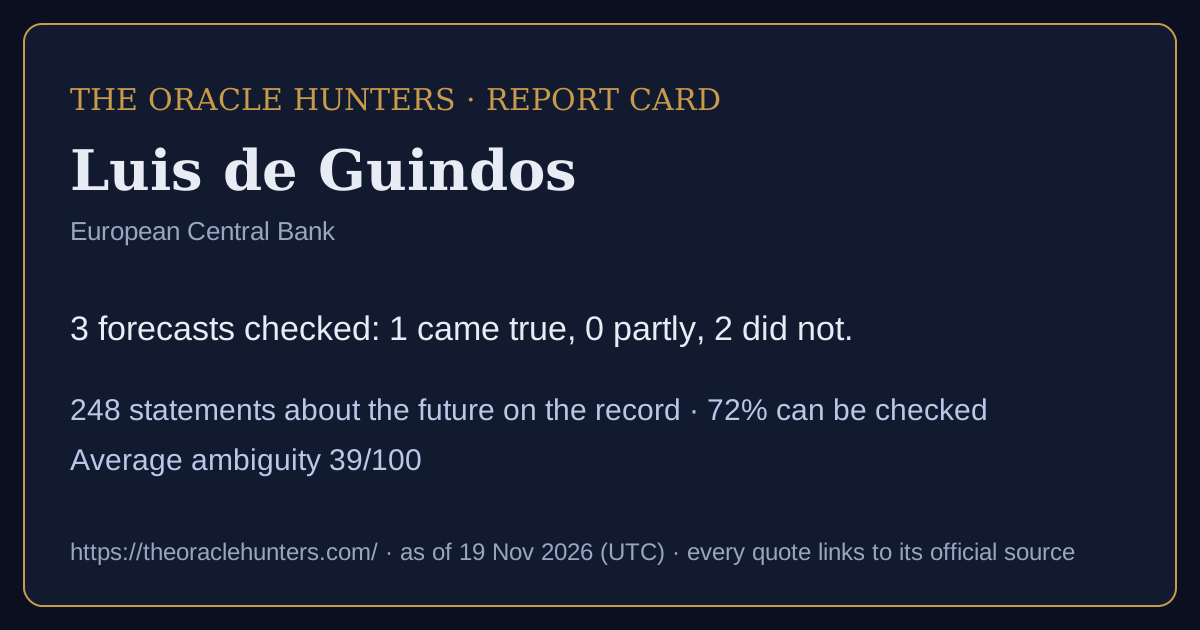
Luis de Guindos
European Central Bank · EU
Track record: 3 forecasts checked: 1 came true, 0 partly, 2 did not.
248forecasts & commitments on the record
72%can be checked as stated
39average ambiguity (0-100)
0goalpost moves recorded
0confirmed U-turns
Timeline
came true partly did not not due / being checked / too vague
Calibration score: shown after 10 checked forecasts with a stated likelihood (now 1).
How they speak about the future: based on data 187, stated on authority 39, educated guess 22.
Kinds of claim: forecast 193, mixed claim 28, scenario (if… then) 19, commitment 8. · Download this report card as a picture
In the nine words
πρόγνωσιςInference from evidence175 · 71%μαντείαInspired knowledge35 · 14%πρόνοιαPreparing for the future19 · 8%προαναγγελίαPublic pre-announcement8 · 3%φρόνησιςPractical wisdom5 · 2%πρόβλεψιςSeeing the signs3 · 1%εἰκασίαConjecture3 · 1%
How to read this
Each box is one sentence a public figure or institution said about the future, word for word, with a link to the official text. Can be checked means it names what will happen, by when, and how likely - so it can be compared with official figures later. Too vague to check means it does not. Ambiguity (0-100) is how many different ways the sentence can be read. When the date passes, the forecast is compared with official data and marked came true, partly or did not come true. Labels judge the sentence, never the person. Full guide and glossary.Checked
These projections foresee annual real GDP increasing by 1.2% in 2019, 1.4% in 2020 and 1.4% in 2021.
Did not come true. Said: economic growth around 1.4% in 2020. Official figure for Euro area: -6.0% (World Bank open data). Missed. Off by 7.4 points. official data · checked 14 Nov 2026 · automatic check against official data (rules v3)
In line with this, our latest projections foresee annual HICP inflation declining to 1.2% in 2019, before recovering to 1.5% in 2020 and 1.6% in 2021.
Did not come true. Said: inflation around 1.5% in 2020. Official figure for Euro area: 0.2% (World Bank open data). Missed. Off by 1.3 points. official data · checked 14 Nov 2026 · automatic check against official data (rules v3)
Real GDP is projected to increase by 2.1% in 2018, 1.9% in 2019 and 1.7% in 2020.
Came true. Said: economic growth around 1.9% in 2019. Official figure for Euro area: 1.6% (World Bank open data). On target. Off by 0.3 points. official data · checked 14 Nov 2026 · automatic check against official data (rules v3)
On the record (248)
It reaffirmed the symmetric 2% medium-term inflation target and recognised the importance of an appropriately forceful or persistent response to large, sustained deviations from the inflation target in either direction.
The progress made on inflation and a favourable inflation outlook allowed the Governing Council to reduce the deposit facility rate further, by 100 basis points, to 2.0% by mid-2025, where it has remained since.
The disinflation process continued broadly on track in 2025, with euro area inflation averaging 2.1%, close to the ECB’s medium-term target of 2.0%.
You can rest assured that, whatever the future may bring, the ECB will remain firmly committed to its mandate of price and financial stability – a foundation of Europe’s prosperity and strength.
Inflation has been at around our 2% medium-term target for about a year, longer-term inflation expectations remain well anchored, there are no pronounced demand-supply imbalances in the euro area economy and our monetary policy stance is broadly neutral.
ECB analysis shows that if internal barriers were as low across all Member States as they are in the best-performing ones, intra-EU trade in services could expand by almost 15%, with effects on GDP roughly four times greater than the estimated losses from US tariffs. A true single market for goods and services would present more attractive opportunities and incentives …
Looking ahead, the war is expected to push up energy prices and drive inflation above 2% in the near term.
We will follow a data-dependent and meeting-by-meeting approach to determining the appropriate monetary policy stance, and we are unwavering in our commitment to ensuring that inflation stabilises at our 2% target in the medium term.
Annual inflation is expected to average 2.6% this year before subsequently converging to our 2% target.
ECB staff now expect annual growth in the euro area to drop below 1% [average 0.9%] this year and to then hover above 1% in the coming years, following significant downward revisions.
Inflation could be affected in different directions: it could be lower if the rise in US tariffs reduced demand for euro area exports and if countries with overcapacity increased their exports to the euro area; or higher if more fragmented global supply chains pushed up import prices, curtailed the supply of critical raw materials and added to capacity constraints in …
However, more forward-looking indicators point to wage growth easing in the coming quarters, before stabilising towards the end of 2026.
Compared with earlier projections, economic growth has been revised up to stand above 1% this year and rise to 1.4% in the following years.
Our most recent assessment reconfirms that inflation should stabilise at the 2% target in the medium term.
A volatile and uncertain macro-financial outlook After double-digit inflation figures in 2022 and a succeeding “bumpy road”, inflation is now close to 2% and we expect it to continue converging towards our medium-term target.
Given the progress with inflation approaching our medium-term target on a sustained basis, we have been able to lower our key interest rates several times, by a total of 200 basis points since June last year.
Inflation is currently at around our 2% medium-term target.
The downward revisions for this and next year, mainly reflect lower assumptions for energy prices and a stronger euro.
In our new projections, it is set to average 2.0% in 2025, 1.6% in 2026 and 2.0% in 2027.
This outlook is confirmed by our projections, indicating real growth rates gradually increasing from 0.9% in 2025 to 1.3% in 2027.
But this situation could reverse if trade-related corporate vulnerabilities unravel and lay-offs in the corporate sector rise, which could have an adverse impact on employment and consumption.
And even if trade tensions subside, this period of high uncertainty is very likely to have led to precautionary actions by firms and households, which could act as a drag on growth.
Sharp adjustments in financial markets could become disorderly, particularly if they are amplified by the growing size and influence of non-bank financial institutions.
We are determined to ensure that inflation stabilises sustainably at our 2% medium-term target.
Most measures of underlying inflation suggest that inflation will settle at around our 2% inflation target, on a sustained basis.
ECB staff have again revised down their growth projections – to 0.9% for 2025, 1.2% for 2026 and 1.3% for 2027.
Overall, the December projections see growth in 2024 at 0.7%.
The labour market remains resilient, with employment growing in the third quarter of 2024, again by more than expected, and the unemployment rate remaining at its historical low of 6.3% in October.
The December Eurosystem staff projections expect inflation to average 2.1% in 2025 and to return sustainably to our target rather early in the projection horizon.
Most measures of underlying inflation continue to suggest that inflation will settle near our 2% medium-term target on a sustained basis.
Growth is projected to be just above 1% in 2025 and to move slightly up to modest levels in 2026 and 2027.
Conclusions The decision in October to lower the deposit facility rate – the rate through which we steer the monetary policy stance – by 25 basis points was based on our updated assessment of the inflation outlook, the dynamics of underlying inflation and the strength of monetary policy transmission.
Chart 1 HICP inflation (annual percentage changes and percentage point contributions) Based on an ongoing assessment of the inflation outlook, the dynamics of underlying inflation and the strength of monetary policy transmission, the Governing Council decided to begin moderating the degree of policy restriction in June by cutting interest rates by 25 basis points.
The key determinants of high savings are expected to persist, though likely to a lesser extent, over the course of next year.
The outlook for the euro area economy - income and consumption growth Turning to the growth outlook, euro area GDP rose by 0.4% in the third quarter of 2024, up from 0.2% in the second quarter, possibly reflecting the buoyant summer tourism season and one-off factors such as the Olympics in France.
Inflation is expected to rise further in the coming months, partly because the sharp declines in energy prices during 2023 will drop out of the annual rates.
It is then projected to decline to the 2% target over the course of next year, as labour cost pressures ease and the past monetary policy tightening gradually feeds through to prices.
We remain determined to ensure that inflation returns to our 2% medium-term target in a timely manner.
But euro area growth could be higher if the world economy grows more strongly than expected or if declining inflation and less restrictive monetary policy lead to a faster recovery in consumption and investment.
And inflation could also turn out higher than anticipated if wages and profits increase by more than expected.
Following the two 25 basis point cuts in June and September this year, we decided to lower the key ECB interest rates again at our October meeting, based on our updated assessment of the inflation outlook, the dynamics of underlying inflation and the strength of monetary policy transmission.
Inflation is expected to rise again later this year – partly due to base effects, as previous sharp falls in energy prices drop out of annual rates – before declining to our target of 2% in the course of next year.
But the capital markets union alone will not deliver those benefits if economic integration is still in the starting blocks, the Single Market remains fragmented, the banking union is not yet complete, and EU industrial competition and trade policies are not part of an overall EU strategy.
But the RRF is a temporary tool, and once it elapses in 2026, the EU budget will shrink significantly owing to the cliff effect. We should be determined to permanently enhance the EU’s fiscal capacity, also to support cross-border and pan-European projects.
Inflation could also turn out higher than anticipated if wages increase more than expected or if profit margins prove to be more resilient.
If our updated assessment of the inflation outlook, the dynamics of underlying inflation and the strength of monetary policy transmission were to further increase our confidence that inflation is converging to our target in a sustained manner, we will dial back the level of monetary policy restriction.
While we expect inflation to return to our 2% target next year, the outlook is surrounded by substantial risks.
It could face significant challenges if growth prospects weakened, inflation stayed above target for a longer period or further geopolitical risks materialised.
The key parameters of the framework will be reviewed in 2026 or earlier if necessary.
Our existing regular refinancing operations will continue to be conducted through fixed-rate tender procedures with full allotment against broad collateral, and the interest rate on the main refinancing operations will be adjusted later in the year to 15 basis points above the deposit facility rate.
Showing the newest 50 - the ledger has all 248.
Also said - not checkable as stated (12 newest)
Remarks about the future with no date, figure or likelihood that could be checked. They are kept on the record and shown here, but not scored.
Stronger, more consistent supervision at EU level will enhance the resilience of the system and remove the barriers that still limit cross‑border capital market integration.
A robust EDIS will protect deposits equally, enhance financial stability and facilitate cross-border transactions, fostering a truly unified and resilient financial system.
Reducing non-prudential barriers – such as disparities in insolvency laws, tax systems and corporate laws – will further streamline operations and remove obstacles to cross-border activity.
Competitiveness must go hand in hand with resilience: both can be achieved by simplifying processes, fostering integration and enabling economies of scale. Well-integrated markets and increased cross-border consolidation enable banks to diversify, strengthen their business models and better support the real economy, especially during times of stress.
To this end, the banking union should be regarded as a single European jurisdiction by all relevant competent and designated authorities.
As EU capital markets expand and become increasingly interconnected across borders, the prudential framework must also evolve so that emerging risks to financial stability can be detected and addressed.
We will monitor developments carefully to deliver on our mandate.
The assessment also underlined how important it is for our monetary policy deliberations to consider not only the most likely path for inflation and growth, but also the surrounding risks and uncertainty – for example by actively using scenarios.
Heightened uncertainty weighs on growth prospects through two main channels: by delaying firms’ investment decisions and so affecting euro area exports, and by prompting households to increase precautionary savings and consume less than expected.
But high uncertainty in the global environment does not appear to be reflected in current market pricing. In fact, negative surprises – such as a re-escalation of trade or other geopolitical tensions, setbacks in AI advances with asset price adjustments or intensifying doubts regarding US fiscal credibility – could trigger abrupt shifts in sentiment, with spillovers across asset classes and …
Should any sudden market drawdowns occur, the balance sheets of euro area non-bank financial intermediaries could come under pressure.
Global financial conditions – notably driven by developments in US markets – could pose challenges to euro area financial stability in the form of disorderly currency swings, the resulting adverse effects on trade competitiveness and fluctuations and spillovers in funding costs for sovereigns, firms and banks.