Lord McNally
Ministry of Justice · GBR
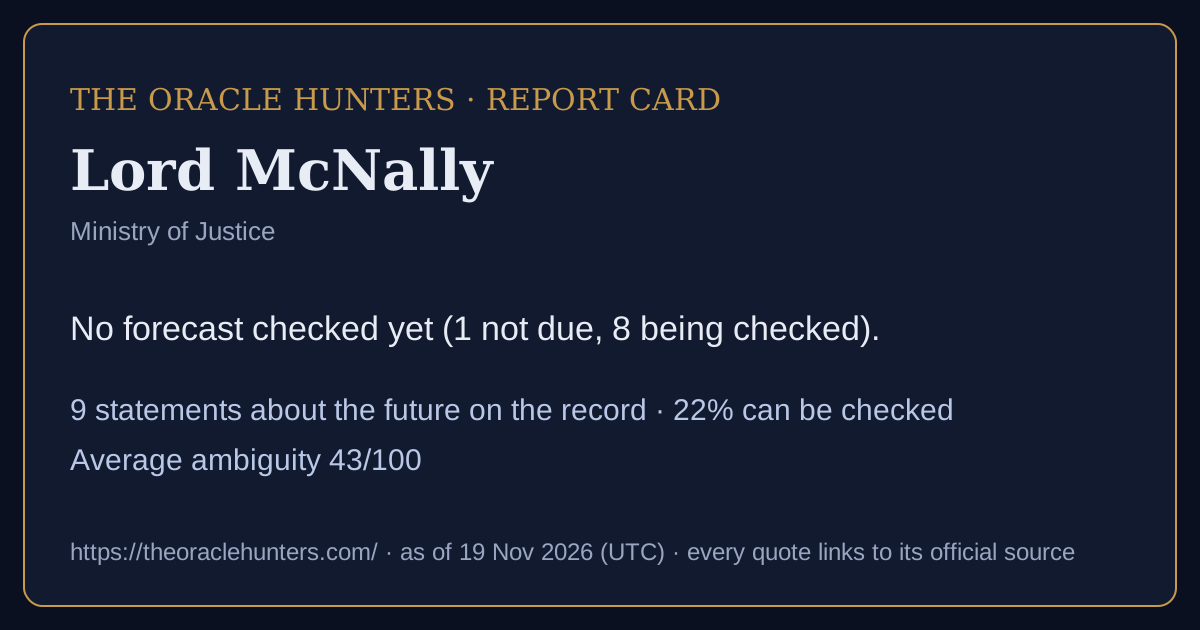
Track record: No forecast checked yet (1 not due, 8 being checked).
9forecasts & commitments on the record
22%can be checked as stated
43average ambiguity (0-100)
0goalpost moves recorded
0confirmed U-turns
Timeline
came true partly did not not due / being checked / too vague
Calibration score: shown after 10 checked forecasts with a stated likelihood (now 0).
How they speak about the future: based on data 8, stated on authority 1.
Kinds of claim: forecast 7, mixed claim 1, commitment 1. · Download this report card as a picture
In the nine words
πρόγνωσιςInference from evidence7 · 78%προαναγγελίαPublic pre-announcement1 · 11%μαντείαInspired knowledge1 · 11%
How to read this
Each box is one sentence a public figure or institution said about the future, word for word, with a link to the official text. Can be checked means it names what will happen, by when, and how likely - so it can be compared with official figures later. Too vague to check means it does not. Ambiguity (0-100) is how many different ways the sentence can be read. When the date passes, the forecast is compared with official data and marked came true, partly or did not come true. Labels judge the sentence, never the person. Full guide and glossary.On the record (9)
The UK will continue to lead the way in supporting the humanitarian response, and I am delighted that, following the initiative of Prime Minister David Cameron at the G20, additional pledges have been made since the start of September now totalling over $1bn.
As stated earlier, it is intended that the Single Family Court will be implemented in April 2014.
The reforms to civil and criminal legal aid that we’ve already brought in – cuts in fees and changes to the scope of the regime – will bring about estimated savings of £320 million every year by the year 2014/2015.
All being well, we anticipate that it will get Royal Assent early next year and compulsory MIAMs (Mediation Information and Assessment Meetings) will come in from April 2014.
We estimate than an extra £10 million of public funding will go into mediation in 2013-2014, bringing the total funding available for family mediation to £25 million for that year, a figure which is not capped.
It will be supported by telephone and face to face support in 2013 for parents that cannot access the web or need more intensive support.
The time limit will be a key part of the family justice provisions in the Children and Families Bill, scheduled to be introduced in early 2013.
To take the criminal justice system as a case in point, in October last year we released court-level sentencing data for each Crown court for 2009, and in May this year we released data covering 2005 to 2010.
There is clearly a public demand for information of this type, and so in May next year we will be going a step further and providing justice outcome information on Police.uk.
Also said - not checkable as stated (12 newest)
Remarks about the future with no date, figure or likelihood that could be checked. They are kept on the record and shown here, but not scored.
No-one should be in any doubt that high quality expert evidence will continue to play an important role in all court proceedings.
There are likely to be cost savings in all of this but it is also in the interests of justice – which must be everyone’s consideration.
In the meantime we will need to undertake some further work with the Family Procedure Rules Committee and the Legal Aid Agency.
We intend to implement the new standards in April next year alongside many of our other family justice reforms.
This work is an important part of our focus on the need to reduce delay, ensures that decisions are child-focused and reduce duplication in the system.
With continuing fiscal challenges, the Government must continue to ensure that every aspect of fee remuneration represents value for money.
Logically, these reforms mean that solicitors need to do less work per case and fewer expert witnesses will be needed.
It will also emphasise the importance to children of relationships with wider family members, particularly grandparents.
We remain in a climate of fiscal challenge and we must continue to reduce public spending wherever possible.
More can also be done in relation to private law proceedings, keeping the needs of children firmly at the centre of the system, while explicitly acknowledging the important role that both parents should play in a child’s life post-separation.
The legislation seeks to tear down the barriers that have come between vulnerable children and the stability and security they need to give them the very best chance to succeed.
And soon we will be able to take into account frozen assets as part of the means test.