Lord Maude of Horsham
Cabinet Office · GBR
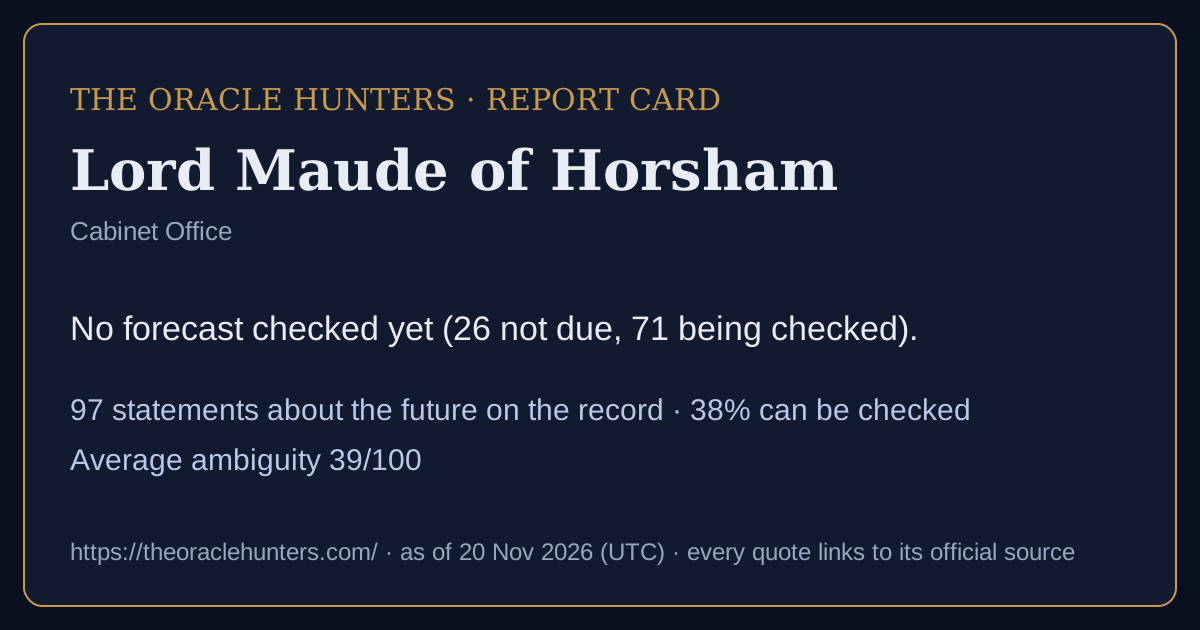
Track record: No forecast checked yet (26 not due, 71 being checked).
97forecasts & commitments on the record
38%can be checked as stated
39average ambiguity (0-100)
0goalpost moves recorded
0confirmed U-turns
Timeline
came true partly did not not due / being checked / too vague
Calibration score: shown after 10 checked forecasts with a stated likelihood (now 0).
How they speak about the future: based on data 74, stated on authority 22, educated guess 1.
Kinds of claim: forecast 66, mixed claim 22, commitment 8, scenario (if… then) 1. · Download this report card as a picture
In the nine words
πρόγνωσιςInference from evidence70 · 72%μαντείαInspired knowledge18 · 19%προαναγγελίαPublic pre-announcement8 · 8%πρόνοιαPreparing for the future1 · 1%
How to read this
Each box is one sentence a public figure or institution said about the future, word for word, with a link to the official text. Can be checked means it names what will happen, by when, and how likely - so it can be compared with official figures later. Too vague to check means it does not. Ambiguity (0-100) is how many different ways the sentence can be read. When the date passes, the forecast is compared with official data and marked came true, partly or did not come true. Labels judge the sentence, never the person. Full guide and glossary.On the record (97)
These ventures once again highlight the diversity of what social enterprise can achieve – from £150,000 going to a skate park in Dundee which provides young people with peer-to-peer education and stewardship, to £10 million to support housing for people with a learning disability so that they have more choice about their living arrangements.
Starting from this year, a new company – Integrated Debt Services Limited – jointly owned by the government and a private sector partner, a company we have brought into existence, will provide a single point of access to a wide range of debt management and collection services.
It’s our hope that by 2020 the remaining outsourced legacy technology contracts that are still in place will have gone.
We’ve learnt a huge amount from other nations – I’m delighted that we’re joined today by representatives of the Estonian government, who will be hosting next year’s D5.
Tonight we are going to hear from two compelling social organisations, Third Space Learning and FC United, to whom angels have been critical for their growth.
One of the ways we will help these clusters to grow is through our Cyber Exports Strategy.
On the strength of that pilot, we will launch a second node in the south east in 2015 and others will follow.
Achieving £20 billion of further efficiency and reform savings for 2019 to 2020 will require very substantial commitment and drive from ministers and officials at the centre and right across departments.
The next round will shortly begin to review a further 360 bodies between now and 2017.
They said it couldn’t be done.But we’ve already achieved a cumulative £2 billion worth of savings since 2010 and we’re now well on track to reach £2.6 billion by March next year
Earlier this year, I opened CERT-UK, our first national Computer Emergency Response Team, which will bring about closer co-operation between businesses and the government and law enforcement agencies.
That’s why we backed our National Cyber Security Strategy – which celebrates its third anniversary next month – with £860 million of investment, much of which is directed toward beefing up our capabilities in this area.
The first round of One Public Estate could bring £40 million worth of benefits to local economies and the possible creation of 5,500 new jobs and 7,500 new homes over the next 5 years.
It identified assets which could be released between now and 2020, generating £5 billion for the taxpayer.
By next year 25 of the government’s biggest services will be digital by default.
By the end of this year, 340 project leaders will have graduated from the Major Projects Leadership Academy, helping build capability within the Civil Service and reducing our reliance on costly consultants.
By next year we want to save £20 billion for the year including by reducing losses from fraud, error and debt.
And we’ve committed to spend a further £100 million with small businesses offering IT services and technology to government by next year.
Digitalising public services could save citizens, the Exchequer and businesses £1.2 billion over the course of this Parliament, rising to an estimated £1.7 billion each year after 2015.
We want to be exporting £2 billion worth of products and services by 2016 – that’s a sharp increase on the £850 million that we sold last year – and we’ve produced the first Cyber Exports Strategy which sets out how we will help to achieve that.
Boston Consulting Group projects an average increase in revenues of 10% this year.
Many of your organisations will have participated also in the Cyber Security Health Check with audit companies last year, which we’ll repeat this year to help inform levels of awareness and preparedness across the FTSE350.
This year we will be looking to support other sectors develop exercises, particularly those owning and operating Critical National Infrastructure, most of which of course these days is not in government hands, which is why partnership is so vital.
We want to be exporting £2 billion worth of products and services by 2016 – that’s a sharp increase on the £850 million that we sold last year - and we’ve produced the first Cyber Exports Strategy which sets out how we will help to achieve that.
A study from Boston Consulting Group projects an average increase in revenues of 10% this year.
Even a back of the envelope analysis suggests that if productivity had risen by the same amount in the public sector, the annual deficit could have been at least a quarter smaller — probably much more — a cut of around £50 billion; or the economy larger by a minimum of £2,000 for every household.
Next month, following his review of staff engagement in the NHS, Chris Ham will provide a set of recommendations to government.
And I think I can say if it hadn’t been for your passion and commitment to this Pauline, I think it’s much less likely that the government would have done this extraordinary thing which was — at a time of falling budgets overall and deep financial constraint — actually to commit a significant additional sum to this whole project and …
As of April 2015, continuing professional development will be mandatory.
In the next Parliament, our projection is that this programme could save up to £160 million in running costs and bring in up to £700 million in capital receipts, as well as £320 million in further long term benefits to local economies, potentially releasing land for 60,000 new homes and create 44,000 new jobs.
We forecast that the land and property released for new uses will lead to the creation of 5,000 jobs and the building of around 7,500 new homes over the next 5 years, with total benefit to local economies estimated at £40 million.
Digitalising public services could save citizens, the Exchequer and businesses £1.2 billion over the course of this parliament, rising to an estimated £1.7 billion each year after 2015.
That’s why I’m pleased to set out my ambition today that through the CloudStore and digital services framework we will spend a further £100 million with small businesses offering IT services and technology to government by the next General Election.
Because we practice what we preach, next year all central government departments will be expected to adopt this standard for their own procurement.
And this event really illustrates that partnership - and I’m going to outline some the ways we are planning to strengthen that collaboration and cooperation during 2014.
The Cyber Growth Partnership includes techUK, which now represents over 850 technology organisations, and we will do everything we can to help them succeed.
Early next year we will launch a new campaign to encourage the public to make simple changes to their online behaviour.
I was able to see it myself when I visited their Newbury Campus earlier this year – and W4 delegates will be visiting later this week.
And Building Information Modelling will be mandated for all central government projects in 2016.
And today, I’m pleased to announce that the Cabinet Office and Government Property Unit will deliver a new shared property by spring 2014, which will produce savings of £60 million over 10 years.
By 2018 we expect all government services handling over 100,000 transactions a year to be offered online.
The UK Digital Strategy commits us to being digital by default in everything we do – and by 2018 we expect all government services handling over 100,000 transactions a year to be offered online.
One rule is that we will no longer let ICT contracts over £100 million in value – unless there is an exceptional reason to do so.
From April 2015 we will cut corporation tax again, down to 20%, giving us the lowest level in the G20;
London was followed-up last year in Budapest, and the dialogue will continue in Seoul next month.
We have started with 25 of the 650 transactions as exemplars, but by 2018 we expect all government services handling over 100,000 transactions a year to be offered in this way: online.
And by opening up opportunities to SMEs we will also stimulate growth and jobs.
A Civil Service Talent Strategy – absent for far too long - will be launched this year to identify and track talent from apprentices to Permanent Secretaries.
It is delivering radical change with a real impact on children and young people, and yet by 2015 it will have halved its administrative budget and halved its headcount.
We expect the first IRM reports on the 8 founding countries for the OGP – including the UK and South Africa– to be published at our plenary in October next year.
Showing the newest 50 - the ledger has all 97.
Also said - not checkable as stated (12 newest)
Remarks about the future with no date, figure or likelihood that could be checked. They are kept on the record and shown here, but not scored.
3) We will strengthen our collaborative approach to data policy and governance.
Today you will have the first São Paulo Pitch event, where start ups have been encouraged to present innovative solutions to public sector challenges in health and education.
Because in the future, as we face challenges including climate change, energy use, security, aging populations and migration, our critical infrastructure and services must be more aware, more interactive and more efficient.
We will trial a similar version of these provisions later this spring as part of our commitments under the National Action Plan with a view to adopting them once we have consulted across Whitehall.
This work will make it much easier for businesses and others to use public data; but we need to go further in championing access to data.
Thanks to the enthusiastic engagement of our exemplar organisations - Department for Environment, Food and Rural Affairs, Department for Transport, Department of Health and the Health and Social Care Information Centre, this will move the NII from being a static inventory of government data, to a living, breathing hub.
It will ensure that the most important data that we hold is constantly updated and that individuals and companies are able to access it in a usable format.
So fraud, error and debt are now firmly on the government’s agenda, where they should be, and public money is being treated with the kind of respect and care that people expect and deserve.
In conclusion, public spending restraint isn’t going to disappear any time soon and the public sector must continue to deliver more and better services for less money.
If someone in receipt of benefits starts to receive earnings or a pension from an employer, we will be able to know that almost immediately.
People who can pay but won’t pay should be pursued and we will do that more effectively through one agency.
We need to do this in a much more holistic and humane way, without being too hard on those who genuinely can’t pay, but at the same time being more effective at getting the money out of people who can pay but won’t, and who will often play off the various parts of the system against each other.