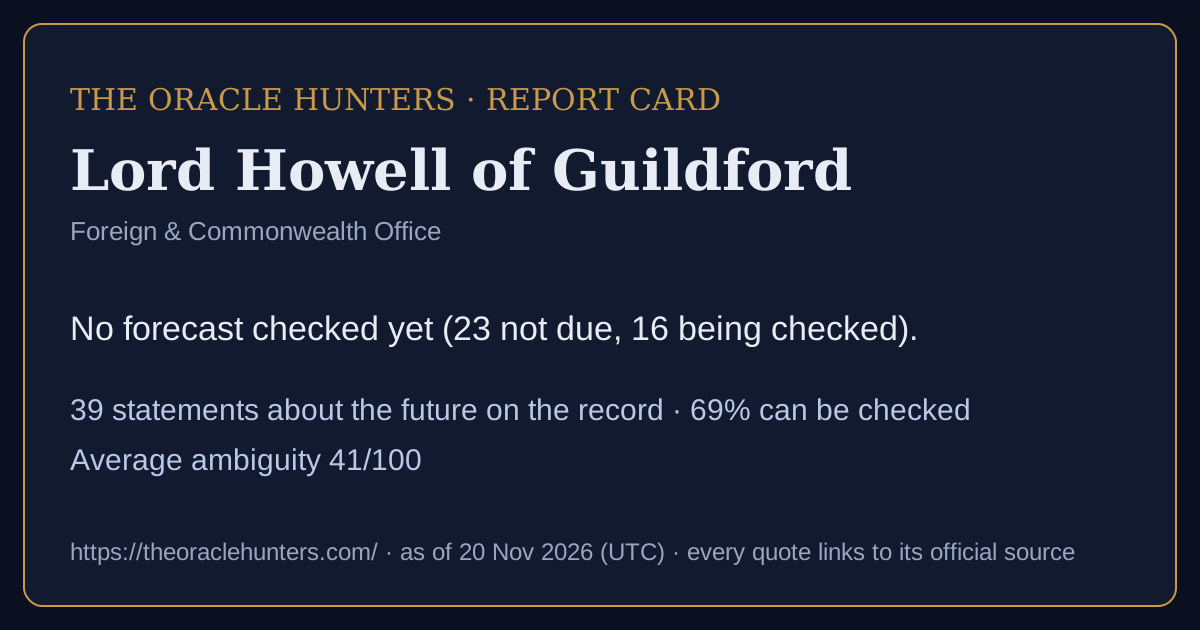
Lord Howell of Guildford
Foreign & Commonwealth Office · GBR
Track record: No forecast checked yet (23 not due, 16 being checked).
39forecasts & commitments on the record
69%can be checked as stated
41average ambiguity (0-100)
0goalpost moves recorded
0confirmed U-turns
Timeline
came true partly did not not due / being checked / too vague
Calibration score: shown after 10 checked forecasts with a stated likelihood (now 0).
How they speak about the future: based on data 32, stated on authority 5, educated guess 2.
Kinds of claim: forecast 32, commitment 3, scenario (if… then) 2, mixed claim 2. · Download this report card as a picture
In the nine words
πρόγνωσιςInference from evidence32 · 82%προαναγγελίαPublic pre-announcement3 · 8%πρόνοιαPreparing for the future2 · 5%μαντείαInspired knowledge2 · 5%
How to read this
Each box is one sentence a public figure or institution said about the future, word for word, with a link to the official text. Can be checked means it names what will happen, by when, and how likely - so it can be compared with official figures later. Too vague to check means it does not. Ambiguity (0-100) is how many different ways the sentence can be read. When the date passes, the forecast is compared with official data and marked came true, partly or did not come true. Labels judge the sentence, never the person. Full guide and glossary.On the record (39)
It seems odd to think of the Gulf as facing a domestic energy crisis, but unless GCC countries tackle their growing energy consumption, the consequences for exports could be devastating.
This is not only adding pressure to an already tight global energy market; it will also have a severe effect on government spending in the region, up to 80% of which is dependent on oil revenues.
This year GDP growth is projected to remain impressively strong, averaging almost 5%.
The figures from the International Energy Agency illustrate this well: over the next 25 years, the global demand for oil is predicted to grow by an additional 20 million barrels per day above current demand, while field depletion will remove around 47 million barrels per day from the market supply.
And incidentally, this has only been possible thanks to the success of a major project by Foster Wheeler UK to increase export capacity from the south, already up from 1.8 mbd to a potential 2.7 mbd, and on track for much higher levels by the end of next year.
This means that by 2035, we will need to find at least 67 million new barrels per day to meet global demand.
UK project and financial management of this £9.3bn project has ensured that the Park is ready on budget and well in advance of the arrival of the Olympic Flame on 27 July.
BG Group announced US$30bn investment in Brazil over the next decade, making them the largest British investor and the largest foreign investor in the Oil & Gas sector. 58 of the FTSE 100 companies are doing business in Latin America.
Generation from alternative renewables is expected to double from 8% to 16%.
Completion could translate into an additional 7% of UK GDP and 14% at the EU level.
We are working towards an EU-Japan Economic Partnership Agreement that will help to strengthen our relationship with a key partner in Asia, and will reinforce our own powerful and intimate bilateral relationship with that remarkable country which accounts for 9% of the world’s GDP.
Completing all the bilateral trade deals now on the table could add 75 billion pounds to Europe’s GDP.
The South Korea Free Trade Agreement alone is expected to save European exporters £1.35 billion annually in tariff reductions.
A single market in energy - which we want to achieve by 2014 - could add 0.8% to EU GDP, but will need vast investment in new interconnectors, transmitting electricity and gas across the European continent.
And, as attention will soon turn to the next summit in 2013, the Commonwealth family must continue to encourage Sri Lanka, as incoming host, to demonstrate its full commitment to Commonwealth values by tackling head on the findings of the Lessons Learned and Reconciliation Commission.
As we continue to move to a low carbon economy, natural gas will become increasingly prominent in the world’s energy mix and we shall need more gas to back up renewable installations such as windfarms, and the importance of Iraq’s gas reserves will rise further.
Qatari projects in UK Trade & Investment’s high value opportunities programme are worth over £12 billion to the UK.
This conference will again link with the Big 5 Construction Exhibition and this year will incorporate a Gulf Infrastructure Conference.
A major health infrastructure project in Qatar is the $2.5 billion Sidra Medical and Research Centre, which is hoped will become a regional hub for medical research in addition to top quality healthcare and training.
We will build on successful events to date, such as our High Growth Gulf Market roadshow across the UK coming up in September and our annual ‘Britain in the Region’ conference in Dubai in November.
Of most significance is the 2022 World Cup, which will require around $57billion in infrastructure development relating to stadia, rail, roads and accommodation.
It has become a global gas superpower - producing 15% of the world’s gas reserves with strong aspirations to realise the potential of green technologies - and will host the Middle East’s first World Cup in 2022.
This will present us with the opportunity to honour collectively her enormous contribution to the Commonwealth and I look forward to celebrating that with you next year.
Looking beyond Perth, next year all eyes will be back on London.
The EU has a strong record in promoting CCS; the sale of 300 million EU Emissions Trading Scheme allowances to support commercial-scale demonstration projects is the most recent example.
And the important role the EU can play in helping to secure that gas supply, as there is little doubt that Europe will remain dependent on largely imported fossil fuels for many years to come.**
As our gas production from the North Sea declines, we expect our dependence on imported gas to increase from around 30% to 50% by 2020.
Project Kuwait is a $7 billion, 25-year plan to increase Kuwait’s oil production to 900,000 barrels per day particularly, aiming to increase output at five northern oil fields–Abdali, Bahra, Ratqa, Raudhatain, and Sabriya.
The project will also process 90 million cubic feet a day of natural gas.
BP predicts that 93% of the increment in energy demand between now and 2030, will be from non-OECD countries.
As an example, Aramco’s largest ever offshore project, the $10bn Manifa oil field, scheduled to come on stream by 2015, could add 900,000 barrels a day of crude to production.
Iraq is the only country in the world with the potential for very significant increases in conventional oil production, and could become a major player in world oil markets if it is able to reach its potential.
In 2007-08, they were 13 per cent, and in 2013-14 they will be around 14.4 per cent of the total FCO budget.
Turkey’s potential is vast : the OECD predicts that Turkey will overtake India as the second fastest growing economy by 2017, and will be the second-largest economy in Europe by 2050.
As the Foreign Secretary said here last year, the maximum removal of tariff and non-tariff barriers between the EU and Japan could deliver a substantial boost to trade flows, estimated to be worth €43bn (JPY4.9 trillion) to the EU, and €54bn (JPY6.1trillion) to Japan.
Nevertheless, as fossil fuels are likely to remain an important part of the global energy mix for the medium term, the development and deployment of Carbon Capture and Storage for both coal and gas will be critical to reducing CO2 emissions from power stations by up to 90%.
In the UK we have established a £500 million fund for smart grids trials, are supporting eight pilot projects for electric vehicle infrastructure, and aim to install smart meters in every household in the UK by 2020.
The position Japan takes towards a low carbon economy has the power to change markets and develop the breakthrough technologies that will be needed worldwide beyond 2020.
As our gas production from the North Sea declines, we expect our dependence on imported gas to increase from around 30% now to 50% by 2020.
Also said - not checkable as stated (12 newest)
Remarks about the future with no date, figure or likelihood that could be checked. They are kept on the record and shown here, but not scored.
As we impose more stringent constraints on our carbon emissions, we will need to invest in improving energy efficiency.
As new technologies develop in the West and we move towards much greater energy efficiency, new unconventional gas sources, nuclear energy and to renewable - hopefully commercial - we will become less dependent on Middle Eastern crude imports.
But we should accept too that it is an evolving relationship that has changed over time, and that will continue to change as the region develops and as global energy trends shift.
Over the next twenty years, it could be that that we will see the country develop into one of the key global players in the energy market.
We know that Iraq will be part of our future, and we must make sure that British industry is part of theirs.
We all know that global oil demand, driven by the growing of markets in China and the East, will continue to expand for decades.
So my government is aware of the opportunities and will do what it can to support trade and investment between our country and those of Latin America.
It is how we shall seek to secure the long-term health of our economy, the long-term resilience of the international system and connections to face the long-term challenges posed by the 21st century.
Of course, we will be keen to share our experience of hosting the Olympics with Brazil, who will succeed us as hosts and who are also holding the next World Cup.
We talk boldly about growth and prosperity but it will indeed be a struggle to maintain our current level of prosperity in the new conditions that we must face.
Their research found that when two trading partners were Commonwealth members the value of trade was likely to be a third to a half more than when one or both trade partners was non-Commonwealth.
As I said, Perth could and should be a defining moment for the Commonwealth.