Lord Henley
Department for Environment, Food & Rural Affairs · GBR
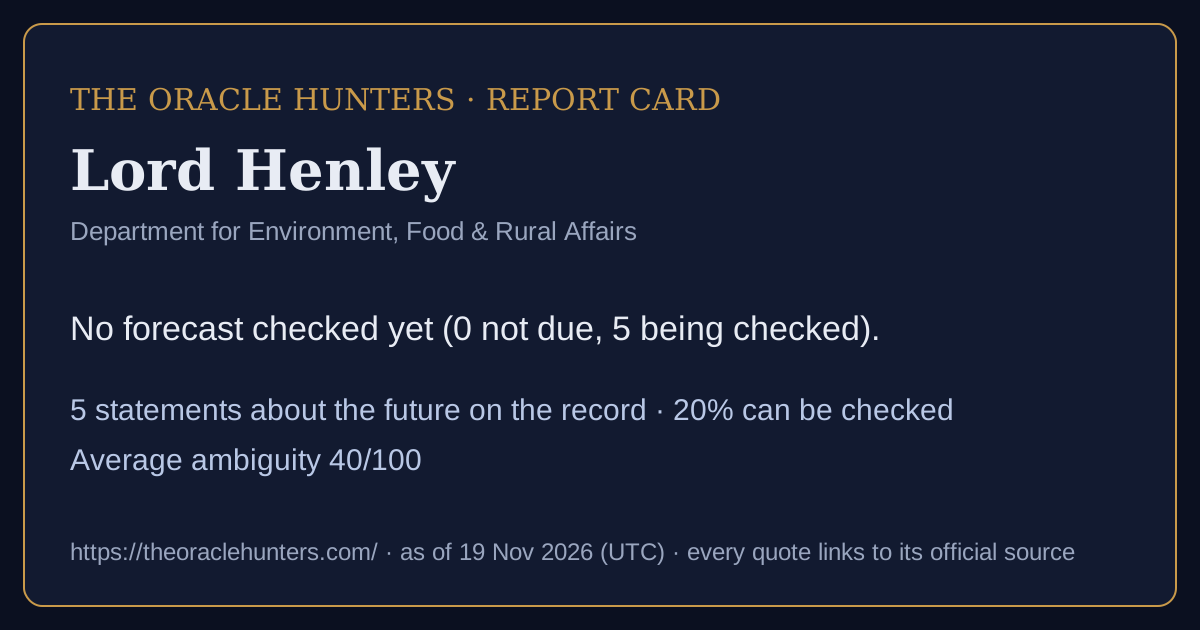
Track record: No forecast checked yet (0 not due, 5 being checked).
5forecasts & commitments on the record
20%can be checked as stated
40average ambiguity (0-100)
0goalpost moves recorded
0confirmed U-turns
Timeline
came true partly did not not due / being checked / too vague
Calibration score: shown after 10 checked forecasts with a stated likelihood (now 0).
How they speak about the future: stated on authority 3, based on data 2.
Kinds of claim: forecast 4, mixed claim 1. · Download this report card as a picture
In the nine words
How to read this
Each box is one sentence a public figure or institution said about the future, word for word, with a link to the official text. Can be checked means it names what will happen, by when, and how likely - so it can be compared with official figures later. Too vague to check means it does not. Ambiguity (0-100) is how many different ways the sentence can be read. When the date passes, the forecast is compared with official data and marked came true, partly or did not come true. Labels judge the sentence, never the person. Full guide and glossary.On the record (5)
We estimate that by 2020 these standards will be saving around seven million metric tonnes of CO2 each year; and delivering around £850 million of savings, mostly on consumers’ and business’ energy bills.
All of these things will inform the first ever UK-wide assessment of present and future climate risks - to be published in January next year.
Later this year, we will publish white papers on the Natural Environment and Water, as well as a new England Biodiversity Strategy - key planks in our drive to prepare the country for climate change.
And last week the European Environment Agency published the facts and figures which will provide the baseline for assessing progress in the EU between 2011 and 2020.
I know many of you in the RSPB and other organisations represented here today are contributing to the Assessment - I’m grateful for your input and support - I understand the final report will be ready for publication in the Spring next year.
Also said - not checkable as stated (12 newest)
Remarks about the future with no date, figure or likelihood that could be checked. They are kept on the record and shown here, but not scored.
If as an international community we are going to reduce carbon emissions through these means, we need to move towards international convergence.
We need to get clear about how best we can influence behaviour, where efforts will be most productive.
The International Energy Agency says that energy efficiency improvements will make the single largest contribution to achieving this goal.
We need to reduce global energy-related C02 emissions to half their current levels by 2050.
I would hope that, by the end of this conference, we will be much closer to a shared understanding of the successes and challenges ahead.
The International Energy Agency has projected that energy efficiency improvements will make the single largest contribution to the goal of halving global energy-related CO2 emissions by 2050.
The UK Government will push for the EU to demonstrate leadership in tackling international climate change.
Businesses - whether they be manufacturers, retailers or importers - need to be sure they are competing in a fair market and that others are not gaining an advantage by selling cheaper, sub-standard products.
We’re already working to get a better understanding of this business need, and how we might build on the work of the UK Climate Impacts Project.
Because, one way or another, climate change is going to affect every organisation, every business, every community and every individual in this country.
Here amongst such a learned audience, I probably don’t need to say, but the UK’s climate is changing and is likely to do so for the foreseeable future.
Once the Climate Change Risk Assessment has identified the key climate risks to the UK, we will conduct an economic analysis and set in place a programme of action to address them.