Lord Freud
Department for Work and Pensions · GBR
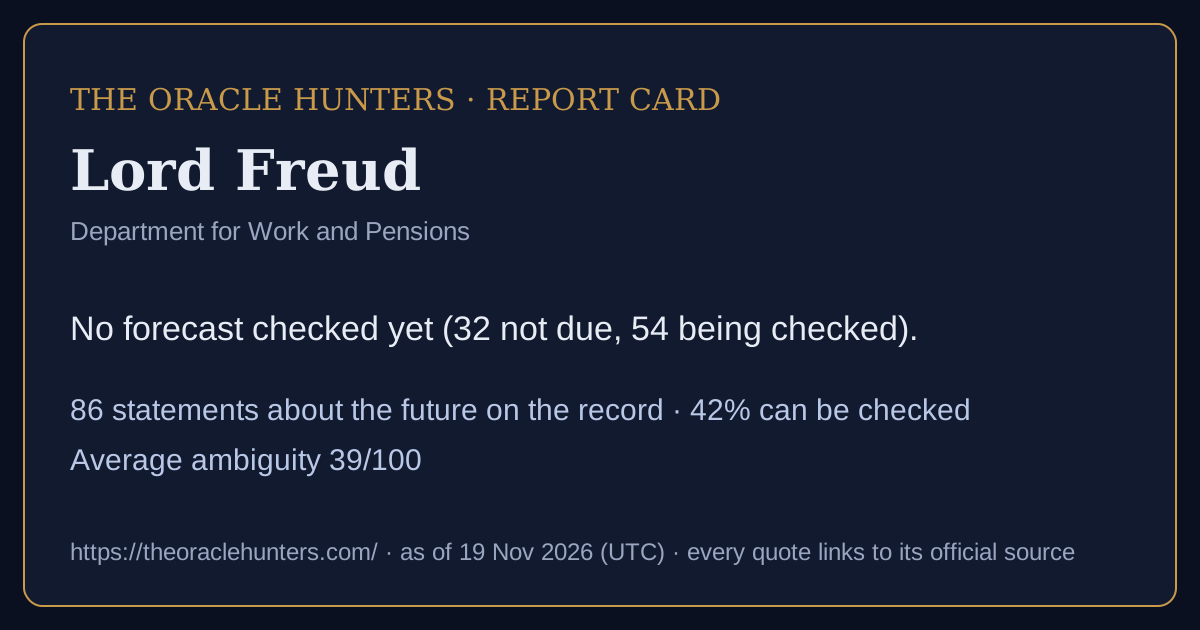
Track record: No forecast checked yet (32 not due, 54 being checked).
86forecasts & commitments on the record
42%can be checked as stated
39average ambiguity (0-100)
0goalpost moves recorded
0confirmed U-turns
Timeline
came true partly did not not due / being checked / too vague
Calibration score: shown after 10 checked forecasts with a stated likelihood (now 0).
How they speak about the future: based on data 64, stated on authority 18, educated guess 4.
Kinds of claim: forecast 60, mixed claim 19, commitment 5, scenario (if… then) 2. · Download this report card as a picture
In the nine words
πρόγνωσιςInference from evidence63 · 73%μαντείαInspired knowledge13 · 15%προαναγγελίαPublic pre-announcement5 · 6%πρόνοιαPreparing for the future2 · 2%εἰκασίαConjecture2 · 2%πρόβλεψιςSeeing the signs1 · 1%
How to read this
Each box is one sentence a public figure or institution said about the future, word for word, with a link to the official text. Can be checked means it names what will happen, by when, and how likely - so it can be compared with official figures later. Too vague to check means it does not. Ambiguity (0-100) is how many different ways the sentence can be read. When the date passes, the forecast is compared with official data and marked came true, partly or did not come true. Labels judge the sentence, never the person. Full guide and glossary.On the record (86)
And these will take effect later this year.
Meaning that virtually all new claims will be for Universal Credit with the last new claims to legacy benefits being accepted during 2017.
Our current planning assumption is that Universal Credit will be fully available in every part of Great Britain during 2016.
Beginning next month Universal Credit will begin to expand across Great Britain in a tranche based approached, mirroring the successful implementation methods that we used to safely and securely roll out Universal Credit in the north west of England.
However I would like to reassure you that the national expansion of Universal Credit over the next year will not directly affect the £304 million agreed in the 2014 Autumn Statement to administer Housing Benefit during the 2015 to 2016 financial year.
Should there be no change in the labour market outlook or the pace at which claims are migrated, the current business case assumes, for planning purposes, that the bulk of this exercise will be complete by 2019.
For those of you with branches or bases in the north-west of England, you will be particularly interested to know that Universal Credit will start to expand to cover more of the north-west by the end of this year.
The vast majority of remaining claimants will then move onto Universal Credit during 2016 and 2017.
Current plans are that during 2016 all new benefit claims will be for Universal Credit instead of legacy benefits such as Jobseeker’s Allowance or Housing Benefit.
I’d like to tell you more about our long term plans for Universal Credit: Over the next 2 years Universal Credit will expand in scope and scale.
Not only, as many of you will have seen last week, have employment levels hit a record high, rising to 30.2 million.
This sets out how we will work together over the course of the next year to test exactly what works in the delivery of Local Support Services.
From there we will move existing claimants of the current benefits over to Universal Credit, and we expect the vast majority of these to be on the new benefit by 2016 and 2017.
The Single Fraud Investigation Service will be introduced as a single organisation within the Fraud and Error Services Team in DWP with implementation taking place in a phased approach from October 2014 – March 2016.
78% of those getting monthly payments were confident they could budget over the month
Our current planning assumption is that the Universal Credit service will be fully available in each part of Great Britain during 2016, having closed down new claims to the benefits it replaced – including working age Housing Benefit; with the majority of the remaining legacy caseload moving to Universal Credit during 2016 and 2017.
We now have live service in 7 areas across the country, and this will grow to 10 areas by spring 2014, giving Universal Credit a national footprint.
Clearly last week’s announcement of our rollout plans will mean we’ll need to take a close look, with LGA colleagues, at 2015/16 funding.
I would like to reassure you again that we will maintain the level of funding required to administer housing benefit in 2014/15.
As you will all be aware we have also introduced the removal of the spare room subsidy this year.
Figures from May 2013 show that the average rent collection rate is 94%.
We estimate, for instance, that 80% of tenants in the Social Rented Sector currently receiving their Jobseekers Allowance and Income Support are expected to pay their rent on time when they move to UC.
This low level of debt will be mitigated even further by improved arrangements for the 10% of tenants who receive Housing Benefit for only part of their rent.
In May I announced the extension of the Demonstration Projects for another six months, to the end of the year.
And that level of arrears will be mitigated by the fact that we will operate an accelerated recovery system under Universal Credit.
I think it’s important to remind ourselves that Universal Credit will roll out over four years to 2017.
But it is important to recognise that, should this be replicated in the national roll-out of Universal Credit, it will not mean that 7% of total rental income is at risk.
Claimants will know that their Universal Credit – and I do foresee people having very personal relationship with the state support they receive – that their Universal Credit will be with them if they lose a job, when they work and when they climb up the income ladder.
The consultation ended on the 15th March and I expect my colleagues in HMT to publish their response later this year.
Early results from the project show around 90% of rent payments are being made.
We will continue to test different rent arrears “trigger” levels so if a tenant falls behind on their rent, payment will switch back direct to the landlord and additional support will be offered to the tenant.
We will pay Universal Credit monthly to reflect the fact that 75% of people in work are paid that way.
In steady-state, we expect there to be 11 million individuals on Universal Credit, of which 5 million are expected to be in work.
**…. **and between 1 and 2.5 million extra hours will be worked by those already in employment.
2.8 million households will gain under Universal Credit - of these 1.3 million households will see their benefit increase by more than £25 per week.
All new unemployed claimants will be making claims to Universal Credit by April 2014.
There will be an early roll out of Universal Credit (Pathfinder) in April 2013 in the North West to test the new payment system with local authorities, employers and claimants in a live environment.
Without our reforms this will increase to £25 billion by 2014/15.
We will roll-out Universal Credit nationally from October 2013.
So to conclude, 2013 will see major changes come in that will affect councils, residents and service users.
2013 will see the start of major reforms that will affect many of your residents
It was critical that we found a solution ahead of the forecast peak of deaths in 2015 and we have achieved that.
It will launch in April 2013, working with four local authorities - Tameside, Wigan, Oldham and Warrington.
An additional £300 million has been invested into childcare support under Universal Credit, making 80,000 more families eligible for this help, which will help people make the journey from being inactive into work.
We will pay Universal Credit monthly to reflect the fact that 75 per cent of people in work are paid that way.
We will spend £2bn more on benefits under Universal credit than we do now.
I know from my visits to Lewisham and Sevenoaks Councils earlier this year the vital work that local authorities already offer many of those who will be Universal Credit claimants.
And we will develop a network of all local authorities who are interested in working with us, so we can keep them plugged into developments as we move towards Universal Credit going live in October 2013.
From the end of 2015 and up to 2017, the final households will be transferring across.
The changes to the social sector size criteria are coming in April 2013, in a little under nine months, and many of you will be affected.
Showing the newest 50 - the ledger has all 86.
Also said - not checkable as stated (12 newest)
Remarks about the future with no date, figure or likelihood that could be checked. They are kept on the record and shown here, but not scored.
While the work the PSF and the government have been doing has focused on improvements that could and should be made, there is still a lot of work to be done – which I am sure the forum would be the first to acknowledge.
To take an example, when insurance companies have to pay back overpaid health charges, currently they have to make a single payment.
Any changes that are made to the payments system must ensure that security and privacy are paramount.
For many people who are moving to Universal Credit, the transition will be straightforward.
However, we know that for some people, managing their Universal Credit claim online and budgeting their award effectively may be difficult.
To be successful in pushing employment up and unemployment down, we must become better at supporting the most vulnerable and excluded in society in to work.
Early evidence has shown positive outcomes and we will continue to review this over the coming months.
Building on this review, we will work with you to put in place appropriate protections.
That is why my department – jointly with the Department for Communities and Local Government, who you will hear from later today – commissioned a supported housing evidence review, nearly 2 years ago.
We have worked with social landlords to allow them to identify tenants who would be unlikely to pay their rent when they started receiving Universal Credit.
These landlords worked with their tenants to provide on-going support, so that in time, their tenants could pay their rent independently.
The successes we have had and those that we will have would not be possible without your support.