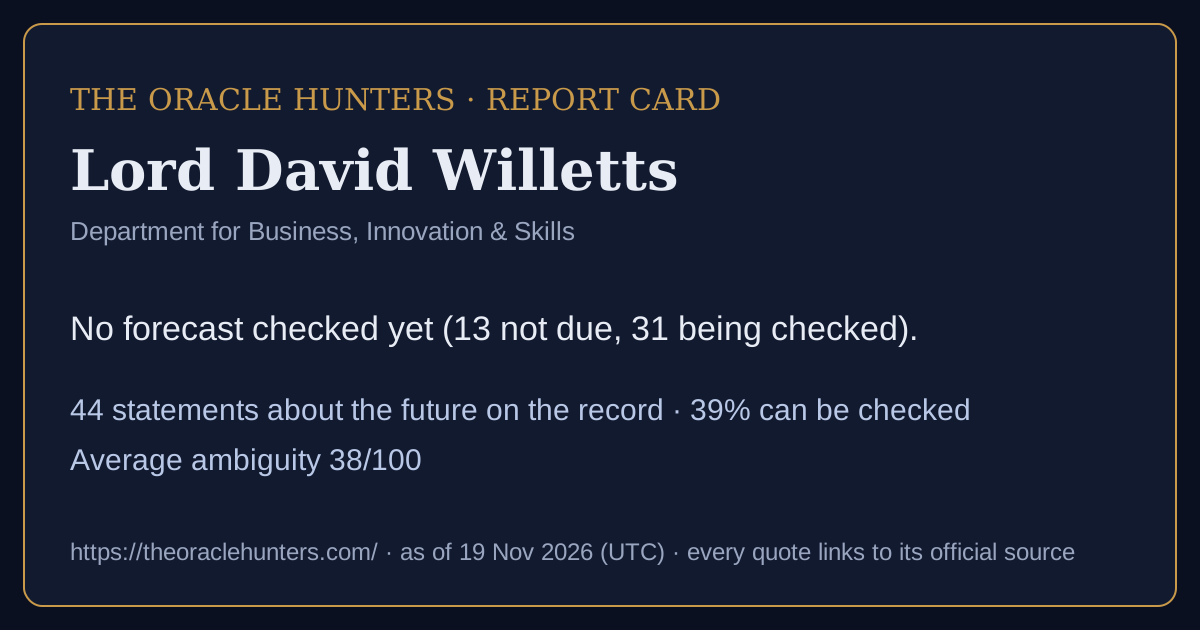
Lord David Willetts
Department for Business, Innovation & Skills · GBR
Track record: No forecast checked yet (13 not due, 31 being checked).
44forecasts & commitments on the record
39%can be checked as stated
38average ambiguity (0-100)
0goalpost moves recorded
0confirmed U-turns
Timeline
came true partly did not not due / being checked / too vague
Calibration score: shown after 10 checked forecasts with a stated likelihood (now 0).
How they speak about the future: based on data 36, stated on authority 8.
Kinds of claim: forecast 29, mixed claim 8, commitment 6, scenario (if… then) 1. · Download this report card as a picture
In the nine words
πρόγνωσιςInference from evidence31 · 70%προαναγγελίαPublic pre-announcement6 · 14%μαντείαInspired knowledge6 · 14%πρόνοιαPreparing for the future1 · 2%
How to read this
Each box is one sentence a public figure or institution said about the future, word for word, with a link to the official text. Can be checked means it names what will happen, by when, and how likely - so it can be compared with official figures later. Too vague to check means it does not. Ambiguity (0-100) is how many different ways the sentence can be read. When the date passes, the forecast is compared with official data and marked came true, partly or did not come true. Labels judge the sentence, never the person. Full guide and glossary.On the record (44)
By 2040 it is predicted that almost none of Europe’s new cars will be powered solely by a traditional engine.
Seven of these centres are now up and running, and 2 new ones will kick off next year.
But next we will be launching an Energy Catalyst to accelerate innovation in that field.
We will of course be looking to improve even further on the already impressively strong levels of university participation in the programme but more importantly we are working hard to raise levels of business participation significantly above the relatively disappointing levels seen in FP7.
And with an expectation that consumers will want 2 billion handsets a year by 2016 they are projecting potential revenues of $2 billion.
I am delighted to announce today that the government will be providing £18.4 million investment in a new network of employers and tech professionals who have come together to create the skills needed to accelerate the growth of our digital economy.
The 30,000 additional places in 2014 to 2015 will be fully funded at the same rate as existing students, with the same top-up from HEFCE for more expensive subjects such as chemistry or engineering.
But further to this, the Chancellor announced in his Autumn Statement that starting in 2015 to 2016 we would invest an extra £185 million over 4 years to support the teaching of these very expensive courses, funding which will also apply to the extra students.
Then in 2015 to 2016 we will sweep away student number controls.
The government will also be investing £50 million through the National Scholarship Programme in 2014 to 2015 and HEFCE will be allocating £366 million through the Student Opportunity Fund.
It could detect airport radars on planets, if they existed, within 50 light years or 470 trillion kilometres.
When Tim takes off in November 2015, he will be the first British astronaut in space more than 20 years and the first British ESA astronaut ever selected for a mission to the space station.
Next year the Royal Society will celebrate the 350th anniversary of the world’s oldest continuously published scientific journal – the one that brought us peer review and the preoccupation with precedence in discovery that drives much of the scientific race to this day.
You see that in the economic growth figures, the 1.3 million new jobs, the 25 million people who will pay less in income tax, the 400,000 new businesses now operating in our country and in the record number of our young people who have taken up apprenticeships to develop new skills that will help to secure their future.
The contribution to ESS could be around £165 million up to 2020 to 2021.
Next month we will be publishing a consultation document with ideas on how best we should spend this unprecedented amount.
And the UK has a firm ambition to have a commercial spaceport in operation by 2018 to take advantage of the exciting opportunities that will soon open up.
I am delighted that downstream applications will be supported under Horizon 2020, which I will be launching this Friday in the UK.
From this year, Galileo will provide early services, giving accurate local information anywhere on earth.
And we will be celebrating the 50th anniversary of its forerunners this year.
This will be a valuable input to the RCUK review late next year, by which time we are expecting publishers to have developed more imaginative and transparent ways of reassuring research institutions that their pricing is competitive and based on sustainable business models.
RCUK has made clear that the transition will probably take around 5 years, and they will review impact next year.
They will invest £17 million in over 100 publication funds in 2013 to 2014 and a further £20 million in 2014 to 2015.
Construction of the first phase will be completed by early 2014.
At the start of next month the Centre for Longitudinal Studies will launch the first findings from the Age 42 Survey of the 1970 British Cohort Study.
Ukube1, our first national cubesat that will enable us to test cutting edge technologies in space at relatively low cost, passed its flight review in June, and is due to launch later this year.
Rosetta was launched in March 2004, and will be waking up from hibernation in January next year.
After lunch today we will be discussing the Innovation and Growth Strategy, which was of course a shared commitment between government, industry and academia to propel us into a leading position in the global space race.
That is why the Chancellor announced last month that the Government will invest in the development of the Synergetic Air-Breating Rocket Engine (SABRE) - an engine which could transform how we think about both space and aviation. £60 million has been committed to begin building the SABRE prototype, to make the technology available to the market and ultimately, to ensure …
We have a clear target of capturing ten per cent of a world space market likely to be worth £400 billion by 2030.
We will have an excellent example of that next year with the first soft landing of a space vehicle on an asteroid.
The rest of this year will bring to the fore the name of another great public servant – Lionel Robbins.
They are up from £550 million last year to £740 million this year and are expected to reach £920 million in 2014-15.
We want greater freedoms and flexibilities for all institutions, not just those with high-tariff students. 2014-15 will be a step towards that.
Through the UK Research Partnership Investment Fund, we are securing over £1bn investment in R&D collaborations between universities, businesses and charities – enhancing university research infrastructure and building strategic partnerships between universities and the private sector which will help support long-term economic growth. 14 projects were announced in the Autumn - with more to come later this year.
For 2014/15, we will continue to increase student choice and to enable popular institutions to expand.
The government’s investment of £600 million through the Autumn Statement 2012 in Research Council infrastructure, and the facilities for applied research and development (R&D) will support the development of innovative technologies and strengthen the UK‘s competitive advantage in areas such as big data and energy efficient computing, synthetic biology and advanced materials.
To support this EPSRC is making a £350 million investment in Centres for Doctoral Training (CDTs) to develop the talented people that will create future growth and a more sustainable future.
This will be invested over the next two years in key areas such as: bioinformatics and environmental monitoring.
In addition the government will invest an extra £30 million to create dedicated R&D facilities to develop and test new grid scale storage technologies.
Today I can announce that as a result of the Autumn Statement the Government will be investing an extra £25 million in the further implementation of the technology vision through Phase-2 of the National Space Technology Programme.
For this reason we will be investing an extra £50 million in these over the next two years.
It has been a condition of new NIHR contracts since December 2011, and performance against this will affect further funding as of April 2013.
From April 2013, the Patent Box will come into force – offering a 10 per cent corporation tax rate on profits attributable to patents.
Also said - not checkable as stated (12 newest)
Remarks about the future with no date, figure or likelihood that could be checked. They are kept on the record and shown here, but not scored.
There has been some comment in the past fortnight about the latest revisions to our estimate of the portion of student loans that we predict we will have to write-off – the so-called resource accounting and budgeting (RAB) charge.
It will run an advisory hub pulling together evidence on what is working, and highlighting the key areas where universities, businesses and local enterprise partnerships should be working together.
Our computers may not be the most powerful, but we have smart software which reduces the number of calculations you need to reach any given result and that makes them very energy efficient.
Regenerative medicine will open up new medical techniques for repairing and replacing damaged human tissue.
This and other technologies will enable the UK to gain from the global transition to new energy sources.
Without this sort of joined up thinking we will fail to exploit fully 1 of Europe’s most important recent investments in space.
Copernicus, which will allow huge leaps forward in climate change modelling, is making good progress on both the legal and technical fronts.
Where the publisher is not offering Gold open access, we will not support articles with an embargo of longer than 6 months for STEM subjects and 12 months for the humanities.
But if the tendency is to go for Green instead of Gold in many countries as the superficially easy option, I think we will come to regret it.
I anticipate that we will see increased competition in the research publications market which will drive costs down.
If we are to meet the 20:20 challenge laid down by the Biotechnology and Biological Sciences Research Council and Rothamsted; producing 20 tonnes of wheat per hectare in 20 years’ time (now less than 20 years), we will have to use technology.
UK researchers have used the Diamond Light Source to develop a new vaccine which could be used in the UK and elsewhere, preventing costly outbreaks.