Lord Bourne of Aberystwyth
Department of Energy & Climate Change · GBR
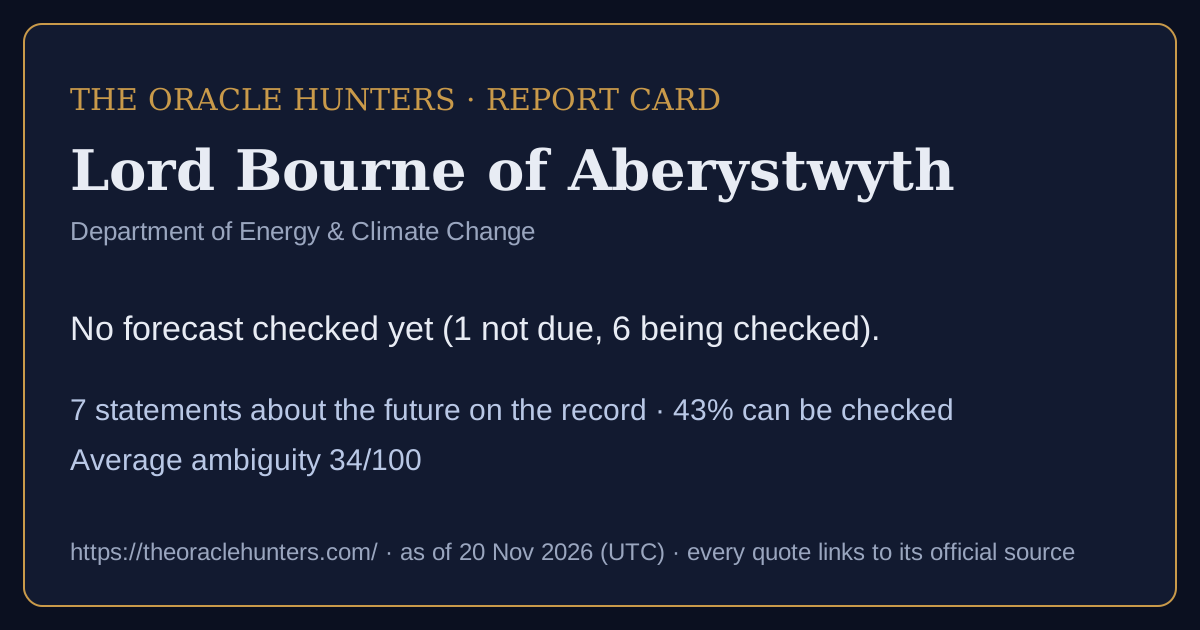
Track record: No forecast checked yet (1 not due, 6 being checked).
7forecasts & commitments on the record
43%can be checked as stated
34average ambiguity (0-100)
0goalpost moves recorded
0confirmed U-turns
Timeline
came true partly did not not due / being checked / too vague
Calibration score: shown after 10 checked forecasts with a stated likelihood (now 0).
How they speak about the future: based on data 6, stated on authority 1.
Kinds of claim: forecast 6, commitment 1. · Download this report card as a picture
In the nine words
How to read this
Each box is one sentence a public figure or institution said about the future, word for word, with a link to the official text. Can be checked means it names what will happen, by when, and how likely - so it can be compared with official figures later. Too vague to check means it does not. Ambiguity (0-100) is how many different ways the sentence can be read. When the date passes, the forecast is compared with official data and marked came true, partly or did not come true. Labels judge the sentence, never the person. Full guide and glossary.On the record (7)
On current plans, we expect to see 10GW of offshore wind installed by 2020.
These products will replace some grants, and will be worth one hundred and sixty five million pounds by 2019-20 – across a range of innovation activities, including energy.
Doubling our investment means the UK public sector as a whole will spend over four hundred million pounds in 2020/2021 on clean energy R&D.
We project our energy efficiency policies will reduce final energy demand by 145 terawatt-hours and net imports by around 20% in 2020.
The global investment community has also been waking up to the opportunities and benefits; worldwide energy efficiency investment in buildings is projected to increase to over $125 billion by 2020.
2016 will be a crucial year for the Programme.
And we will strengthen devolution by implementing our St David’s Day commitments to devolve more powers to the Assembly in areas such as transport, energy and elections, as well as powers that will enable the Assembly to manage its own affairs.
Also said - not checkable as stated (12 newest)
Remarks about the future with no date, figure or likelihood that could be checked. They are kept on the record and shown here, but not scored.
A deal by which each and every one of us will take action to reduce the risks and impacts of dangerous climate change, take action to increase our ability to adapt to the impacts of climate change and foster climate resilience, and take action to mobilise all finance flows towards sustainable growth.
Spending on energy research and development needs to be better targeted; and we need to be tough on how we spend it – on areas that will help the UK.
We will ensure that our clean energy technology priorities fit with our wider Departmental goals on decarbonisation, smart systems, heat in homes and in industry, and energy efficiency.
Modern day innovators need to make their own ground-breaking discoveries to tackle climate change, and in my Ministerial role I have already seen impressive progress, including the ‘SPECIFIC’ project near Port Talbot.
Despite this good progress, though, there is more to do if we are going to meet the United Kingdom’s climate change targets, manage risks around security of supply and maintain our competitive advantage.
We will continue to consult and to work with the business community - and with organisations such as the Energy Managers Association - to ensure that the Government’s energy efficiency policy delivers effective results for businesses and for the economy as well as for the planet.
How we will help businesses to play their part.
For example, Government is working with the most energy intensive industries, such as the iron and steel, glass and chemical sectors, to put in place 2050 Action Plans by the end of next year with the aim of improving energy efficiency and reducing emissions while maintaining competitiveness.
Smart Energy GB are key to this journey, and will need to reach out to the diverse British public – including the most vulnerable in society, and the microbusinesses that make a vital contribution to our economy.
No longer will householders or suppliers need to read their meters.
The rollout will not happen overnight, so we need to ensure continuity and momentum over an extended period.
Updating the nation’s energy infrastructure so that it is fit for the challenges of the 21st century, and working at pace to deliver by the end of 2020, is right for industry, the economy, and hard working families and businesses across Britain.