Lord Benyon
Department for Environment, Food & Rural Affairs · GBR
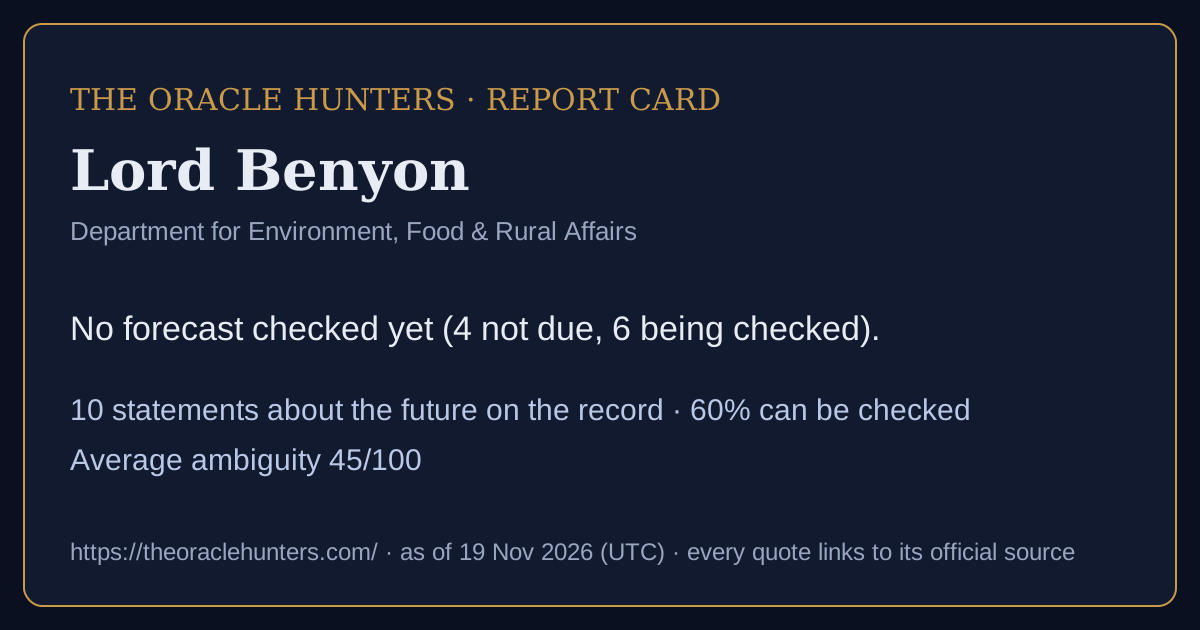
Track record: No forecast checked yet (4 not due, 6 being checked).
10forecasts & commitments on the record
60%can be checked as stated
45average ambiguity (0-100)
0goalpost moves recorded
0confirmed U-turns
Timeline
came true partly did not not due / being checked / too vague
Calibration score: shown after 10 checked forecasts with a stated likelihood (now 0).
How they speak about the future: based on data 6, stated on authority 4.
Kinds of claim: forecast 7, mixed claim 2, commitment 1. · Download this report card as a picture
In the nine words
πρόγνωσιςInference from evidence6 · 60%μαντείαInspired knowledge3 · 30%προαναγγελίαPublic pre-announcement1 · 10%
How to read this
Each box is one sentence a public figure or institution said about the future, word for word, with a link to the official text. Can be checked means it names what will happen, by when, and how likely - so it can be compared with official figures later. Too vague to check means it does not. Ambiguity (0-100) is how many different ways the sentence can be read. When the date passes, the forecast is compared with official data and marked came true, partly or did not come true. Labels judge the sentence, never the person. Full guide and glossary.On the record (10)
This was an important step forward for the reform process, and bodes well that the final package we will negotiate this year will include the radical reforms we all agree are needed.
Meanwhile, under worst case climate change scenarios, water demand by consumers could increase by 55%, industrial demand by 10% and agricultural demand by 180%, the last meaning that significantly more irrigation could be required.
Under climate change scenarios, summer and autumn river flows could reduce by 50% or more, while average flows could reduce by up to 15%.
Above all its important that together we get all of this right, so we will consult, listen and act and put the water sector on a strong footing for generations to come.
We will also be consulting on issues raised in Anna Walker’s review later this year - on metering and affordability and the relationship to water efficiency.
Looking at the current timelines it looks like the new approval system could be in place from October next year at the earliest - but it might be better to delay this, for example until April 2012.
These in turn will feed into your local strategies next year.
In May, the New Scientist reported research indicating that nearshore waves have 80 to 90% of the usable energy found in offshore waves.
Which is why we have confirmed the pledges, made at the Copenhagen climate change conference, of £1.5bn from the UK for fast start climate finance through to 2012, of which £300m will be for forests.
From 2012 we estimate the additional future costs of meeting WFD will be £30-50 million each year.
Also said - not checkable as stated (12 newest)
Remarks about the future with no date, figure or likelihood that could be checked. They are kept on the record and shown here, but not scored.
I entered this year’s negotiation clear in my mind that decisions on quotas, or days spent at sea, need to be based on three clear principles: following scientific advice; sustainability; and the need for continued discard reduction.
But in dealing with the immediate issues we must not lose sight of the longer term challenges - in particular how we respond to the increasing demands that climate change and population growth will put on our water supplies in the future.
We will reinforce this message about the importance of options to reduce demand over the first five years and beyond in our strategic policy statement to Ofwat.
We have to manage our own water use effectively now and to instil the appropriate behaviour change that will help us to manage the future pressures on water resources.
Everyone, businesses and householders, needs to be aware that there will be less water per person in the future.
In particular, we will be looking to companies to reflect the longer term supply challenges through to 2050; to more accurately reflect the cost of abstraction to the environment; to set ambitious goals for reducing average water consumption and support them with robust plans for delivery.
Where companies are in a designated water stressed area, or where they have demand that is above the national average, we will expect companies to produce a plan that will deliver overall demand reduction in the first five years.
Research shows that people in the most disadvantaged groups in society are the least likely to travel to access the natural environment - so there is even more need to make sure we improve the quality of the environment where they are.
If we are to achieve our ambitions for the natural environment and growth then green infrastructure needs to be an essential part of how local authorities plan for the future.
I am delighted to announce that the Government will continue to fund the Unit so that it can continue to build on the good work that it has done.
The figure we should be shouting about is the £85 billion has been invested in the industry since privatisation and over £21 billion will be invested under Price Review 09.
We will need to engage with customers in a more sophisticated manner so they understand the need for demand management in the face of climate change.