Loi M Bakani
Bank of Papua New Guinea
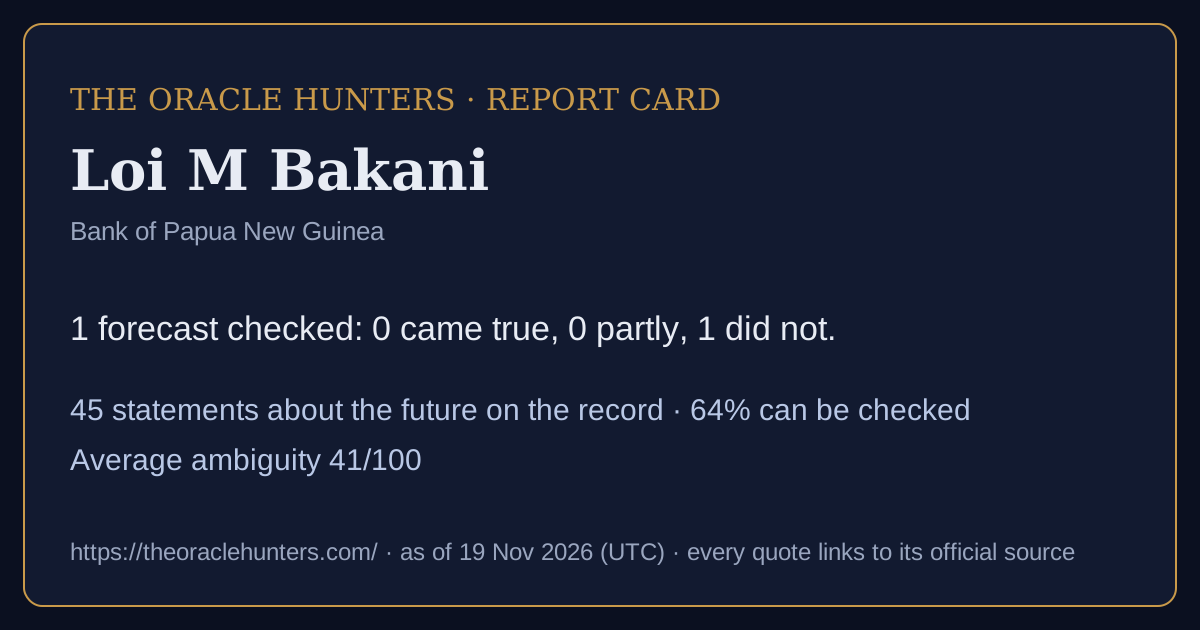
Track record: 1 forecast checked: 0 came true, 0 partly, 1 did not.
45forecasts & commitments on the record
64%can be checked as stated
41average ambiguity (0-100)
0goalpost moves recorded
0confirmed U-turns
Timeline
came true partly did not not due / being checked / too vague
Calibration score: shown after 10 checked forecasts with a stated likelihood (now 1).
How they speak about the future: based on data 41, educated guess 2, stated on authority 2.
Kinds of claim: forecast 38, mixed claim 3, scenario (if… then) 2, commitment 2. · Download this report card as a picture
In the nine words
πρόγνωσιςInference from evidence38 · 84%πρόνοιαPreparing for the future2 · 4%εἰκασίαConjecture2 · 4%μαντείαInspired knowledge1 · 2%φρόνησιςPractical wisdom1 · 2%προαναγγελίαPublic pre-announcement1 · 2%
How to read this
Each box is one sentence a public figure or institution said about the future, word for word, with a link to the official text. Can be checked means it names what will happen, by when, and how likely - so it can be compared with official figures later. Too vague to check means it does not. Ambiguity (0-100) is how many different ways the sentence can be read. When the date passes, the forecast is compared with official data and marked came true, partly or did not come true. Labels judge the sentence, never the person. Full guide and glossary.Checked
For the medium term, headline inflation is projected to be around 7.5 percent in 2013 and 7.0 percent in 2014.
Did not come true. Said: inflation around 7.5% in 2013. Official figure for Papua New Guinea: 5.0% (World Bank open data). Missed. Off by 2.5 points. official data · checked 14 Nov 2026 · automatic check against official data (rules v3)
On the record (45)
For this Year, I will be making some announcements towards the end of the year after consultations with HR and the Respective Assistant Governors.
The Bank will issue a special and limited K100 banknote to commemorate the 2018 APEC Summit to be hosted by the Government of Papua New Guinea.
Going forward, and into the new year 2018, current challenges to monetary policy will remain and new opportunities arise with the country hosting the APEC Summit in 2018.
By the end of September 2016, PFIP had reached an impressive cumulative total of over 1.1 million clients across the Pacific, already surpassing the programme's 2019 goal of 1 million clients.
In Papua New Guinea, PFIP has been supporting the Bank of PNG and the Centre for Excellence in Financial Inclusion through support for development and implementation of the country's National Financial Inclusion Strategic Plans, the second of which (spanning from 2016-2020), you may be aware, was launched recently in December 2016.
The construction of the US$19 billion PNG LNG project has transformed the PNG economy, with spin-off benefits into other sectors and place PNG on the world map as a suitable investment destination that can host world-class multi-billion dollar projects.
However, if the regulation is streamlined to a model conducive for credit unions to grow, regulation of the sector will be beneficial in the long term.
Given the very high economic growth, as measured by the real increase in Gross Domestic Product (GDP) of 9.5% in the same period, the inflation outcome is at the low end of our projections and expectations.
If things will materialize as planned, then GDP growth will be substantially higher from the 5.2% projected, and closer to the five year average growth of 9%.
With the commencement of the operation of the LNG project in 2014, Papua New Guinea has a huge potential to continue and grow at high rates in the future.
This projection which, in my view is on the low side, means that in the five years 2009 to 2013 average GDP growth will be 9%.
At the present the Bank's projections show that inflation in 2013 will be around 5.5%.
Based on the fact that the PNG LNG Project construction is scaling down in 2013, and will end in early 2014, the Government decided to present an expansionary budget with a substantial deficit of K2.5 billion or around 7.1% of GDP.
On the second day of this workshop, all participants will be assigned to specific Working Groups to deliberate on key topics and reach consensus on 3 priority actions each to be accomplished from 2014 to 2015.
CEFI's efforts will be a major step in achieving the objectives of Vision 2050, the Medium Term Development Plan 2012-2017 and the government's policy focus on service delivery to the rural population;
Real GDP growth is expected to remain buoyant in 2012 of around 8.0 percent, supported by strong domestic demand, as construction activity for the PNG Liquefied Natural Gas (LNG) project peaks, production at the Ramu Nickel/Cobalt mine commences, other private sector investments come on line, and high public and private spending ensues in the lead up to the national elections.
By the end of 2012, the gross foreign exchange reserves are projected to be around US$5,087 (K10,598) million, sufficient for 7.6 months of total and 19.9 months of non-mineral import covers.
Given the projected strong domestic economic growth and associated demand pressures in 2012, the Bank will continue to assess the trade-off between high economic growth and inflation.
At the end of 2012, the gross foreign exchange reserves are projected to be around US$5,087 (K10,598) million, sufficient for 7.6 months of total and 19.9 months of nonmineral import covers.
Global growth is now forecast to be at 3.3 percent in 2012 and 3.9 percent in 2013, down from 4.0 percent and 4.5 percent, respectively, projected in the September 2011 WEO .
For the medium term, headline inflation is projected to be around 7.5 percent in 2013 and 7.0 percent in 2014.
Did not come true. Said: inflation around 7.5% in 2013. Official figure for Papua New Guinea: 5.0% (World Bank open data). Missed. Off by 2.5 points. official data · checked 14 Nov 2026 · automatic check against official data (rules v3)
Although estimates have shown that only 20 percent of the food consumed in PNG is imported, it may be as high as 50 percent in urban areas. 1 There is, therefore, a clear market for increased local production and distribution.
This poor coordination may cost the Bank of PNG, and ultimately the Government, around K70 million per year in interest costs.
It can be expected that this trend will continue during the period 2011 to 2014.
As can be expected, over the last five years the increase in economic growth resulted in an increase in formal employment averaging 6.0% per annum.
Projections by the Bank of Papua New Guinea indicate that economic growth in 2011 will be around 9.5%.
Even if there will be a slowdown in the economic activity in the developed economies, high growth in the major emerging markets of Brazil, Russia, India, China and South Africa (BRICS) should ensure that the slowdown in global activity will not be severe.
The growth in economic activity shall continue all through the 2011 to 2014 period.
Based on the above outlook it is assumed that economic growth as measured by real GDP will continue to be high at the 8% to 10% range, all through the period of the construction of the LNG project, that is, up to the end of 2014.
What is relevant for PNG is the taxes, dividends and royalties that will accrue to PNG Government, and landowners which will be in the range of a low of K2.0 billion a year to a peak of K14.0 billion a year (ibid).
The joint paper by Monash and BPNG argues that what is important for the PNG economy is the expenditure out of that total amount on domestic supplies, by firms households and labour, which will total around A$1.8 billion (K4.5 billion) over the three years of construction (BPNG &
There is a lot of hype about the size of the project and the huge money, involved A$12 billion for construction-phase expenditure in 2010-2012 and annual exports averaging A$4.0 billion (in 2010 prices) (taken from the study done by BPNG and Monash University, 2010, based on ExxonMobil funded 2008 ACIL Tasman study and information supplied by ExxonMobil in 2010).
In its Mid Year Economic and Fiscal Outlook (MYEFO) Report released on 31 July 2010, the Government projects a revenue surplus of K533.3 million for 2010.
In 2010, the Central Bank commenced work in partnership with the World Bank and UNDP to undertake a Financial Literacy Survey during 2011, which will lead to specific intervention programs aimed at extending financial services to the unbanked and underserved segment of the population.
The annual headline inflation was 6.2 percent in June 2010 and is expected to be around 7.0 percent by end of 2010.
This way we will avoid unwarranted domestic price increases and the import of competing machinery, equipment and labour that, will depart the day the construction of the LNG project is completed.
The recovery in commodity prices in 2009 and 2010 might entail a further opportunity to establish the SWF earlier than the production stage of the LNG project in 2014.
It is estimated that at the end of 2010 the great majority of our people, those in the non-mineral sectors will be 20% better off from where they were at the beginning of 2007.
To put it in another way, at the end of 2010 our people will be 18.3 percent better off from where they were at the beginning of 2007.
Even this higher mark is achievable only if the Government and the Central Bank will cooperate and coordinate all their activities, to ensure that fiscal operations are not imposing any further pressures on the scarce domestic resources and monetary policy management does not become difficult and expensive as experienced in 2008 and 2009.
The GDP may increase significantly (expected to be around 50%) but what matters most are the expenditures on domestic factors of production for the construction and set-up phase.
A joint working group has been set up comprising Treasury and BPNG staff and will submit its recommendation on an appropriate model or framework for these Funds to the National Executive Council (NEC) at the end of June 2010.
You will all agree that once it was realized that inflation is on the rise during 2007 and 2008, the Bank of Papua New Guinea took steps to contain it and it declined to 5.7% in 2009.
Looking at each year you will see that the range of annual inflation rates varied from 2.4% in 2006 to 11.2% in 2008.
If the Government will receive any windfall revenue from high mineral taxes and dividends as a result of increasing commodity export prices, it should allow the Central Bank to insulate them by keeping the funds in offshore foreign currency accounts, instead of depositing them in trust accounts domestically.
Also said - not checkable as stated (12 newest)
Remarks about the future with no date, figure or likelihood that could be checked. They are kept on the record and shown here, but not scored.
I look forward to the discussions that we will have on these initiatives in the next two days.
While these topics contain several key issues for which reforms are necessary to stimulate growth within the finance sector, they often lack enough consideration of the necessary actions which will have the greatest impact on marginalized population segments; namely low income or rural communities and those operating outside of the formal financial sector.
These issues should be further aligned with broader reforms related to the investor base, regulatory frameworks and market infrastructure focused on the goal of accelerating inclusive economic growth.
While I have been encouraged by our progress in Papua New Guinea of women led micro-businesses, increased women with bank accounts and increased women recipients of financial literacy training - but more must be done.
I wish you well in your deliberations, and urge you to take on your tasks with energy, knowing that you contribute to the welfare and benefit of our people - particularly those who are in most need of support.
The Bank continues to coordinate with Government's fiscal policy to achieve the right policy mix that will sustain growth that is non-inflationary in the medium to long term.
The new K100 banknote will retain its original design elements and security features of the existing banknote except that it will have the overprint design of the APEC logo, and additional security feature called SPARK Live will be added onto the banknote.
This security feature will be applied on the K50 and K100 banknotes.
These are some of the challenges which we should also discuss and may be research out the causes.
The Bank of PNG continues to ensure that, in all aspects of digital financial services, the following parameters need to be in place:
- o Ensure safety, and must satisfy the requirements of the Central Bank.
Economic activity - growth in real GDP is expected to slow down in 2016 reflecting lower international commodity prices, including oil, and the adverse effects of the El Niño weather phenomenon.