Lockheed Martin
Institution - official statements with no named speaker · USA
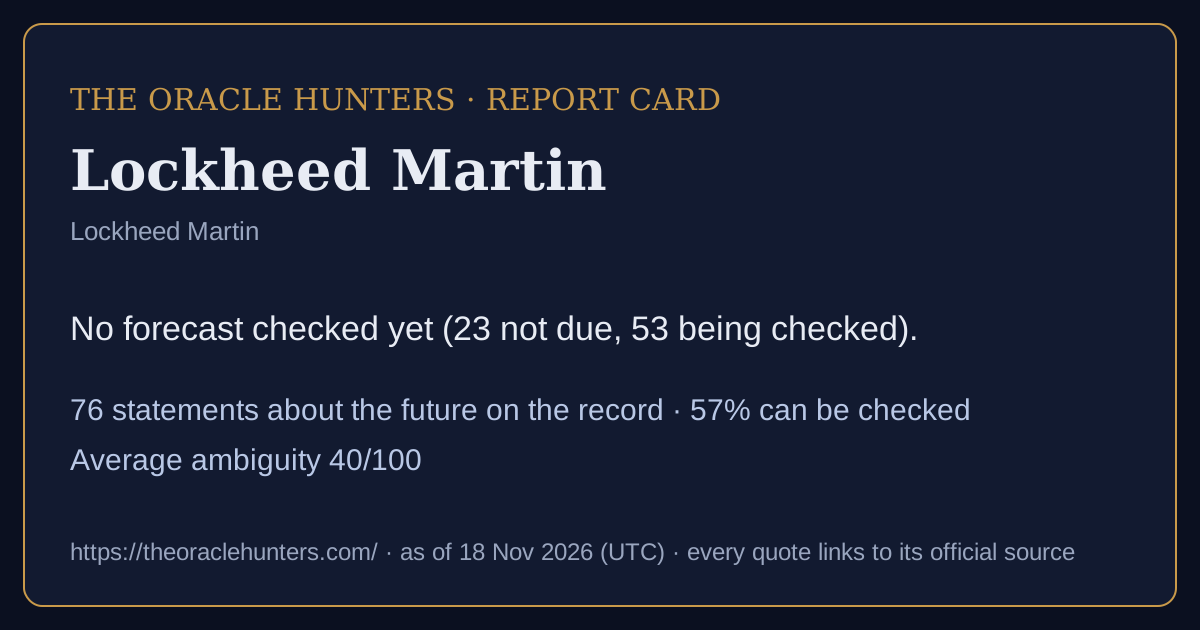
Track record: No forecast checked yet (23 not due, 53 being checked).
76forecasts & commitments on the record
57%can be checked as stated
40average ambiguity (0-100)
0goalpost moves recorded
0confirmed U-turns
Timeline
came true partly did not not due / being checked / too vague
Calibration score: shown after 10 checked forecasts with a stated likelihood (now 0).
How they speak about the future: based on data 73, stated on authority 3.
Kinds of claim: forecast 69, commitment 4, mixed claim 3. · Download this report card as a picture
In the nine words
How to read this
Each box is one sentence a public figure or institution said about the future, word for word, with a link to the official text. Can be checked means it names what will happen, by when, and how likely - so it can be compared with official figures later. Too vague to check means it does not. Ambiguity (0-100) is how many different ways the sentence can be read. When the date passes, the forecast is compared with official data and marked came true, partly or did not come true. Labels judge the sentence, never the person. Full guide and glossary.On the record (76)
We now anticipate accelerated year‑over‑year sales growth of approximately 8%, driving 28% higher segment operating profit, and increased free cash flow, now projected to be over $7 billion” said Lockheed Martin Chairman, President and CEO Jim Taiclet.
As a result of the One Big Beautiful Bill Act (the Tax Act) and the Notice, the company is no longer subject to CAMT this year and expects to make reduced federal income tax payments for 2026.
We reaffirm our 2026 full year guidance with anticipated sales and operating profit growth of approximately 5% and 25% year-over-year, respectively, and expected free cash flow between $6.5 and $6.8 billion.”
We expect sales and reported segment operating profit growth of approximately 5% and 25% year-over-year, respectively, and free cash flow between $6.5 to $6.8 billion, an increase compared to our prior expectation.
With a strong emphasis on operational performance and clear alignment with our customers’ national defense priorities, we will continue to deliver superior, reliable capabilities to U.S. and Allied militaries to strengthen deterrence and provide overwhelming combat advantage, while providing strong results and value to our shareholders.”
We remain committed to delivering these critical capabilities that our customers are counting on and are fully focused on the growth inflection we expect as the result of heightened interest and demand for Lockheed Martin’s products and technologies.
The company’s financial outlook for 2025 assumes that fiscal year 2025 appropriations bills are adopted in a timely manner, the company’s programs remain funded and that the U.S. Government does not shutdown or continue to operate under a continuing resolution for the remainder of 2025.
At the end of the third quarter of 2024, the company also had approximately $2 billion in potential termination liability exposure to third parties related to Lots 18-19 (some of which would be recoverable in the unlikely event of a termination).
The company's financial outlook reflects no significant reduction in customer budgets or changes in priorities, continued support and funding of the company's programs, and a statutory tax rate of 21%.
The decrease was primarily attributable to lower operating profit for tactical and strike missile programs due to a $100 million reach-forward loss recognized for an option on a classified program and an unfavorable profit adjustment on HELLFIRE as a result of additional costs expected to be incurred associated with a contract claim, partially offset by the production ramp up described …
In addition, we continued our disciplined and dynamic capital deployment by investing over $700 million into R&D and capital projects and returned significant capital to shareholders through dividends and share repurchases as we remain committed to delivering meaningful free cash flow per share growth over the long-term.
The company’s financial outlook for 2024 assumes that fiscal year 2024 appropriations bills are adopted in a timely manner, the company’s programs remain funded and that the U.S. Government does not shutdown or continue to operate under a continuing resolution for the remainder of 2024.
In addition, the outlook reflects no significant reduction in customer budgets or changes in priorities, continued support and funding of the company’s programs, and a statutory tax rate of 21%.
•receiving net proceeds of $1,975 million from a debt issuance of senior unsecured notes, consisting of $500 million aggregate principal amount of 4.45% Notes due May 15, 2028, $850 million aggregate principal amount of 4.75% Notes due February 15, 2034, and $650 million aggregate principal amount of 5.20% Notes due February 15, 2055.
As we track toward our objective of growth resumption in 2024, we will continue to execute our dynamic and disciplined capital allocation program, by reinvesting in our business and pursuing growth opportunities, and returning capital to shareholders.
In addition, the outlook reflects no significant reduction in customer budgets or changes in priorities, continued support and funding of the company’s programs, and a continuing statutory tax rate of 21%.
We now expect FAS pension expense of approximately $1.1 billion in 2022, inclusive of the noncash, non-operating pension settlement charge of $1.5 billion (pre-tax) described above.
On May 5, 2022, the company received net proceeds of $2.3 billion from a debt issuance of
The company continues to anticipate annual deliveries of 156 aircraft beyond 2025 for the foreseeable future.
Deliveries are expected to remain in the range of 147-153 aircraft per year in 2023 and 2024, before the company achieves its 156 aircraft delivery target in 2025.
Represents the impact of the change in the estimated annual effective tax rate primarily due to lower earnings before income taxes associated with the pension settlement charge, which will be realized in the third and fourth quarters of 2022.
In connection with this transaction, the Company expects to recognize a non-cash, non-operating settlement charge of approximately $1.5 billion ($1.2 billion, or $4.50 per share, after tax) in the second quarter of 2022, related to the accelerated recognition of actuarial losses for the affected plans that were included in stockholders’ equity.
Pursuant to the transaction, on January 1, 2023, Athene, through its wholly-owned subsidiaries Athene Annuity and Life Company and Athene Annuity & Life Assurance Company of New York, will begin paying and administering the retirement benefits of the affected retirees and beneficiaries in the Lockheed Martin Corporation Salaried Employee Retirement Program and the Lockheed Martin Aerospace Hourly Pension Plan.
The company currently estimates that unless the provision is deferred, modified, or repealed, this change will result in an additional $500 million of tax payments in 2022, which has been reflected in the company’s current 2022 financial outlook for cash from operations.
The company currently expects a total net FAS/CAS pension benefit of approximately $2.2 billion in 2022, which includes total expected U.S. Government cost accounting standards (CAS) pension cost of approximately $1.8 billion and total expected financial accounting standards (FAS) pension income of approximately $400 million.
Additionally, the company’s preliminary outlook for 2022 assumes no significant reduction in customer budgets, changes in funding priorities and that the U.S. Government will not operate under a continuing resolution for an extended period in which new contract and program starts are restricted.
No additional impacts to the company’s operations, supply chain, or financial results as a result of continued COVID-19 disruption or implementation of the vaccine executive order have been incorporated into the company’s preliminary outlook for 2022 as the company cannot predict how the pandemic will evolve or what impact it will continue to have.
The preliminary outlook for 2022 also assumes continued support and funding of our programs, a statutory tax rate of 21%, known impacts of COVID-19, and the continued acceleration of supplier payments at current levels.
The company expects 2022 net sales to decline from expected 2021 levels to approximately $66 billion and 2022 total business segment operating margin to be approximately 11.0%.
Over the short-, mid- and long-term, we will strive to maximize cash flow per share dynamically, based on revenue growth opportunities, inorganic investments, and share repurchases to take full advantage of our significant cash flow generation and strong balance sheet.”
The corporation expects total non-service income for its qualified defined benefit pension plans in the table above, along with non-service cost for its other postretirement benefit plans of $35 million, to total non-service credit of $340 million for 2021.
The transaction is expected to close in the second half of 2021 and is subject to the satisfaction of customary closing conditions, including regulatory approvals and approval by Aerojet Rocketdyne’s stockholders.
Quarters are typically 13 weeks in length but, due to our fiscal year ending on Dec. 31, the number of weeks in a reporting period may vary slightly during the year and for comparable prior year periods.
The corporation expects to make contributions of approximately $1.0 billion to its qualified defined benefit pension plans in 2021 and anticipates recovering approximately $2.1 billion of CAS pension cost.
The corporation currently expects a total net FAS/CAS pension benefit of approximately $2.1 billion in 2021.
Additionally, the preliminary outlook for 2021 assumes that there will not be significant reductions in customer budgets, changes in funding priorities and that the U.S. Government will not continue to operate under a continuing resolution for an extended period in which new contract and program starts are restricted.
The preliminary outlook for 2021 assumes continued support and funding of our programs, including recovery of COVID-19 cost impacts, and a statutory tax rate of 21%.
Total business segment operating margin in 2021 is expected to be in the 10.9 percent to 11.1 percent range and cash from operations is expected to be greater than or equal to $8.1 billion, net of $1.0 billion of planned pension contributions.
The corporation expects its 2021 net sales to increase to greater than or equal to $67 billion.
The corporation expects total non-service income (cost) for its qualified defined benefit pension plans in the table above, along with non-service cost for its other postretirement benefit plans of $30 million, to total non-service credit of $185 million for 2020.
In June 2020, the corporation used the net proceeds from the May 2020 debt offering plus cash on hand to redeem $750 million of the outstanding $1.25 billion in aggregate principal amount of the 2.50% Notes due 2020, and $400 million of the outstanding $900 million in aggregate principal amount of the 3.35% Notes due 2021.
In May 2020, the corporation received net proceeds of $1.13 billion from a $1.15 billion debt issuance of senior unsecured notes, consisting of $400 million aggregate principal amount of 1.85% Notes due 2030 and $750 million aggregate principal amount of 2.80% Notes due 2050.
Differences between these assumed values and actual values will affect the corporation’s plan funded status and stockholders’ equity as measured at year-end 2020.
In addition, the corporation’s financial performance assumes actual returns on its pension assets during 2020 will be 7.0%, and the discount rate used to re-measure its pension liabilities at year-end 2020 will be 3.25%.
The corporation expects total non-service credit (cost) for its qualified defined benefit pension plans in the table above, along with non-service cost for its other postretirement benefit plans of $30 million, to total non-service credit of $185 million for 2020.
Typically, the corporation's fiscal quarters are 13 weeks in length but due to its fiscal year ending on Dec. 31, the number of weeks in the corporation's quarters may vary slightly from year to year.
Changes in circumstances may require the corporation to revise its assumptions, which could materially change the corporation's current estimate of 2020 net sales, operating margin and cash flows.
As noted above, the corporation expects to make contributions of approximately $500 million to its qualified defined benefit pension plans in 2020 and anticipates recovering approximately $2.2 billion of CAS pension cost.
The impact of changes in the discount rate is significantly less than in prior years (i.e., $15 million for 2020 compared to $120 million for 2019) due to the expected completion of the planned freeze of the corporation’s salaried
The corporation currently expects a total net FAS/CAS pension benefit of approximately $2.1 billion in 2020.
Showing the newest 50 - the ledger has all 76.