Liz Kendall
Department for Work and Pensions · GBR
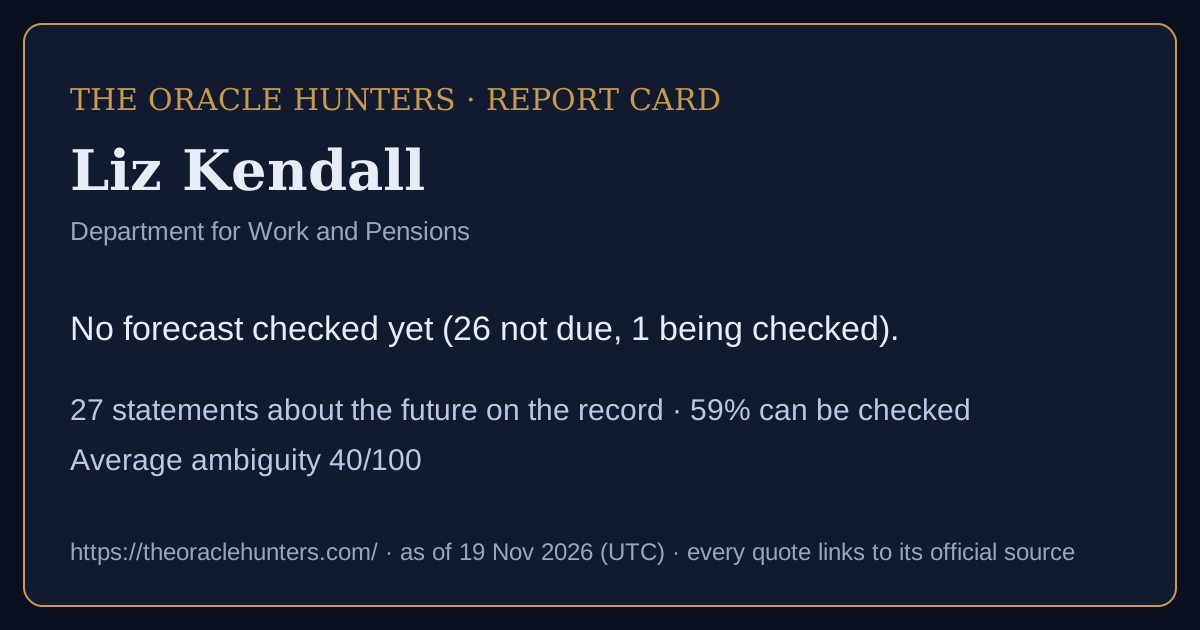
Track record: No forecast checked yet (26 not due, 1 being checked).
27forecasts & commitments on the record
59%can be checked as stated
40average ambiguity (0-100)
0goalpost moves recorded
0confirmed U-turns
Timeline
came true partly did not not due / being checked / too vague
Calibration score: shown after 10 checked forecasts with a stated likelihood (now 0).
How they speak about the future: based on data 21, stated on authority 6.
Kinds of claim: forecast 16, mixed claim 8, commitment 3. · Download this report card as a picture
In the nine words
πρόγνωσιςInference from evidence20 · 74%μαντείαInspired knowledge4 · 15%προαναγγελίαPublic pre-announcement3 · 11%
How to read this
Each box is one sentence a public figure or institution said about the future, word for word, with a link to the official text. Can be checked means it names what will happen, by when, and how likely - so it can be compared with official figures later. Too vague to check means it does not. Ambiguity (0-100) is how many different ways the sentence can be read. When the date passes, the forecast is compared with official data and marked came true, partly or did not come true. Labels judge the sentence, never the person. Full guide and glossary.On the record (27)
That is why our new £120m AI Hardware Innovation Programme, delivered by UKRI, will back teams at every stage – helping them move from initial concept to a full, validated prototype, and then on to contracts.
If Britain could secure just 5% of this market it would bring $50 billion in revenue to the UK with tens of thousands of high paid jobs in tech.
Right now the global AI chips market is growing at an annual rate of 30% and expected to reach $1 trillion in the early 2030s.
It will invest £500m in British AI companies to start up, scale up and win globally
We will build a £750m mixed chip supercomputer.
That’s why earlier this year, I announced we will make a decisive shift towards backing more British AI companies, especially in the areas where we have real strengths – like life sciences, AI hardware and new approaches to foundational models.
Starting this year in the North West, and rolled out across the country next year this will provide free summer AI bootcamps to give school leavers with few or no qualifications basic AI skills, followed by a guaranteed apprenticeship for those who successfully complete the course, working with companies like JD Sports and BAE Systems, in towns including Blackpool, Blackburn, …
We are establishing new AI Sandboxes so companies can safely test AI products, and through our new pioneering cross-economy AI Growth Lab which we will legislate for in our Regulating for Growth Bill.
Last but by no means least, we will back the tech and AI talent of the future through our £187m Tech First scheme, helping 1 million young people get the skills they need, with a new target that 40% will be in the most disadvantaged schools.
If Britain could secure just 5% of this market it would bring fifty billion dollars in revenue to the UK with tens of thousands of high paid jobs in tech.
The global AI chips market is growing at an annual rate of 30% and expected to reach one trillion dollars in the early 2030s.
Sovereign AI will invest £500 million in British AI companies to start up, scale up and win globally … and offer the key to unlocking much wider government support where it makes a real difference.
Extrapolate this trend and by the end of next year AI will be able to complete in hours what would currently take software engineers weeks.
And I am really delighted to confirm that alongside extra investment for AI research and for engineering biology, the dedicated budget for life sciences will guarantee £1.5 billion for R&D in this sector, over the next 4 years.
With an annual funding pot, this year worth £4.5 million, these awards will support around 60 female founders with a grant of up to £75,000 each to help scale up their brilliant, cutting-edge companies.
We expect the Pension Commission to provide its recommendations in 2027.
The number of people on the health top up of Universal Credit is set to rise by 50 per cent to 3 million by the end of the decade.
… with the benefits bill for sickness and disability up £20 billion since the pandemic and set to rise by a further £18 billion by the end of this Parliament, unless we change course.
… and spending will be £8 billion higher than it is now: rising faster than GDP, and faster than spending on public services.
But 9 out of 10 people claiming PIP at the point when the changes come into force in November 2026 will not be affected by the end of the Parliament.
And taxpayers paying millions more on the costs of failure, with spending on working age sickness and disability benefits up £20 billion since the pandemic, set to rise by a further £18 billion by the end of this Parliament to £70 billion a year.
And Mr Speaker, this is a significant reform package that is expected to save over £5 billion in 2029/30.
So today I can announce we will invest an additional £1 billion a year for employment support with the aim of guaranteeing high-quality, tailored and personalised support to help people on a Pathway to Work.
We will legislate for a change in PIP so people will need to score a minimum of 4 points in at least one activity to qualify for the daily living element of PIP from November 2026.
And alongside this, Mr Speaker, we will bring in a permanent, above inflation rise to the standard allowance in Universal Credit… for the first time EVER, a £775 annual increase in cash terms by 2029/30.
We will legislate to rebalance the payments in Universal Credit from April next year …
We will pursue this ambition alongside our wider economic goals to raise productivity and living standards and to improve the quality of work - as part of the Government’s growth mission.
Also said - not checkable as stated (12 newest)
Remarks about the future with no date, figure or likelihood that could be checked. They are kept on the record and shown here, but not scored.
Some people may think the challenge we face is too daunting, or that we should somehow try and ‘pause AI’.
We will seriously consider all of the proposals that have been put forward.
AI will also change jobs, helping to free up time currently taken on red tape and repetitive tasks so employees can focus more on the things that matter most.
And today I can announce we will go further, with a new AI Hardware Plan which I will launch at London Tech Week in June.
So in July, at the next meeting of the international network of AI Security Institutes, which the UK Chairs, we will publish best practice on the science of evaluating AI models.
I believe that with the talent in this room – and a government that has a cause to make technology work for all, that believes in an active state, and that is prepared to do things differently – we can and we will lead our country to a better future.
I believe Sovereign AI is going to be one of the most important things this government does to build a better future for our country.
That is why we must be an AI maker, not just an AI taker.
Speeding up clinical trials, which we can and should expect to see much more progress on.
We will only succeed in winning for Britain if people have the confidence this technology is safe and when we support people through the changes AI inevitably brings.
And it’s why this government will not be a bystander when people are worried about the impact AI will have on their jobs, and their children’s job prospects too.
We will support people through the jobs transition.