Lisa D Cook
Federal Reserve · USA
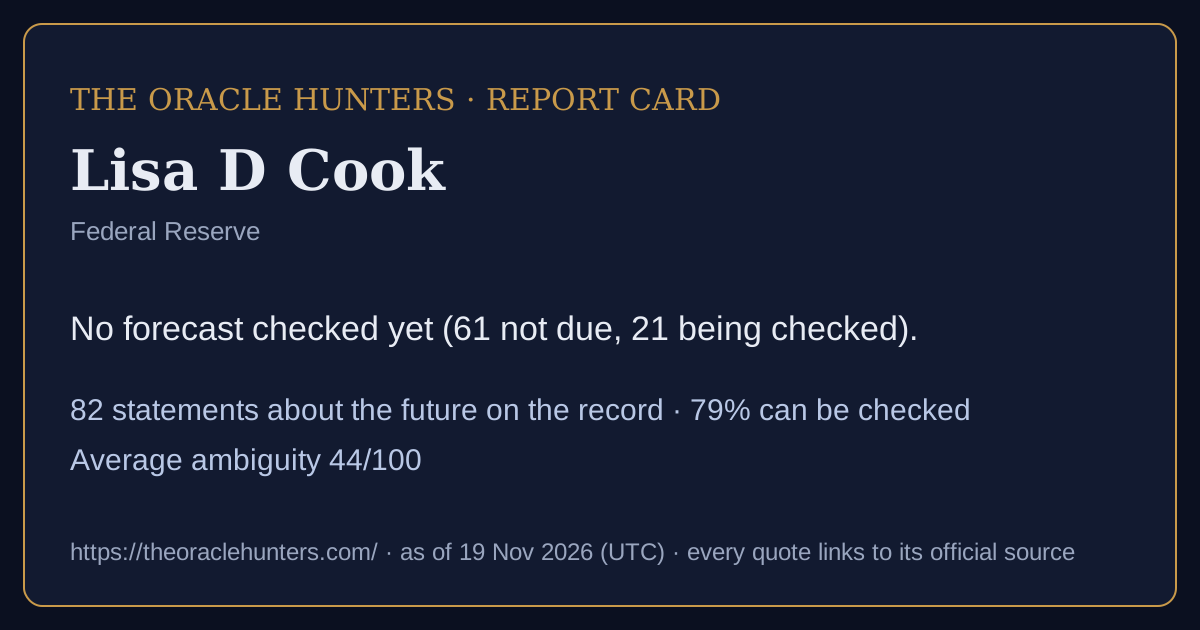
Track record: No forecast checked yet (61 not due, 21 being checked).
82forecasts & commitments on the record
79%can be checked as stated
44average ambiguity (0-100)
0goalpost moves recorded
0confirmed U-turns
Timeline
came true partly did not not due / being checked / too vague
Calibration score: shown after 10 checked forecasts with a stated likelihood (now 0).
How they speak about the future: based on data 41, educated guess 21, stated on authority 20.
Kinds of claim: forecast 55, scenario (if… then) 21, mixed claim 5, commitment 1. · Download this report card as a picture
In the nine words
πρόγνωσιςInference from evidence38 · 46%πρόνοιαPreparing for the future21 · 26%μαντείαInspired knowledge19 · 23%εἰκασίαConjecture2 · 2%πρόβλεψιςSeeing the signs1 · 1%προαναγγελίαPublic pre-announcement1 · 1%
How to read this
Each box is one sentence a public figure or institution said about the future, word for word, with a link to the official text. Can be checked means it names what will happen, by when, and how likely - so it can be compared with official figures later. Too vague to check means it does not. Ambiguity (0-100) is how many different ways the sentence can be read. When the date passes, the forecast is compared with official data and marked came true, partly or did not come true. Labels judge the sentence, never the person. Full guide and glossary.On the record (82)
Scenarios where we might get less inflation relief are ones in which productivity gains are not passed on to prices—say, if market concentration leads to less competition and higher markups.
This could happen. if the productivity gains were highly concentrated among higher-income consumers who tend to spend less of each additional dollar of income or wealth; if productivity gains are not passed on to wages because of low worker bargaining power; or if a painful stretch of job reallocation leaves unemployment higher and confidence lower, increasing households' precautionary savings.
If demand does not expand to meet additional supply, you would expect prices to fall.
Furthermore, in coming months I expect to see continued pressure on inflation from the AI buildout, as discussed today, and from the pass-through of higher oil prices and supply chain disruptions associated with the conflict in the Middle East.
However, I do not expect those effects to arrive in time to offset the broadening inflationary pressure later this year.
You can see signs in the inflation data that the pressure may be broadening: Electricity and water costs are each up around 5 percent over the past year, potentially attributable in part to AI, and core goods prices, which were drifting down before the pandemic, are running over a 3 percent annual pace so far this year.
Second, while oil prices continue to be elevated relative to early this year because of the Middle East conflict, many forecasters suggest that they will come down by the end of the year, providing some deflationary relief.
GDP growth in 2025 came in at 2.0 percent, and FOMC participants now forecast that 2026 will come in at 2.2 percent.
In June of last year, Fed officials forecast inflation of 2.4 percent for 2026 for both the headline measure and the core reading, which excludes volatile food and energy prices.
The median Federal Open Market Committee (FOMC) participant forecast for gross domestic product (GDP) growth in 2025 and 2026 was just 1.4 percent and 1.6 percent.
Core inflation is also coming in well above what I previously anticipated, driven by core goods prices, which have been increasing at a striking 5 percent annual pace so far this year.
Still, economists widely expected that inflation would resume a downward trajectory by the end of 2026.
However, as I have stated at several points this year, the risks from high inflation concern me more at this time.2 Even though this week's consumer price index and producer price index reports were softer than expected, they still imply that the price index we target rose 3.7 percent in the 12 months through June.
Still, most forecasters and market participants, as reflected in oil futures, expect that oil and gasoline prices should decline, to some extent, by the end of the year.
This could reverse when the AI productivity gains are more fully realized or if the labor market transition leads to a rise in income inequality, such that well-off consumers receive a larger share of income, which could lower the neutral rate, all else equal.
First, if AI continues to raise productivity, economic growth could remain strong, even as churn in the labor market leads to an increase in unemployment.
Inflation remains persistently above our 2 percent target, and there is considerable uncertainty about when the tariff effects will recede.
Vulnerable and LMI households are the ones who will be the first and most hurt, if the labor market were to suddenly deteriorate or if inflation were to remain too high.
Moreover, I will be prepared to act forcefully, if the tariff effects appear to be larger or last longer than expected, or if other evidence emerges that higher levels of inflation are becoming entrenched in expectations.
The unemployment rate edged up over this summer from 4.1 percent in June to 4.3 percent in August, a relatively low reading one would expect to see in a healthy economy.
Output has been supported by household consumption that has held up better than expected earlier this year.
As such, I expect inflation to remain elevated for the next year.
The most recent data show that inflation was 2.1 percent for the 12 months ending in April and 2.5 percent when excluding food and energy costs.3 Price increases tied to changes in trade policy may make it difficult to achieve further progress in the near term.
Over time, if uncertainty clears and we see further progress on inflation toward our 2 percent target, it will likely be appropriate to lower the policy rate to reduce the degree of monetary policy restriction.
If they were to rise substantially, it may become more difficult to keep actual inflation on a path back toward our 2 percent goal.
In figure 15, you can see that those firms report a significant rise so far this year in the prices they are paying for inputs and in the prices they expect to charge for their products.
Currently, my baseline forecast is that U.S. economic growth will slow moderately this year, with the unemployment rate picking up a bit, while inflation progress will stall in the near term, in part because of tariffs and other policy changes.
Gross domestic product expanded at a 3.1 percent annual rate in the third quarter of last year, and many forecasters estimate growth of about 2.5 percent in the fourth quarter.
However, November's monthly change was lower than expected and consistent with a 2 percent inflation trend.
I expect more progress in reducing housing services inflation this year as the earlier slowing in growth of rents charged to new tenants feeds through into the growth of average rents.
This year, I will continue to work on calibrating monetary policy to ensure inflation returns sustainably to our 2 percent target while maintaining a solid labor market.
However, if inflation progress slows and the labor market remains solid, I could see a scenario where we pause along the downward path.
If the labor market and inflation continue to progress in line with my forecast, it could well be appropriate to lower the level of policy restriction over time until we near the neutral rate of interest, or the point when monetary policy is neither stimulating nor restricting economic growth.
With job growth coming in below the breakeven pace, which was likely more than 200,000 jobs a month over the past year, the unemployment rate has risen from a historical low of 3.4 percent in April 2023 to 4.1 percent in October.
My view is that housing services inflation will come down gradually over the next two years as the earlier slowing of growth in new tenant rent feeds through into the overall rate.
Even so, I still see headline and core inflation falling to 2.2 percent next year and to lower levels after that.
Economic growth has been robust this year, and I forecast the expansion will continue.
Of the firms sampled in the U.S. Census Bureau's semiweekly Business Trends and Outlook Survey, 5.5 percent indicated they had used AI in the two weeks preceding the August 25, 2024, survey—1.5 percentage points higher than a year earlier.
The 2024 Work Trend Index Annual Report, published by Microsoft and LinkedIn, reports that 45 percent of knowledge workers are afraid AI will replace them.
Affected workers in these jobs could experience larger declines in their earning power, if AI depreciates the value of their accumulated human capital.
If it is, then the reduction in software programmers' hours devoted to programming tasks that can now be performed by AI will be more than offset by the increase in their hours from the greater demand for AI-enhanced software programming.
If AI can improve our ability to generate new ideas, then it could provide a long-term boost to labor productivity growth, as each newly discovered idea will itself provide an incremental boost to labor productivity.
The unemployment rate was a still-low 4 percent in May, but it has gradually risen over the past year since touching a more than half-century low of 3.4 percent in April 2023.
Beyond that, I see inflation slowing more sharply next year, with housing-services inflation declining to reflect the past slowing in rents on new leases, core goods inflation remaining slightly negative, and inflation in core services excluding housing easing over time.
In the past two years, 12-month inflation in the PCE price index has fallen from a peak above 7 percent to 2.7 percent in April, and it likely moved a bit lower in May based on consumer and producer price data.
Today, I will provide a progress report on disinflation, give you my outlook on the economy, and share my views on how to ensure that monetary policy brings inflation fully back to 2 percent over time while being attentive to the risk of a slowing labor market.
These data suggest that payroll job gains were overstated last year and may continue to be so this year.
I expect 12-month inflation will roughly move sideways for the rest of this year, with monthly data likely similar to the favorable readings during the second half of last year.
What might the implications be if house prices were to weaken at some future date?
Reforms adopted by the SEC and coming into force this year will improve funds' liquidity positions and address the structural first-mover advantages among money fund investors that contributed to some of the runs we have seen in this sector over the years.
Showing the newest 50 - the ledger has all 82.
Also said - not checkable as stated (12 newest)
Remarks about the future with no date, figure or likelihood that could be checked. They are kept on the record and shown here, but not scored.
As a Fed Governor, my charge is to set policy that will best achieve maximum employment and stable prices for all Americans, including those of us who live in rural communities.
Indeed, several factors are salient, but I will mention two: the increase in energy prices and in housing costs.
The rise in home values likely filtered through to put upward pressure on rents in rural and less dense areas as well.
Another outcome from the pandemic that may be familiar to those of you from Asheville, as well as those from other tourism-dependent rural areas, is a surge in the value of vacation properties and second homes.
See Alexander Hermann and Peyton Whitney (2024), "The Geography of Pandemic-Era Home Price Trends and the Implications for Affordability," working paper (Cambridge, Mass.: Harvard University Joint Center for Housing Studies, May).
Cook (2024), "Growth and Change at Community Development Financial Institutions," speech delivered at the Expanding Access to Capital for CDFIs event, hosted by the Federal Reserve Bank of New York, New York, May 14.
Several factors could explain why employers are not hiring as much as they did in the recent past, including longer-term structural shifts, pandemic-era over-hiring, or increased work from home.
At the same time, many workers understandably worry about how AI will affect their livelihood.
Some disinflationary forces are already in play, which could push inflation toward our target without a rate increase.
So even though those tariffs account for a lot of the elevated inflation seen in 12-month changes, they may no longer provide much inflationary push going forward.
As supply chains adjust and sector-specific efficiency gains accrue, I believe some of the inflationary pressure coming from the AI buildout will ease.
Achieving our dual mandate of maximum employment and stable prices will create the conditions where small businesses and all Americans can thrive.