Lim Hng Kiang
Central bank (via BIS)
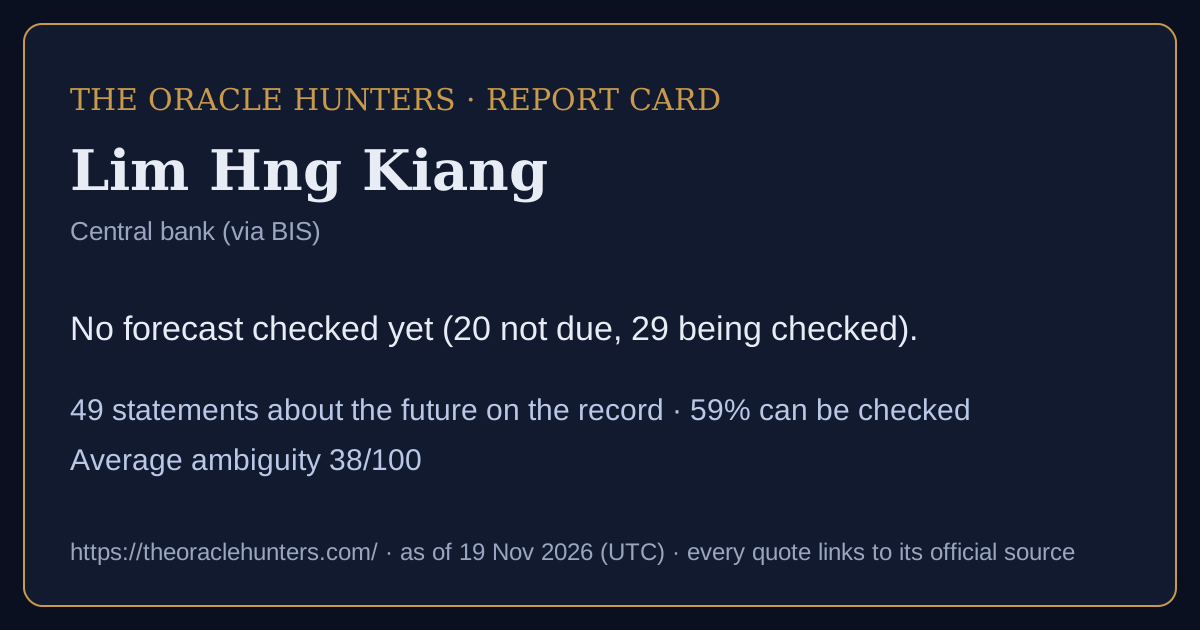
Track record: No forecast checked yet (20 not due, 29 being checked).
49forecasts & commitments on the record
59%can be checked as stated
38average ambiguity (0-100)
0goalpost moves recorded
0confirmed U-turns
Timeline
came true partly did not not due / being checked / too vague
Calibration score: shown after 10 checked forecasts with a stated likelihood (now 0).
How they speak about the future: based on data 44, stated on authority 4, educated guess 1.
Kinds of claim: forecast 44, commitment 2, scenario (if… then) 2, mixed claim 1. · Download this report card as a picture
In the nine words
πρόγνωσιςInference from evidence43 · 88%προαναγγελίαPublic pre-announcement2 · 4%πρόνοιαPreparing for the future2 · 4%μαντείαInspired knowledge2 · 4%
How to read this
Each box is one sentence a public figure or institution said about the future, word for word, with a link to the official text. Can be checked means it names what will happen, by when, and how likely - so it can be compared with official figures later. Too vague to check means it does not. Ambiguity (0-100) is how many different ways the sentence can be read. When the date passes, the forecast is compared with official data and marked came true, partly or did not come true. Labels judge the sentence, never the person. Full guide and glossary.On the record (49)
Vital public infrastructure, such as roads and railways, gas pipelines, power plants and ports will be built in over 60 countries, with total estimated infrastructure investment to exceed USD 1 trillion.
This grant will run from 1 January 2018 and will be applicable to ILS bonds covering all forms of risks beyond just natural catastrophe risks.
IMF has projected Asia to grow by 5.7% in 2013, and 6.0% the following year, exceeding the outlook for the global economy. 5 Growth in Asia over the medium term will be supported by continued urbanisation, favourable demographics and increased intra-Asian trade and investment.
We will leverage on these strengths to further support the growth of Islamic finance.
They estimated that this share could nearly double to 20% by 2020.
IMF estimates that growth in the GCC countries will moderate slightly but remain robust at 4.0% in 2013 and 2014. 4 Growth will be largely driven by increased domestic demand, and further spending on infrastructure to address present shortfalls and facilitate economic expansion.
McKinsey has estimated that productivity of the infrastructure value chain could be increased to achieve 40% savings, if project sponsors globally adopt proven best practices.
Despite a doubling of their lending in the last three years, they only contributed 16% of project debt financing volumes globally in 2012.
Last year, the Topaz Solar Farm project in California was structured with a US$1.2b debt package featuring US$850m of bonds.
The global project finance bank loan market registered a 7% fall y-o-y in 2012.
RCEP will be one of the biggest FTAs in the world, covering 3 billion people and accounting for one-third of the world's GDP.
The realisation of the AEC by 2015 will result in an even more tightly integrated region, and this has opened up more opportunities for corporates as well as investors.
Besides China, India's middle class is expected to grow to almost 600 million people by 2025.
In Indonesia, almost 60 per cent of Indonesian households, in a country of 240 million people, are expected to reach middle-class status by 2020.
In 2012, ASEAN-China trade volumes reached a record high of US$400 billion, and by 2015, ASEAN is expected to be China's top trading partner.
The CLMV countries have reduced tariffs on 98.86% of their tariff lines to the 0-5% tariff range in 2010, and are expected to eliminate tariffs on these goods by 2015, with flexibility for a few tariff lines until 2018.
If they fail, high unemployment will cause increasing restlessness and agitation for political change and revolution.
There are 23 megacities today; and it is projected that this number will double by 2030.
For example, bilateral trade between Thailand and Indonesia is projected to be almost five times as high in 2030 as it was in 2009.
China's trade with developing Asia, particularly with Malaysia, Thailand and Indonesia, will propel these bilateral trade routes into the top 25 bilateral trade routes by 2030.
By 2030, 20 years from now, the centre of gravity of global trade patterns is projected to shift even further to within Asia, with China accounting for 17 out of the top 25 bilateral trade routes, overtaking trade links between developed countries like Japan-USA, Germany-USA that will grow but they will grow much more slowly.
Besides China, India's middle class is estimated to grow to almost 600 million people by 2025, and almost 60% of Indonesian households, in a country of 240 million people, are expected to reach middle-class status by 2020.
In a 2011 report published by Cerulli Associates, institutional investable assets from Asia ex-Japan are expected to triple from US$4.3 trillion in 2006 to US$13.6 trillion by 2015.
The average hedge fund returns across strategies was negative 4.6% in 2011, with most of the losses occurring in 3Q 2011 when global equities declined by around 17%. 3 Whilst hedge fund performance this year-to-date as at end-August 2012 was up 3.8% 3 , the outlook remains uncertain and I think hedge funds may struggle to provide consistent returns over …
Firstly, Asia has been leading the global recovery with growth expectations in developing Asia projected to exceed global growth at 6.7% in 2012 and 7.2% in 2013. 5
Global growth is now expected to be 3.3% in 2012 and 3.6% in 2013. 2 However, this is dependent on the assumption that there will be sufficient policy action to ease financial conditions globally and that recent policy easing moves in emerging market economies will gain traction.
- (iv) The new eligibility criteria for regulatory capital will also be phased in between 1 Jan 2014 and 1 Jan 2018.
This will be phased in between 1 Jan 2016 and 1 Jan 2019.
This will be fully phased in by 1 Jan 2015.
Singapore-incorporated banks will be required to meet the Basel III minimum standards by 1 January 2013, ahead of the Basel Committee's January 2015 timeline.
We will require Singapore-incorporated banks to meet Basel III earlier and at a higher standard.
incorporated banks will have to maintain at least 9% Common Equity Tier 1, compared to the Basel III minimum of 7%.
Despite the recent spate of shocks, the world economy has been resilient with growth projected to moderate slightly to 4.5% 1 , compared to 5.8% last year.
The ADB Institute estimated that Asia will need US$8.2 trillion in infrastructure investment between 2010 and 2020.
The International Monetary Fund (IMF) projects Asia's growth to reach almost 7% this year, led mainly by China at 9.6% and India at 8.2%.
Considering the uncertainty in parts of MENA, the IMF nevertheless still expects the GCC to grow by 7.8% this year, driven by the robust expansion of oil production and strong public spending.
Within Asia, the ASEAN-5 (Association of Southeast Asian Nations-5) countries 3 are expected to expand by 5 to 6% this year and their external trade volume will reach around 60% that of China.
The IMF estimated that GDP growth for Asia will settle at a more sustainable 7 percent in 2011.
According to the International Monetary Fund (IMF), Asia is expected to grow by an average of 7.1% in 2010 and 2011, up from 3.4% in 2009.
While the industry has generally been fairly resilient to date, business conditions this year are expected to be very challenging.
The Organisation for Economic Cooperation and Development sees agricultural commodity prices retreating from peaks but rising up to 50% higher in the next decade.
By 2010, NEWater, our very own water recycling industry, will be able to meet 30% of Singapore's water demand.
According to the IMF, China will continue to grow by 9.3% in 2008 and 9.5% in 2009, a slight decline from its double-digit growth rates in the previous years, but strong growth nonetheless.
Some speculated that this could happen before the end of 2008.
This is projected to grow annually by about 6.5% to about US$10.5 trillion by 2010.
Net capital inflows into emerging market portfolio equity investment reached a high of US$30bn in 2003, almost double that seen before the internet bust in early 2000. 2 This positive economic outlook, coupled with growing intra-regional trade and investment, augurs well for the region.
London Stock Exchange (LSE) will launch its Dutch Trading Service, euroSETS, in May this year.
Average real GDP growth for the East Asian economies 1 is projected to fall to around 4.5% for 2001.
This year, we expect the momentum to be sustained, with GDP growth at around 4.5-6.5%.
Also said - not checkable as stated (12 newest)
Remarks about the future with no date, figure or likelihood that could be checked. They are kept on the record and shown here, but not scored.
- 28 We will pilot the OBOR consortium with two lines of business: Construction; and Project Cargo &
Central banks will have to be vigilant against undue financial market stresses arising from last Thursday's referendum in the UK, and to be prepared for a period of heightened uncertainty that such an unprecedented event might entail.
In the near term, the unexpected results of the UK's EU referendum or Brexit, would very likely continue to reverberate across financial markets around the world.
The present low-growth, low-inflation environment, which in all likelihood will continue for some time, suggests that monetary policy settings in many parts of the world will remain accommodative, especially in advanced economies where inflation has been below target for a number of years.
Stress tests will become an increasingly important and integral part of risk management in the financial sector.
This involves banks describing scenarios under which their solvency could come under threat, thereby providing further insights on the risks that could impair the financial system.
Within an FI, the weak links could also manifest in the carelessness or lack of cyber-security awareness by individuals or lax processes, on top of vulnerabilities in adopted technology systems.
Going forward, the broadening and deepening of economic and financial ties between Asia and the Middle East, the two major centres for Islamic finance, will also provide further impetus for future growth of Islamic finance globally.
Asia's demand for energy exports from the Middle East will continue to remain robust as the region expands.
Credit or risk guarantees provided by multilateral development banks or export credit agencies may also need to be adapted for use in the capital markets.
Banks should therefore consider bringing in different types of capital at different stages as the risk profile of a project changes over time.
As hedge funds cope with a more demanding operating and economic environment, the industry will have to deal with two key challenges.