Liam Fox
Ministry of Defence · GBR
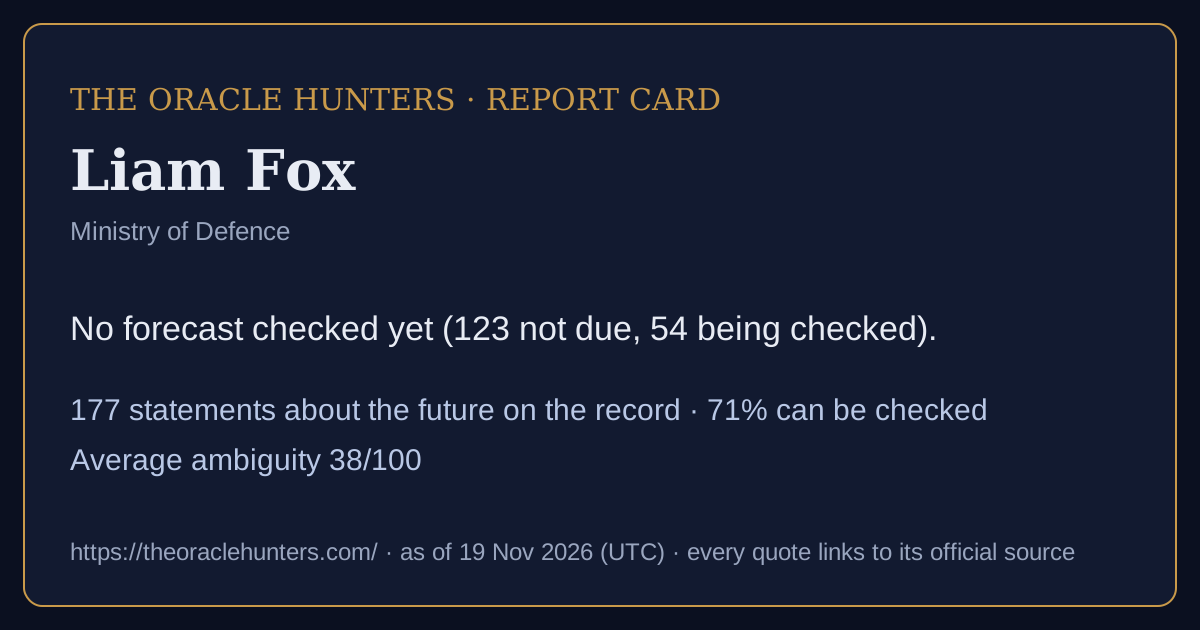
Track record: No forecast checked yet (123 not due, 54 being checked).
177forecasts & commitments on the record
71%can be checked as stated
38average ambiguity (0-100)
0goalpost moves recorded
0confirmed U-turns
Timeline
came true partly did not not due / being checked / too vague
Calibration score: shown after 10 checked forecasts with a stated likelihood (now 0).
How they speak about the future: based on data 124, stated on authority 45, educated guess 8.
Kinds of claim: forecast 121, commitment 33, mixed claim 22, scenario (if… then) 1. · Download this report card as a picture
In the nine words
πρόγνωσιςInference from evidence118 · 67%προαναγγελίαPublic pre-announcement33 · 19%μαντείαInspired knowledge17 · 10%εἰκασίαConjecture7 · 4%προφητείαInterpreting the will of authority1 · 1%πρόνοιαPreparing for the future1 · 1%
How to read this
Each box is one sentence a public figure or institution said about the future, word for word, with a link to the official text. Can be checked means it names what will happen, by when, and how likely - so it can be compared with official figures later. Too vague to check means it does not. Ambiguity (0-100) is how many different ways the sentence can be read. When the date passes, the forecast is compared with official data and marked came true, partly or did not come true. Labels judge the sentence, never the person. Full guide and glossary.On the record (177)
At the same time, global trade growth forecasts have been revised down significantly: by 1.6 percentage points to 2.1% for 2019 - the weakest rate since the height of the financial crisis.
And the African Development Bank has estimated that by 2060 there could be 1.1 billion middle class Africans: quite a big consumer market.
It is predicted that the share of global GDP of the seven largest emerging economies - including China, India and Turkey - could increase from around 35% to nearly 50% of global GDP by 2050, which would mean that they overtake the G7.
The World Bank has identified that mounting protectionism and a broad-based increase in global tariffs could translate into a possible annual decline in global trade of 9%, or over US $2.6 trillion relative to the baseline in 2020.
Last month, the OECD forecast of world GDP growth in 2019 and 2020 were revised down to 3.2% and 3.4% respectively.
And as the sun rises on our future as an ambitious, creative, and truly global independent trading nation outside the European Union, we are determined that all our firms, both large and small, have the opportunity to share in Britain’s export success story.
Now the IMF estimates that 90% of global GDP growth in the next five to ten years will come outside of continental Europe.
Forecasts for some of the major economies, such as Germany and the Eurozone more widely, have been downgraded, significantly and this may well have an impact on the 44% of our exports which currentlygo to the EU.
Earlier this year, for example, I announced that UKEF will provide an additional £1 billion in UK support to Iraq – and that’s on top of the £1 billion backing we have already given for critical infrastructure projects in that country.
And while the UK will continue building upon our business links with our valued trading partners in the EU, there are now unprecedented opportunities for growth in emerging markets which our firms are well-placed to take.
The result of these - and the imposition of unilateral and retaliatory tariffs - has seen trade growth slow dramatically from 5.4% in 2017 to a projected 3.4% this year.
And it is predicted that the share of global GDP of the seven largest emerging economies - including China, India and Turkey - could increase from around 35% to nearly 50% of global GDP by 2050, which would mean that they overtake the current G7.
When I try to explain it to people, I point out them that by 2030, China will have more than 220 cities with a population of more than 1 million people.
While our established partners such as the EU will continue to be of great importance, the locus of economic power is shifting rapidly, with an estimated 90% of global economic growth projected to occur outside the European Union over the next five years.
Deducts 20% to reflect the proportion of the value of exports that might be accounted for by the use of imported inputs.
And we have worked to ensure we have bilateral agreements in place to ensure continuity of trade with key markets currently covered by existing EU trade arrangements worth £71 billion, whether that is in the event of no deal, or probably more importantly after the proposed implementation period.
In the event of a no deal exit, 87% of total imports to the UK by value will be eligible for tariff-free access.
The share of global GDP of the seven largest emerging economies - including China, India and Turkey - has been projected to increase from around 35% to nearly 50% by 2050.
The global middle class is expected to reach 5.4 billion people by 2030, up from 3 billion in 2015.
Britain stands on the brink of a new era in our trading history, continuing our close cooperation with our partners in European Union while reaching out to friends old and new in the wider world, from which 90% of global growth is expected to originate in the next five years.
Services account for almost half of all our exports-42.4% going to the EU and 57.6% to non-EU countries.
This document formalises the efforts we have made with RISC and the many trade bodies that they represent over the last year to strengthen our mutual support for the sector, and we will be setting out our plans for this in more detail in the forthcoming Security Export Strategy.
There is also the Offshore Cape Three Points Project in Ghana, where UK Export Finance provided $400 million as part of an innovative project financing/reserve-based lending structure.
China alone will have 220 cities with a population of more than one million people by 2030, when the whole of Europe has just 35.
The rise of Asia is no longer part of the future: one figure I often quote is that according the IMF 90% of global growth will occur outside the European Union.
This is the equivalent to taking 1.2 million cars off Ghana’s roads each year, or planting 152 million trees; and it will support jobs across the United Kingdom, from Bristol and Aberdeen.
It is no longer just a case of saving the planet for our future generations: if we don’t fix the problem by 2030, we could see permanent harm in our own lifetimes.
My colleague Baroness Fairhead, the Minister of State for Exports, will headline the Energy Exporting Conference to be held in Aberdeen in June this year.
Research from the Bank of England suggests that if a large sample of trade partners lowered their services trade barriers to the level of the least restrictive country, the UK’s current account deficit could fall by up to 16%.
I often point out to those who are sceptical about the scale of change that China is expected to have 220 cities with a population of more than a million by 2030.
It is predicted that the share of global GDP of the seven largest emerging economies - including China, India and Turkey - could increase from around 35% to nearly 50% by 2050, which would mean that they overtake the G7.
This will be driven, in part, by a rapid expansion of the global middle class, which is expected to reach 5.4 billion people by 2030, up from 3 billion in 2015.
The Chinese bond market is expected to grow from around US $3 trillion to US $32 trillion by 2030, which is not a long time away, and by 2050, Asia’s financial sector is likely to be four times the size of that in the West.
Over the coming months I will be talking about the challenges we face in more detail such as the consequences of a protracted US – China trade dispute, the potential slowing of the global economy and the unmet challenges in the global trading system.
Services account for almost half of all our exports, 42.4% going to the EU, and 57.6% to non-EU countries.
The Political Declaration will enable both parties to deliver the legal agreements that will give the future relationship effect by the end of 2020, covering an economic partnership; a security partnership; and specific agreements on cross-cutting cooperation.
The Withdrawal Agreement means that, from the 29th of March next year, we can begun to build closer commercial relationships with our closest allies, such as the US, New Zealand and Australia, as well as laying the groundwork for improved market access for UK companies to key global growth economies.
The IMF has predicted that 90% of global growth in the next 5 years will originate outside the EU.
Recent research published by the Institute for Economic Affairs indicated that, through an increased tax take, job creation and other factors, a 10% increase in the value of the UK’s exports could potentially raise £20 billion for the Exchequer, funding the NHS, our armed forces, and the vital public services on which we all rely.
The IMF predicts 90% of global growth will happen outside the EU – not in the distant future, but in the next 5 years.
In the recent Budget, the Chancellor announced a £500 million increase in Brexit funding, which will now amount to more than £4 billion.
By 2030 China will have more than 220 cities with over 1 million people – the whole of Europe will have only 35.
We will be a constructive member of the EU until the day we leave - and we will be a constructive partner afterwards – fully committed to a global free trade agenda as we take up our independent seat at the WTO at the end of March next year.
And we will use this opportunity to further strengthen the ‘Golden Era’ of trade that the UK and China are now embarked on.
The EU remains the market for 44% of our exports, but the EU itself accepts that 90% of global growth in the next five to ten years will come from markets outside Europe.
Based still on the 10% uplift in exports, the budget deficit could, according to the IEA, reduce by some £20bn.
But, where they got to suggested that a 10% increase in the gross value of our exports – currently at £620 billion – could lead to a £50 billion increase in GDP.
International data flows will be 300 times higher by 2021 then they were in 2005.
As you will be aware, from April next year the United Kingdom will begin to negotiate new, independent trade deals with key partner nations.
I will repeat again - around 90% of global economic growth in the next 10 to 15 years is expected to be generated outside the European Union.
Showing the newest 50 - the ledger has all 177.
Also said - not checkable as stated (12 newest)
Remarks about the future with no date, figure or likelihood that could be checked. They are kept on the record and shown here, but not scored.
For example, the internationalisation of the rupee will be a crucial issue in ensuring the Indian economy plays its full role in international trade in the years to come.
Within whatever spending envelope comes out of the next Spending Review, we must ensure that we prioritise those areas that will generate economic growth and wealth creation for our country in the future.
Our new Export Strategy will help the UK climb the ranks of the 21st century’s great trading nations by encouraging, informing, connecting and facilitating finance for firms to realise their full exporting potential, and that is particularly true for SMEs where we need to find new exporters.
But I am convinced that when the dust settles the City of London will do what it always does, which is to emerge fitter, stronger and more dynamic than ever.
Of course, there’s no room for complacency and we must face up to the fact that there will be significant challenges as well as opportunities ahead, not least because a number of new players will become apparent.
We will be meeting tomorrow in Belfast and I’ve been fortunate enough to have senior individuals from across the political parties with experience, Patricia Hewitt, for example, former Secretary of State at DTI, is one of our members, Brian Willson also has joined us.
When we do so we will have the freedom to shape a better future, not just for ourselves and our own people, but for the wider world too.
I said there that “free trade has, and will continue to, transform the world for the better, and the UK has a golden opportunity to forge a new role for ourselves and importantly for the rest of the world.”
If you do not understand the complexity and importance of global value chains you will fail to set the appropriate policy frameworks.
Tariffs mean people at home pay more for the things they use every day, and the businesses that we rely on to drive our economy will pay more to manufacture products with components from overseas.
Whereas in the past some nations may have used tariffs to protect infant industries in a world where production and value chains were principally within that country, this model no longer works.
So, returning for the last time to the iPhone example: US import data will show an iPhone purchased in the US as an import at the retail cost, which is recorded as a trade deficit for the US, and a trade surplus for China.