Lesetja Kganyago
South African Reserve Bank
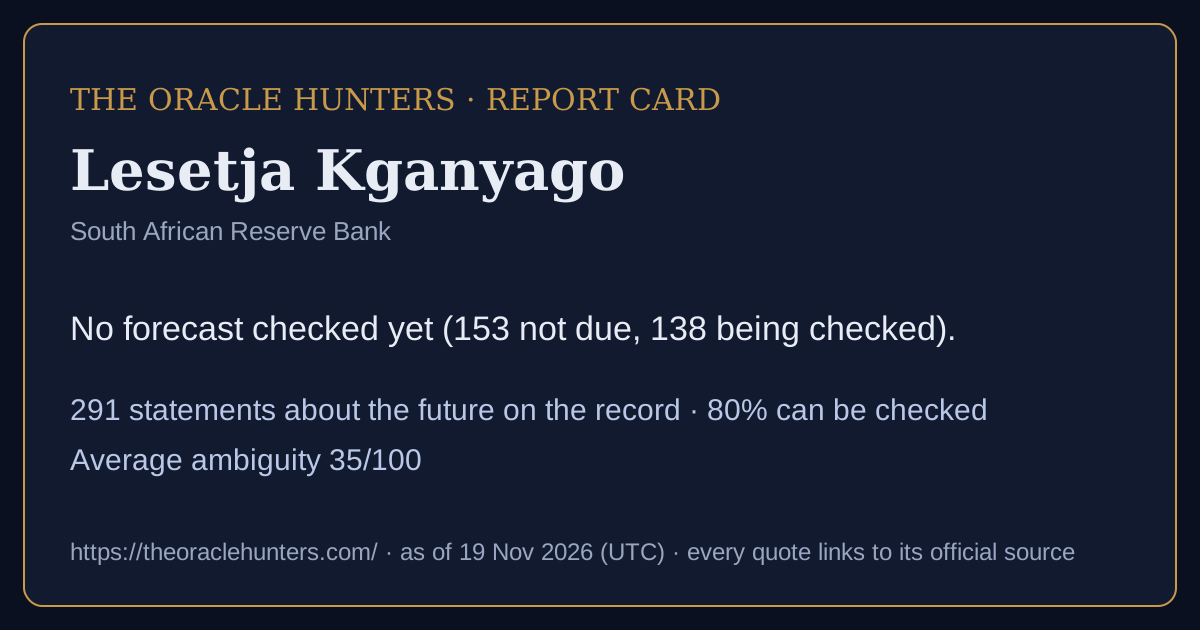
Track record: No forecast checked yet (153 not due, 138 being checked).
291forecasts & commitments on the record
80%can be checked as stated
35average ambiguity (0-100)
0goalpost moves recorded
0confirmed U-turns
Timeline
came true partly did not not due / being checked / too vague
Calibration score: shown after 10 checked forecasts with a stated likelihood (now 0).
How they speak about the future: based on data 232, stated on authority 33, educated guess 26.
Kinds of claim: forecast 237, mixed claim 25, scenario (if… then) 23, commitment 6. · Download this report card as a picture
In the nine words
πρόγνωσιςInference from evidence226 · 78%μαντείαInspired knowledge28 · 10%πρόνοιαPreparing for the future23 · 8%εἰκασίαConjecture7 · 2%προαναγγελίαPublic pre-announcement5 · 2%πρόβλεψιςSeeing the signs1 · 0%φρόνησιςPractical wisdom1 · 0%
How to read this
Each box is one sentence a public figure or institution said about the future, word for word, with a link to the official text. Can be checked means it names what will happen, by when, and how likely - so it can be compared with official figures later. Too vague to check means it does not. Ambiguity (0-100) is how many different ways the sentence can be read. When the date passes, the forecast is compared with official data and marked came true, partly or did not come true. Labels judge the sentence, never the person. Full guide and glossary.On the record (291)
We would be much better off if we could stop betting on sports and start betting on growth instead.
Before this shock hit, our main forecasting model showed the policy rate declining to about 6%.
That is why we raised rates to 7% in May - to ensure that inflation gets back to target.
We have just been hit by a big oil shock, which pushed headline inflation to 4.5% in May and 5% in June.
Our judgement in raising rates at that May meeting was that we needed to act so that inflation could return to target over time, rather than getting stuck above 3%.
If governments could spend without constraint, countries would never default on their debt, and bond yields in South Africa would not have risen as public debt increased after the global financial crisis.
18 On sovereign risk, see also R Kima and K Lesame, 'New 3% inflation target meets its first test', SATIED blog, 27 May 2026.
Let there be no doubt, the South African Reserve Bank will be getting inflation back down to 3%.
Ladies and gentlemen, to conclude, I have had a few questions recently, including at our MPC press conference, about whether we will do what was done in 2002 and abandon the lower target and revert to 3-6%.
We are projecting core inflation around 4% in the first half of next year, within the relevant horizon for monetary policy.
And that is before we start to discuss another food price risk: El Niño, which could bring drought next year to various parts of the country, In this context, at our MPC meeting last week, we decided to raise rates from 6.75% to 7%.
Our baseline is that we will have inflation of 4.4% this year, reverting to 3% by 2028.
In the South African case, you will have noticed how the rand has held up well this year.
9 The change is about 20 percentage points, from fuel inflation of -8.7% in March to a projected +11.4% in April.
Higher real rates, tighter financial conditions and the enhanced monetary policy credibility created by the new target probably balance the fact that expectations are not anchored at 3%.
If we do have to raise rates, it will be to sustain low and stable inflation, and all the benefits that brings.
It seemed we were going to complete the disinflation soon, perhaps this year. 13 Now this process will take longer.
This timeframe means you cannot do much about inflation that is suddenly going to be higher next month.
If petrol stays at R30, in May 2027 petrol price inflation will be 0%.
As the Nobel committee reminded us this year, innovation is the fundamental driver of prosperity and it is people like you who lead it. 3 We are going to have a financial system in the future that is more open, inclusive and secure - and it may well be ideas in this room that get us there.
As many of you will know, this year we expressed a preference for inflation to settle at the bottom of our 3 -6% target range.
The most recent scenarios from the Network for Greening the Financial System indicate that, under a 'current policy' scenario, the physical impacts of climate change - such as more frequent and severe extreme weather events - could result in global GDP losses of around 15%.
By contrast, a one percentage point increase in value-added tax raises about R30 billion. 23 And we could realistically save on debt costs.
As country risk and inflation falls, we could aim for a neutral policy rate of something more like 5.25%.
But lowering inflation to 3% will also reduce inflation volatility and country risk, the latter, perhaps by half a percent.
At our July meeting, we then formally announced our preference for inflation to settle at 3%, the bottom end of the target range, and we published a forecast to get there.
We laid the groundwork for the shift at our May MPC meeting by publishing a scenario with a 3% inflation objective.
6% band - is not ambitious enough and significantly reduces the benefits that the inflation-targeting framework could otherwise provide.' See P Honohan and A Orphanides, 'Monetary policy in South
This moved our growth projection lower for the year down by about 0.1 percentage points.
But in April, it was expecting 2.8%, so we have actually had some upward growth revisions.
In this year's accounts, you will see the results of significant reforms undertaken last year.
However, we expect this uptick in headline inflation to be temporary, and we look forward to inflation coming back to around 3% over the medium term, which is at the bottom of our 36% target range.
Late last year, the International Monetary Fund (IMF) still expected growth of 3.2% for 2025, which is now down to 3%.
Looking ahead, inflation is expected to rise over the next few months.
If we achieved this, I think South Africans would enjoy the lower inflation experience, and will look back at the era of inflation generally over 5% as a period of great inconvenience and difficulty.
Unpacking this issue, it is important to realise that high administered price inflation negatively impacts everyone, whether the target is 6% or 4.5% or 3%, or whatever it may be.
For instance, at the start of 2017, two-year ahead survey expectations were at 6%. 21 At the beginning of 2020, that measure was down to 4.8%, and by the end of the year it was 4.5%.
flagship forecasting model, the Quarterly Projection Model, which included an explicit 4.5% objective and projected a path for the policy rate that would deliver on that goal.
At 6% inflation, prices double in just over a decade and triple in two decades. 15 No one could confuse that with price stability.
As Jerome Powell said in his Jackson Hole speech this year, 'The good ship Transitory was a crowded one, with most mainstream analysts and advanced-economy central bankers on board.' 4 You will notice he exempted emerging market central bankers, who were more used to severe supply-demand imbalances and their inflation consequences.
At that growth rate, banknotes and coin would now be around R240 billion; they are instead likely to end 2024 close to R180 billion.
The post-lockdown surge in secured lending was aimed primarily at big ticket items: by the end of 2021, credit agreements larger than R400 000 were up by about 28%, while smaller agreements -those for R20 000 or less — contracted by 17.5%.
Households across the country have had to reprioritise their spending, made more difficult for families on or near the food poverty line.2° By May 2023, the food poverty line, which measures the food basket of a typical low-income household, had risen by 35% compared to its pre-pandemic level.
The International Monetary Fund's (IMF) forecast for global inflation for this year remains high, at 5.9%.
Even with some quantitative and qualitative adjustments to risk perceptions over time, the Monetary Policy Committee (MPC) has felt it appropriate to maintain the repurchase (repo) rate at 8.25% - a level set in May of 2023.
6 Load-shedding is expected to detract less (0.2 percentage points) from growth in 2024, compared to 1.5 percentage points in 2023.
But above all, we will hold fast to our price and financial stability mandates.
3 Persistent services inflation, especially in the advanced economies, along with higher commodity prices, is expected to continue slowing the pace of disinflation in 2024 and 2025.
While headline inflation came out between 5% and 6% for much of the past year, our current forecast shows it easing to 4.9% this year, pulled lower mainly by softening food and fuel inflation, and resting at the midpoint in 2025 and 2026.
As energy and logistics constraints continue to ease, the growth outlook will also improve. 6 The domestic economy is expected to grow by 1.1% this year, rising to 1.7% by 2026, as both household spending and investment start to strengthen.
Showing the newest 50 - the ledger has all 291.
Also said - not checkable as stated (12 newest)
Remarks about the future with no date, figure or likelihood that could be checked. They are kept on the record and shown here, but not scored.
However, if you try to defend the peg, you run out of dollar reserves, and you probably need to set interest rates so high that you break local balance sheets anyway.
In it, he demonstrates that growth is transformative for human well-being, and you don't need to be sidetracked by alternative policies and caveats.
We also need to accept that growth means trying things that are risky.
We will continue to work, through our communication and our policymaking, to ensure that our message on driving inflation down is widely heard and widely believed - and, of course, act as appropriate to deliver this outcome.
It will also deliver rand users an experience much closer to price stability.
I think this shows an understanding in markets that the shock is temporary and inflation will come back to the new target.
Still, our May decision should remove any lingering doubts that the SARB intends to achieve its target.
On the fiscal side, we have gone from being a problem child to being a rare example of a country where sovereign debt is expected to stabilise in the current year.
Now a supply shock has intruded, pushing up inflation and obliging us to raises rates, as we did in May.
The recent decline in oil prices should help too, getting us back to 3% a bit faster - although there are still plenty of risks out there.
Let me start with a simple observation: many of the most important decisions that shape your lives are made in rooms you will never enter, and based on debates you will never hear.
If one assumes that government faces no fiscal constraints, the multiplier will always appear large and additional spending will seem beneficial.