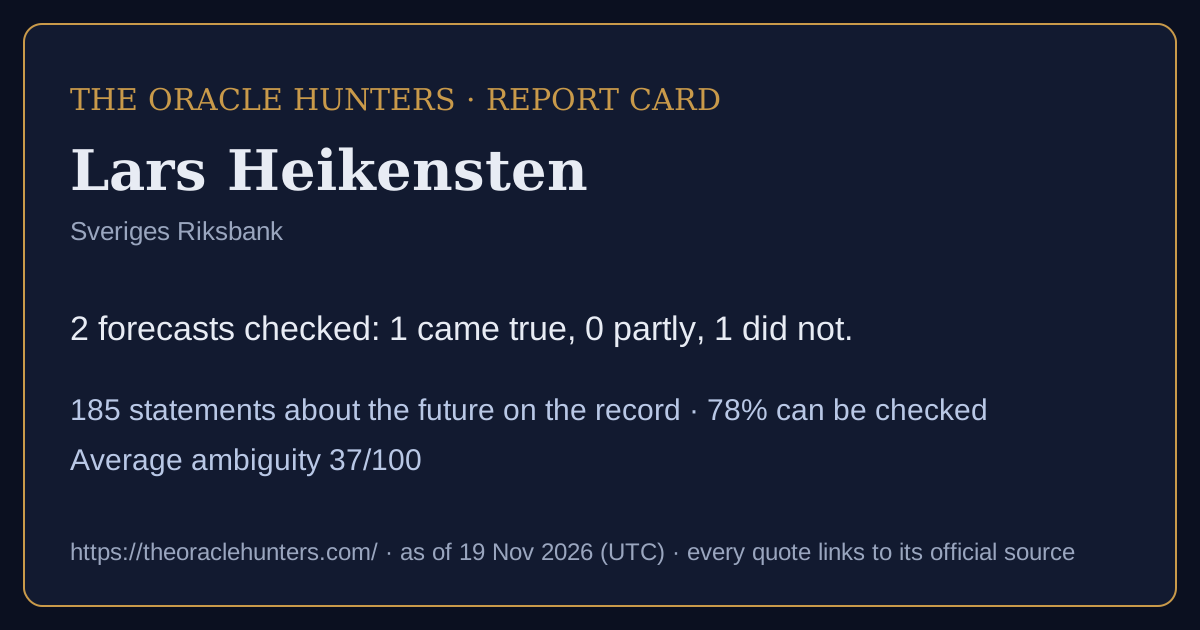
Lars Heikensten
Sveriges Riksbank
Track record: 2 forecasts checked: 1 came true, 0 partly, 1 did not.
185forecasts & commitments on the record
78%can be checked as stated
37average ambiguity (0-100)
0goalpost moves recorded
0confirmed U-turns
Timeline
came true partly did not not due / being checked / too vague
Calibration score: shown after 10 checked forecasts with a stated likelihood (now 1).
How they speak about the future: based on data 116, educated guess 44, stated on authority 25.
Kinds of claim: forecast 116, mixed claim 34, scenario (if… then) 34, commitment 1. · Download this report card as a picture
In the nine words
πρόγνωσιςInference from evidence109 · 59%πρόνοιαPreparing for the future34 · 18%μαντείαInspired knowledge23 · 12%εἰκασίαConjecture16 · 9%προαναγγελίαPublic pre-announcement1 · 1%πρόβλεψιςSeeing the signs1 · 1%φρόνησιςPractical wisdom1 · 1%
How to read this
Each box is one sentence a public figure or institution said about the future, word for word, with a link to the official text. Can be checked means it names what will happen, by when, and how likely - so it can be compared with official figures later. Too vague to check means it does not. Ambiguity (0-100) is how many different ways the sentence can be read. When the date passes, the forecast is compared with official data and marked came true, partly or did not come true. Labels judge the sentence, never the person. Full guide and glossary.Checked
GDP growth is estimated to be 2.3 per cent this year and 3.0 per cent next year.
Did not come true. Said: economic growth around 3% in 2006. Official figure for Sweden: 4.7% (World Bank open data). Missed. Off by 1.7 points. official data · checked 14 Nov 2026 · automatic check against official data (rules v3)
To sum up, the forecast in the main scenario is that Swedish GDP growth will be 3.6 per cent this year and 3.2 per cent a year in 2005 and 2006.
Came true. Said: economic growth around 3.2% in 2005. Official figure for Sweden: 2.8% (World Bank open data). On target. Off by 0.4 points. official data · checked 14 Nov 2026 · automatic check against official data (rules v3)
On the record (185)
Just as the Riksbank emphasised during 2003 and 2004 that the strong krona was one reason behind the low inflation rate, there is reason to point out that the weakening of the krona this year, particularly if it persists, could result in higher inflation,' said Mr Heikensten.
All in all, the global growth rate was expected to be between 3.5 and 4 per cent, which is slightly lower than last year, but still entails good opportunities for Swedish exports,' said Mr Heikensten.
For this year it is mainly the revision of the outcome for the first quarter that has affected the forecast.
Thereafter, it will gradually fall towards just over 2 per cent in 2008.
GDP growth is estimated to be 2.3 per cent this year and 3.0 per cent next year.
Did not come true. Said: economic growth around 3% in 2006. Official figure for Sweden: 4.7% (World Bank open data). Missed. Off by 1.7 points. official data · checked 14 Nov 2026 · automatic check against official data (rules v3)
According to this assumption the repo rate will remain at 1.5 per cent up to about the second quarter next year, when it gradually begins to be raised.
Our forecast is that the twelve-month change in the CPI will be 1.5 per cent in one year and 2.2 per cent in September 2007.
The announced labour market policy programmes for next year entails that total employment will rise more than regular employment, but there should also be an increase in the number of regular jobs.
However, it is fully possible that we will have reason to revise up our forecast for productivity growth even more in coming years.
The Government's recently announced labour market policy programmes for next year can be expected to entail that total employment will increase considerably more than regular employment.
Less expansionary economic policy is also expected to contribute to somewhat lower growth in 2007 and 2008.
The budget bill that was presented in September also suggests that fiscal policy, particularly in 2006, will be slightly more expansionary that we anticipated then.
Even though the start of the year did not turn out quite as weak as it seemed in June when we lowered the repo rate, it still appears that economic growth and resource utilisation this year will be markedly lower than we expected at the beginning of the year.
All in all, it appears that GDP growth abroad will continue to be high this year, albeit somewhat lower than last year.
If prices of various assets covary to a greater extent than before, the financial agents' risk exposure could increase rapidly.
The negative effects on the real economy will therefore be much less significant than if the central bank had merely reacted to the higher inflation and used an aggressive policy to rapidly bring inflation back in line.
The typical result of weighing up these considerations is that - unless it would threaten credibility - the central bank will allow much longer time for inflation to return to target level than if the rate of price increase had been pushed up by
This task often goes hand in hand with a stabilisation of the real economy; if demand in the economy develops in line with the long-term potential, it will often contribute to a stable development in inflation.
Nonetheless it can of course be maintained that employment could have been somewhat higher if the Riksbank had kept interest rates lower, something that would have been possible given what we now know about inflation.
The forecast for domestic cost pressures this year has been revised down somewhat all the same compared with the assessment in December on the basis of new data for 2004.
Compared with the December Inflation Report the forecast for GDP growth in 2005 has been revised up marginally to 3.2 per cent, mainly due to higher investment and increased services trade.
Individual monthly figures for inflation are difficult to forecast, however, and next month the forecast could just as easily overshoot the outcome.
price-dampening factors are also estimated to affect imported inflation in the period ahead, and the forecast has therefore been revised down both for this year and next.
Around this target is a tolerance band of +/- 1 percentage point, the purpose of which is both to make clear that inflation from time to time will deviate from 2 per cent and that the Riksbank's ambition is to limit such deviations.
On that occasion we left the rate unchanged despite the fact that inflation was forecast to be below our target of 2 per cent during the greater part of the next two years.
UND1X inflation is expected to be 1.4 per cent one year ahead and 2.0 per cent two years ahead, while the corresponding figures for CPI inflation are forecast to be 1.6 per cent and 2.5 per cent, respectively.
Private consumption and investment are expected to take over from exports as the main driving forces behind the pickup in demand in 2005 and 2006.
- Another question is how inflation could be so low thus far this year, despite growth being relatively high.
Coupled with the unexpectedly large price increases for oil and other commodities, this means that international price pressures are expected to be slightly higher than previously forecast, particularly this year and next year.
International economic activity is expected to continue to strengthen this year.
To sum up, the forecast in the main scenario is that Swedish GDP growth will be 3.6 per cent this year and 3.2 per cent a year in 2005 and 2006.
Came true. Said: economic growth around 3.2% in 2005. Official figure for Sweden: 2.8% (World Bank open data). On target. Off by 0.4 points. official data · checked 14 Nov 2026 · automatic check against official data (rules v3)
Growth this year of almost 4½ per cent now appears likely.
Our assessment in May was that economic growth in the United States would slow at the end of this year, chiefly due to the assumption that fiscal policy would be less expansionary.
The Riksbank's assessment in the latest Inflation Report in May was that international economic activity would continue to strengthen this year and during the coming two years.
GDP growth was forecast to average almost 3 per cent from 2004 to 2006.
Furthermore, in the case of Sweden it should be added that inflation is rising from a low level and that agreements in the labour market have been settled for 2005 and 2006, further reducing the risk of contagion effects via the jobs market.
For the euro area, it now appears reasonable to expect growth of 2 per cent this year and a slightly higher figure in the next two years.
Towards the end of the year, we made a downward adjustment in the inflation forecasts and the repo rate was cut by as much as it had been raised during the spring.
At the end of the two-year period that comprises the main focus of the forecasts, inflation according to UND1X is expected to be 1.6 per cent, on the assumption of an unchanged repo rate.
During 2004 UND1X inflation is expected to amount to an average of 0.6 per cent, which is 0.5 percentage points lower than the December forecast.
Inflation was expected to be below target level and we therefore cut the repo rate by 0.25 percentage points.
When we look ahead somewhat, we can conclude that the temporary fluctuations in energy prices, which have had a strong effect on inflation since the end of 2002 and pushed it down significantly in recent months, are expected to have abated by mid-2005.
As yet, there are few signs of a turnaround in the labour market and business tendency surveys indicate that the upturn in the private sector will be relatively weak this year.
On the whole, therefore, GDP growth may be roughly as we expected in the December Inflation Report and when we took our decision in February, reaching around 2.5 per cent per year in the years ahead.
Most factors still indicate that growth in household consumption will continue to be stable around 2.5 per cent in the
Against this background, most factors suggest that inflation in the next two years will be below the Riksbank's target.
There is reason to expect total rises in wage costs to average around 3.5 per cent in 2004 and 2005, which in terms of average collectively agreed levels leaves little room for more than about 2 per cent on average in the years ahead.
Growth in the OECD area could reach about 3 per cent this year and average around the same in 2005 and 2006.
If the forecast in this perspective indicates that inflation will be lower than 2 per cent, the repo rate should normally be cut and vice versa.
For instance, we might be forced to raise the interest rate even if economic activity weakened.
Showing the newest 50 - the ledger has all 185.
Also said - not checkable as stated (12 newest)
Remarks about the future with no date, figure or likelihood that could be checked. They are kept on the record and shown here, but not scored.
However, even if we should not - as I see it - change our basic assessment that the krona will strengthen, its value at present is rather different.
International growth was expected to remain good.
In the United States, the strong growth was expected to slacken somewhat, mainly due to tighter monetary policy.
This was expected to be counteracted to some extent by higher growth in the euro area.
One explanation could be that Swedish banks are just unusually well-capitalised.
The possible reasons for such a valuation discount are either that the expected profitability is lower for Swedish banks or that they are judged to be riskier than their European counterparts.
That might indicate that the limited improvement potential is due to Swedish banks already being highly efficient.
It may be the case that the Swedish banking sector is stingy rather than efficient.
The Swedish banking sector is in fact relatively small, in terms of assets in relation to GDP, but this is probably not explained by low lending, which is average, but by the fact that relatively speaking Sweden together with Finland has the lowest level of deposits among all EU15 countries.
It could quite simply be that Swedish bank customers prefer to use charge cards instead of cash, but that is not the case.
The risk management models in the financial institutions must be tested to a greater extent with regard to how they will function if market conditions change rapidly.
The trends and tendencies I intend to highlight today with regard to market agents' behaviour may be primarily observed outside of Sweden's borders - it is important to emphasise this.