Kwasi Kwarteng
Department for Business, Energy & Industrial Strategy · GBR
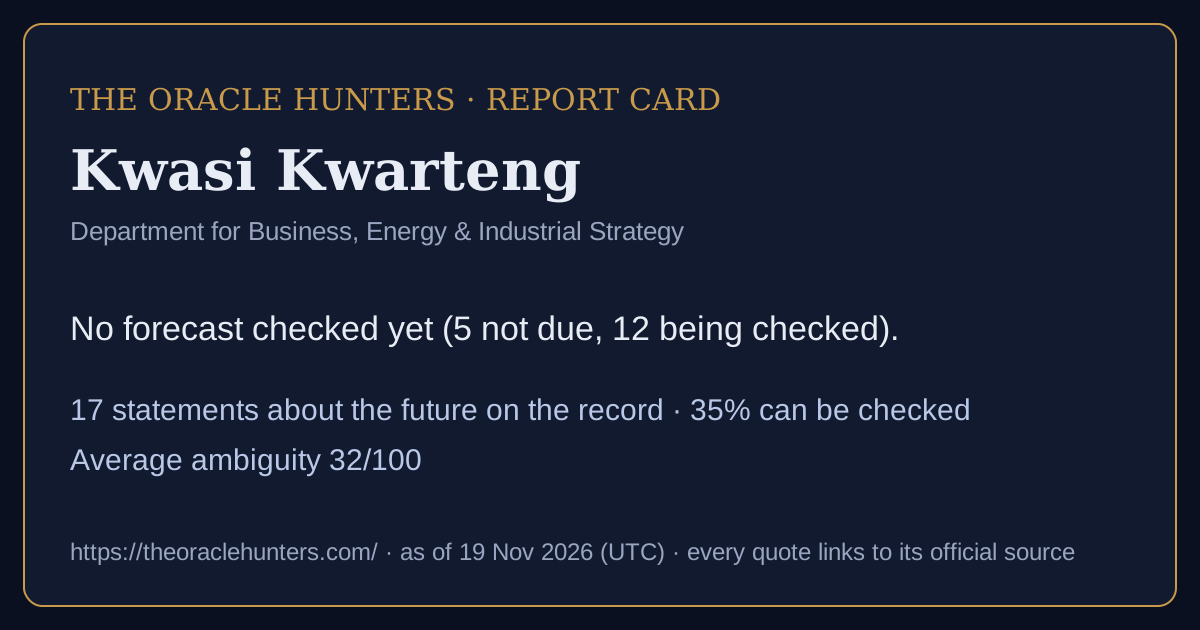
Track record: No forecast checked yet (5 not due, 12 being checked).
17forecasts & commitments on the record
35%can be checked as stated
32average ambiguity (0-100)
0goalpost moves recorded
0confirmed U-turns
Timeline
came true partly did not not due / being checked / too vague
Calibration score: shown after 10 checked forecasts with a stated likelihood (now 0).
How they speak about the future: based on data 11, stated on authority 6.
Kinds of claim: mixed claim 9, forecast 6, commitment 2. · Download this report card as a picture
In the nine words
πρόγνωσιςInference from evidence11 · 65%μαντείαInspired knowledge4 · 24%προαναγγελίαPublic pre-announcement2 · 12%
How to read this
Each box is one sentence a public figure or institution said about the future, word for word, with a link to the official text. Can be checked means it names what will happen, by when, and how likely - so it can be compared with official figures later. Too vague to check means it does not. Ambiguity (0-100) is how many different ways the sentence can be read. When the date passes, the forecast is compared with official data and marked came true, partly or did not come true. Labels judge the sentence, never the person. Full guide and glossary.On the record (17)
So taken together, Mr Speaker, we are cutting everyone’s energy bills by an expected £1,400 this year.
They will have heard reports that their already-expensive energy bills could reach as high as £6,500 next year.
Firstly, we will automatically sunset EU regulations by December 2023, requiring departments to review, replace or repeal retained EU law.
I can announce today that we will cut the basic rate of income tax to 19p in April 2023 – one year early.
We can announce that in the coming months, we will bring forward a new Bill to unpick the complex patchwork of planning restrictions and EU-derived laws that constrain our growth.
From April 2023, we will have a single higher rate of income tax of 40 per cent.
So, this summer, I will launch a Hydrogen Business Model and our Hydrogen Fund allocation round – with contracts awarded in 2023.
Next month, I will announce the results of Allocation Round 4 – our biggest renewable energy auction ever.
Then, later this year, we will update our planning policy and eliminate some of the bureaucracy, which can get offshore wind and solar projects off the ground.
And by the end of this year, we will no longer import any Russian fossil fuels.
This is how we will deliver net zero by 2050 – working in partnership with business, science, and academia.
The Contracts for Difference scheme, which launched again this year, will be bigger than ever.
By 2035 all our electricity will come from clean sources, subject of course to the security of supply.
And that is the agenda that we will be putting at the heart of our COP26 Presidency next year.
The OECD estimates that we will need nearly 7 trillion dollars a year up to 2030 to meet the Paris Agreement and the Sustainable Development Goals.
So we will continue to support stable, competitive markets to provide security in supply.
We will continue to work closely with actors across the sector to ensure that our energy system remains secure and reliable, within a competitive market framework.
Also said - not checkable as stated (12 newest)
Remarks about the future with no date, figure or likelihood that could be checked. They are kept on the record and shown here, but not scored.
Not only would that lead to thousands of job losses, but without gas, we will have no carbon capture and we will have no blue hydrogen production.
We have always been clear that shale gas could be part of our future energy mix, but we need to be led by the science and above all we need to have the support, the ongoing support of local communities.
We are going to replicate this success in other areas…like solar, tidal and hydrogen - the new super-fuel of tomorrow.
If the West doesn’t lead this global race, we will become even more exposed to forces we cannot control.
This week, the UK government will set out a new Energy Security Strategy to supercharge cheap renewables and new nuclear, while continuing support our North Sea oil and gas industry.
It remains the case that there will continue to be an ongoing demand for oil and gas over the coming decades while we transition to clean energy.
Old industries that haven’t innovated will disappear, jobs will be lost and the burden on the taxpayer will become excruciating.
For the first time, if we achieve our targets – and I’m confident we will – we will not be reliant on hydrocarbons.
In terms of forward publications, we look forward to the comprehensive Net Zero Strategy, which will be published in the next few weeks, and we’re convinced that we can, at COP26 in only three weeks time, we can show the world leadership that many people expect from the UK.
It will shift us away from volatile fossil fuels and also turbocharge our use of homegrown green technologies – from wind and hydrogen, to solar and Carbon Capture, Utilisation and Storage (CCUS).
With COP 26 on the horizon, this week the Prime Minister made a commitment that will help us lead and show the world how committed we are to the fight against climate change.
This all gives me and the UK great confidence for COP26 next year.