Krzysztof Rybiñski
National Bank of Poland
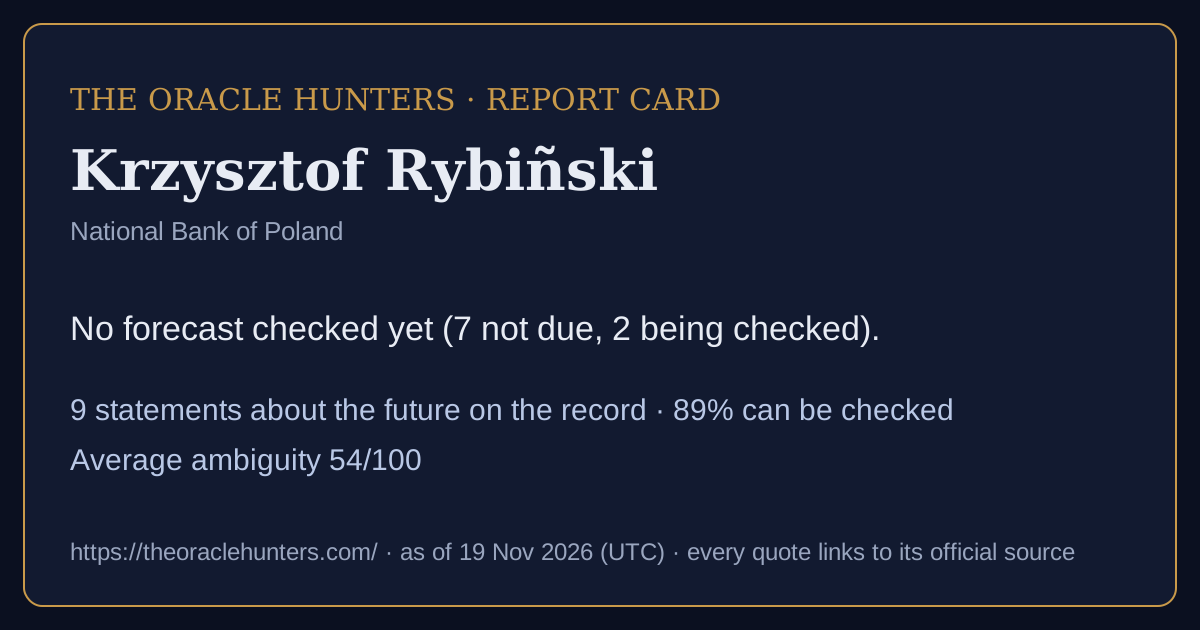
Track record: No forecast checked yet (7 not due, 2 being checked).
9forecasts & commitments on the record
89%can be checked as stated
54average ambiguity (0-100)
0goalpost moves recorded
0confirmed U-turns
Timeline
came true partly did not not due / being checked / too vague
Calibration score: shown after 10 checked forecasts with a stated likelihood (now 0).
How they speak about the future: based on data 4, educated guess 4, stated on authority 1.
Kinds of claim: scenario (if… then) 5, forecast 3, mixed claim 1. · Download this report card as a picture
In the nine words
πρόνοιαPreparing for the future5 · 56%πρόγνωσιςInference from evidence2 · 22%εἰκασίαConjecture1 · 11%μαντείαInspired knowledge1 · 11%
How to read this
Each box is one sentence a public figure or institution said about the future, word for word, with a link to the official text. Can be checked means it names what will happen, by when, and how likely - so it can be compared with official figures later. Too vague to check means it does not. Ambiguity (0-100) is how many different ways the sentence can be read. When the date passes, the forecast is compared with official data and marked came true, partly or did not come true. Labels judge the sentence, never the person. Full guide and glossary.On the record (9)
If we don't accelerate reforms we may still be lucky, there could be few years in a row with good global crops, or someone will finally produce cheap hydrogen-powered car to replace gasoline, resulting in a collapse of oil prices.
High corporate profits have provided a cushion yet, but, if this situation continues, many companies will be forced to raise prices to remain profitable.
It is worth keeping in mind that the share of food in the CPI basket is some 10 pp. higher in Poland than in the eurozone, so agflation, if it materializes, will lead to inflation divergence.
Finally, if strong exchange rate appreciation continues, we may just make it will both fiscal and inflation criteria, but we will enter eurozone with heavily overvalued exchange rate, which may harm growth for many years if not decades.
According to official government and NBP forecasts Poland will fulfill all eurozone entry criteria this year (fiscal deficit, public debt, inflation, long-term interest rates).
It is worth keeping in mind that the share of food in the CPI basket is some 10 pp. higher in CEE countries than in the eurozone, so agflation, if it materializes, will lead to inflation divergence.
For example, McKinsey Global Institute estimated that in 2008 ca. 160 million jobs in services, i.e. 11% of the global employment in services estimated at 1.46 billion, may theoretically be performed at a distance from the customer.
First, if borrowing accelerates massively, banks may start extending loans without properly checking their customers' creditworthiness - this could result in bad debt problems.
In a groundbreaking study Rose (2000) estimated that joining a currency union may boost cross-country trade by over 200%.
Also said - not checkable as stated (12 newest)
Remarks about the future with no date, figure or likelihood that could be checked. They are kept on the record and shown here, but not scored.
It is important to note that some costs will materialize if asymmetric shocks hit the enlarged eurozone.
As the tail wind of globalization is reversing these days, the most difficult challenge which CEE countries will have to face with is to keep fast real growth and, at the same time, to manage nominal convergence - indispensable condition of EMU graduation.
The tail wind of globalization will probably return in the medium run, but structural adjustments, which may take several years, must be completed first.
While part of this asset price and credit growth may be explained by structural factors often referred to as 'convergence', the observed rates of growth are clearly unsustainable and they contribute to economic imbalances.
Both the above-mentioned World Bank report and the paper 5 prepared by International Monetary Fund staff, also presented in Session 6, were aimed at identifying vulnerabilities and risks that might threaten the financial stability of CEE countries.
While the largest new EU member states seem to be still on the safe side, the Baltic states and, to a lesser extent, the emerging economies of South-Eastern Europe probably witness a credit boom that leads to significant macroeconomic imbalances and might ultimately end in a crisis.
These conclusions reinforce the findings of the papers presented in Session 1, which I have discussed before, that the Baltic states and the South-East European economies have probably already reached or even overshot the equilibrium level of credit to GDP.
booms from 'bad' ones, i.e. such that probably eventually lead to a banking crisis.
It has also established that booms that coincide with current account imbalances seem less dangerous (a finding that may seem counter-intuitive at a first glance), that trade openness is another factor that makes a crisis less probable, and that the more prolonged booms as well as those accompanied by high inflation or slow economic growth are the 'bad' ones.
This would probably lead to a deterioration of banks' asset portfolio - a result that cannot be ignored by monetary policymakers and bank supervision authorities.
Our knowledge about trade creation effects of the euro is still far from complete and we will probably have to wait another 10+ years to have enough data to draw firm conclusions about its magnitude in the eurozone.
First, there is no independent domestic monetary policy which could lower interest rates, and one should not expect the ECB to react to a local shock.