Koh Yong Guan
Monetary Authority of Singapore
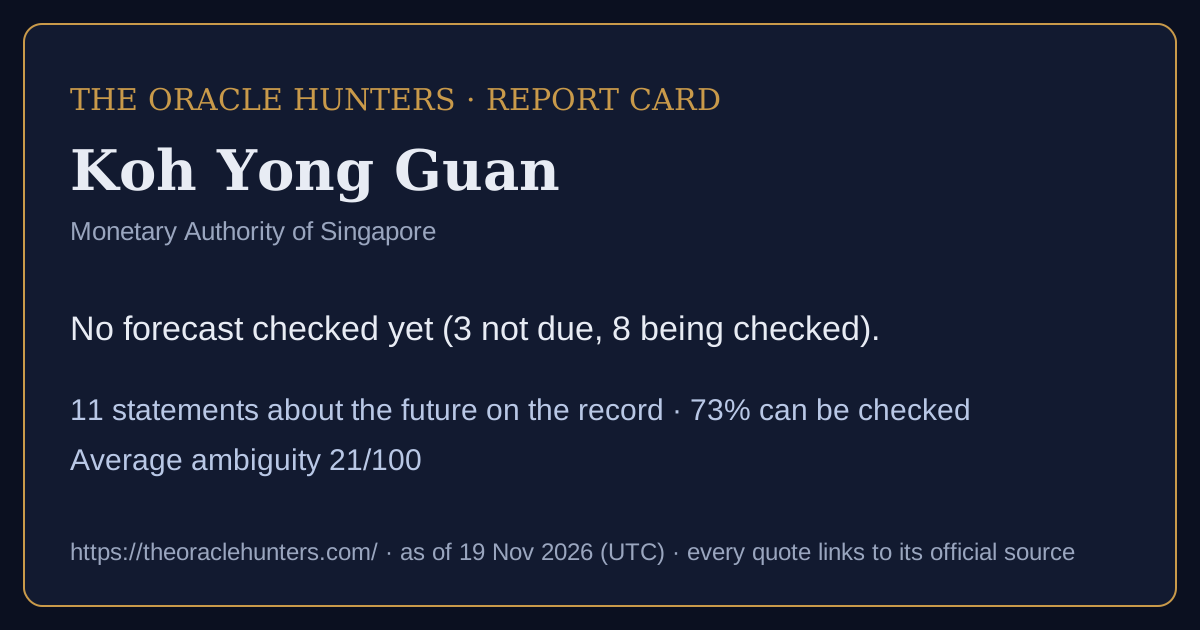
Track record: No forecast checked yet (3 not due, 8 being checked).
11forecasts & commitments on the record
73%can be checked as stated
21average ambiguity (0-100)
0goalpost moves recorded
0confirmed U-turns
Timeline
came true partly did not not due / being checked / too vague
Calibration score: shown after 10 checked forecasts with a stated likelihood (now 0).
How they speak about the future: based on data 7, stated on authority 4.
Kinds of claim: forecast 9, mixed claim 1, commitment 1. · Download this report card as a picture
In the nine words
πρόγνωσιςInference from evidence7 · 64%μαντείαInspired knowledge3 · 27%προαναγγελίαPublic pre-announcement1 · 9%
How to read this
Each box is one sentence a public figure or institution said about the future, word for word, with a link to the official text. Can be checked means it names what will happen, by when, and how likely - so it can be compared with official figures later. Too vague to check means it does not. Ambiguity (0-100) is how many different ways the sentence can be read. When the date passes, the forecast is compared with official data and marked came true, partly or did not come true. Labels judge the sentence, never the person. Full guide and glossary.On the record (11)
The forecast for CPI inflation in 2004 was hence revised upwards to the 1.5-2.0% range.
Notwithstanding the risks from rising interest rates, higher oil prices and a sharper than expected slowdown in China, the upturn in the global economy is likely to be sustained through the rest of this year and will support the continued expansion in the domestic economy.
We lowered our GDP forecast for 2003 to a range of 0.5-2.5 per cent.
In the financial sector, we will continue to partner with industry players to build on our successes in key growth areas like asset management, the debt market, and treasury business, while looking out for new niche areas and opportunities.
At the same time, inflation has turned out lower than expected, and the outlook is for inflation to remain subdued into 2004.
The financial sector is expected to post a small positive growth this year, following the 4.8 per cent contraction in 2002.
We will be undertaking an FSAP this year.
We invite you to send in your comments by May 2002.
To help financial institutions mitigate credit risk through information pooling, the Singapore Consumer Credit Bureau will be launched in September this year.
Looking ahead, we expect the growth momentum to be sustained for the rest of 2000 and to moderate only slightly next year.
We expect CPI inflation to edge up slightly, to about 1-2% in 2000 and 2001.
Also said - not checkable as stated (12 newest)
Remarks about the future with no date, figure or likelihood that could be checked. They are kept on the record and shown here, but not scored.
We will continue to work closely with the Singapore-incorporated banks to assess the impact of the New Framework and determine how best to adapt the proposals for Singapore.
We will work with the industry to continue to develop a more dynamic, competitive and vibrant financial sector.
The labour market is also expected to strengthen, with the unemployment situation improving for the rest of the year.
We issued details of changes to the capital adequacy requirements for Singapore-incorporated banks in May 2004.
We will continue to refine our regulatory and supervisory framework as we progressively shift the emphasis from a rule-based regime to a risk-based and disclosure-based approach.
With the expected pick-up in domestic and regional economic activity in H2 2003, we are also likely to see further improvement in commercial banking.
The establishment of international standards and best practices as the way forward will become even more compelling as globalisation continues, and regulators should be prepared to stay engaged with the process.
Keynote address by Mr Koh Yong Guan, Managing Director of the Monetary Authority of Singapore, at the MAS Capital Markets Seminar 2002, Singapore, 2 May 2002.
The presentations by leading industry practitioners will add an important market dimension.
As an example, a localised weak link in clearing and custody networks used for cross-border transactions that buckles under stress will have far reaching repercussions on the smooth functioning of counterparties and markets in other jurisdictions.
Improvements to comply with globally accepted principles will benefit the market's growth and in the long term attract participants with strong internal controls.
Stress testing consists of assessing the attributes of a portfolio, assessing the scenarios that are likely to occur and calculating the stress loss should a crisis come to pass.