Klaus Liebscher
Austrian National Bank
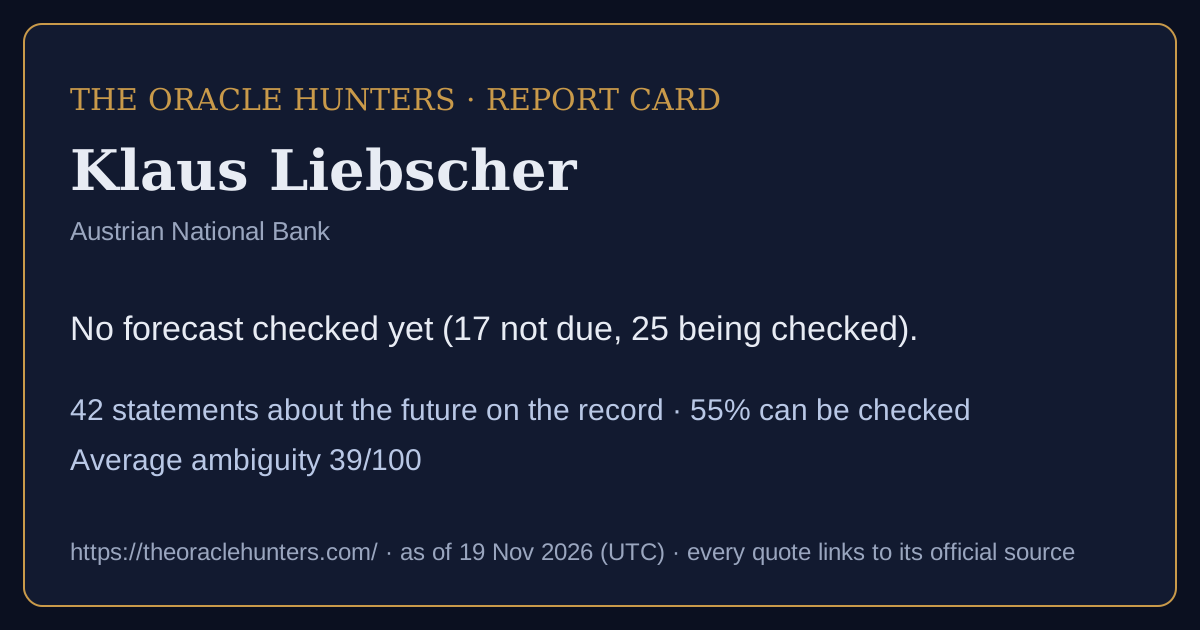
Track record: No forecast checked yet (17 not due, 25 being checked).
42forecasts & commitments on the record
55%can be checked as stated
39average ambiguity (0-100)
0goalpost moves recorded
0confirmed U-turns
Timeline
came true partly did not not due / being checked / too vague
Calibration score: shown after 10 checked forecasts with a stated likelihood (now 0).
How they speak about the future: based on data 36, stated on authority 5, educated guess 1.
Kinds of claim: forecast 35, mixed claim 3, commitment 3, scenario (if… then) 1. · Download this report card as a picture
In the nine words
πρόγνωσιςInference from evidence36 · 86%προαναγγελίαPublic pre-announcement3 · 7%μαντείαInspired knowledge2 · 5%πρόνοιαPreparing for the future1 · 2%
How to read this
Each box is one sentence a public figure or institution said about the future, word for word, with a link to the official text. Can be checked means it names what will happen, by when, and how likely - so it can be compared with official figures later. Too vague to check means it does not. Ambiguity (0-100) is how many different ways the sentence can be read. When the date passes, the forecast is compared with official data and marked came true, partly or did not come true. Labels judge the sentence, never the person. Full guide and glossary.On the record (42)
On January 1, 2008, Cyprus and Malta are going to adopt the euro.
We are aware that structural improvements are only part of the reason for the current improvement in euro area fiscal balances, from -1.6% in 2006 to an expected -1.0% in 2007.
Concerning the outlook for prices, ECB staff projects annual inflation to average between 1.9% and 2.1% this year and between 1.5% and 2.5% in 2008.
The ECB staff projections from September 2007 see growth ranging from 2.2% to 2.8% in 2007 and from 1.8% to 2.8% in 2008, even though risks are tilted to the downside.
We are aware that structural improvements are only part of the reason for the current improvement in euro-area fiscal balances, from -1.6% in 2006 to an expected -1.0% in 2007.
Given the vigorous monetary and credit growth in an environment of already ample liquidity, the Governing Council of the ECB will continue to be strongly vigilant in order to ensure that risks to price stability over the medium term do not materialize.
Concerning the outlook for prices, the ECB staff projects annual inflation to average between 1.5% and 2.1% this year and between 1.4% and 2.6% in 2008.
The ECB staff projections from March 2007 see growth ranging between 2.1% and 2.9% in 2007 and between 1.9% and 2.9% in 2008.
This is defined as an inflation rate of below, but close to 2% over the medium term.
We are aware that the present improvement of fiscal balances in the euro area, from -2.4% in 2005 to an expected -1.6% in 2006 3 , is only partly driven by structural improvements.
For 2008, our staff expects some growth acceleration for Hungary, and some moderation in the other countries mentioned.
The ECB staff projections from March 2007 foresee annual inflation averaging between 1.5% and 2.1% this year and between 1.4% and 2.6% in 2008.
The ECB staff projections foresee growth in a range between 2.1% and 2.9% in 2007 and between 1.9% and 2.9% in 2008.
For the three EU members Czech Republic, Hungary and Poland, and also for Russia, the staff of our Bank forecasts annual real GDP growth to range between 5% in the Czech Republic, 6% in Poland and 6 ½% in Russia, while economic activity in Hungary is expected to slow down to less than 3% this year, as necessary austerity measures …
I am happy that Slovenia has managed to fulfill all these requirements and thus will join the euro area in January, 2007, as the first country among the new EU Member States.
Let me at this point express how pleased I am that Bulgaria and Romania will join the EU as new members in January 2007.
In addition to the wholesale financial infrastructure, I would like to mention the field of retail payments, namely the Single Euro Payments Area (SEPA) project, an initiative of the European banking industry, which will go live in 2008.
The 2005 tax reform is expected to raise the deficit to 1.8% in 2005.
The OeNB recently forecast real GDP to grow by 2.0% in 2005 and 2.2% in the next two years.
Austria's current account surplus amounted to 0.3% of GDP in 2004 and is expected to improve further in the course of this year.
The aim of the Eurosystem to maintain inflation rates close to but below 2% over the medium term is widely accepted.
The latest - but not last - enlargement of the EU by 10 new member states in May 2004 has brought the definite end to the division of Europe into 'East' and 'West.' Bulgaria's and Romania's EU accession treaties are scheduled to be signed on April 25 - in less than a month - and we hope to see Bulgaria …
This new location which has been in use since May of this year will guarantee continuity in training for the years to come.
On the one hand, we will investigate the importance of the above-mentioned factors for the success of the past integration process within the European Union as well as for the ongoing transition process in the current group of acceding countries.
While over the short term, inflation may show some volatility reflecting temporary factors, inflation rates are expected to remain in line with the Eurosystem's definition of price stability of below[, but close to] 2% over the medium term.
We need a binding commitment by each Member State on the concrete reform steps that it will implement until 2010.
The Stability and Growth Pact obliges euro area member states to achieve budgetary positions close to balance or in surplus in a sustainable manner, in order to minimize the risk of breaching the budget deficit criterion of 3% of GDP in the course of a business cycle.
Economic and monetary integration of the accession countries will proceed in three stages: first, the acceding countries will join the EU in May 2004, second, the new Member States will participate in ERM II, the exchange rate mechanism of the EU, for at least two years, and third, after the sustainable fulfilment of all the convergence criteria laid down in …
If oil prices moderate, as indicated by futures, inflation rates in the euro area will most likely fall below 2% in the course of 2003 and should remain at levels in line with price stability thereafter.
In addition, I would like to point out that those of you who are interested in getting more information about all these issues may consult the most recent editions of the "Focus on Austria" as well as the "Focus on Transition" of the Oesterreichische Nationalbank, whose general theme ties in with the topic of this year's Vienna International Summer University.
The Stability and Growth Pact obliges participating EU Member States to achieve budgetary positions close to balance or in surplus in a sustainable manner, in order to minimize the risk of breaching the budget deficit criterion of 3 % of GDP, according to the Treaty of Maastricht, in the course of a business cycle.
Thus I am confident that the world economy, after a temporary slowdown, will return to healthier growth rates in the course of 2002.
However, the terrorist attacks on the U.S. have further dampened global economic activity in 2001 and will postpone an economic rebound at least for one or two quarters in 2002.
But the latest forecasts confirm that inflation will most likely fall below 2 % in the first half of 2002.
But the euro will only be able to fulfil this expectations if it is a stable currency strengthened by a determined monetary policy, structural reform and wage moderation.
So, when from January 2002 onwards, you take out a euro banknote or coin to pay the newspaper, you will be reminded that you are a citizen of Europe.
Starting on 1 January next year, national banknotes and coins will be replaced with euro-denominated cash.
I am convinced that we will cope also with future economic downturns in as timely and appropriate a manner as we did with the recent period of high growth.
And I am convinced that the changeover to euro cash at the beginning of 2002 will further enhance public support for the euro.
Moreover, as it is imperative to contain upward pressure on prices in the medium term, the Governing Council of the ECB has gradually raised the interest rate on the main refinancing operations by a total of 2.25 percentage points to 4.75% since November 1999.
The Governing Council of the ECB has decided that price stability should be defined as a year-on-year increase in the Harmonized Index of Consumer Prices (HICP) for the euro area of below 2%, and that this objective has to be achieved over the medium term.
Let me just mention that - due to the Asian and Russian crises - some regions of the euro area will experience substantially lower growth this year than last year, and for the same reasons real growth in the euro area as a whole dropped from around 3% in 1998 to an estimated 2.1% this year.
Also said - not checkable as stated (12 newest)
Remarks about the future with no date, figure or likelihood that could be checked. They are kept on the record and shown here, but not scored.
Under this condition, differences in interest rates between two economies should be equal to the expected change in exchange rates between their currencies.
1. the trade channel probably is the most obvious way in which currency developments can impact the economy.
An appreciation is likely to entail a negative trade balance, as the prices of foreign currency-denominated exports increase while import prices fall.
The outlook for price stability over the medium term is subject to upside risks as increased oil, commodity and food prices as well as the favorable labor market situation are likely to make higher wage settlements possible.
Taken together these functions may help build confidence - probably the most essential task central banks have.
The role of the euro as a settlement currency for exports of goods from euro area countries appears to have stabilized, while its share in the invoicing and settlement of imports of goods declined during the review period, probably in conjunction with developments in energy markets.
In the meantime, high oil prices are perceived as a rather structural and probably lasting event, which is going to allow oil exporters to spend more of their energy-related income on imports, thereby ameliorating global imbalances.
Because ultimately, the - at least in the longer term - necessary rebalancing of the imbalances will be accompanied by significant shifts of productive factors from and to tradedand non-traded sectors, respectively shifting resources between export orientated- and domestic demand orientated sectors.
The Governing Council of the ECB will continue to support this upswing by acting vigorously to maintain price stability.
Risks to the medium-term outlook for price stability remain on the upside, relating in particular to stronger than currently expected wage developments in a context of ongoing robust growth in employment and economic activity.
Speech by Dr Klaus Liebscher, Governor of the Austrian National Bank, at the Southeastern European Financial Forum, Bucharest, 17 May 2007.
Stress tests indicate that the banks' exposure is manageable and potential contagion effects on Austrian banks should be very limited.