Kikuo Iwata
Bank of Japan
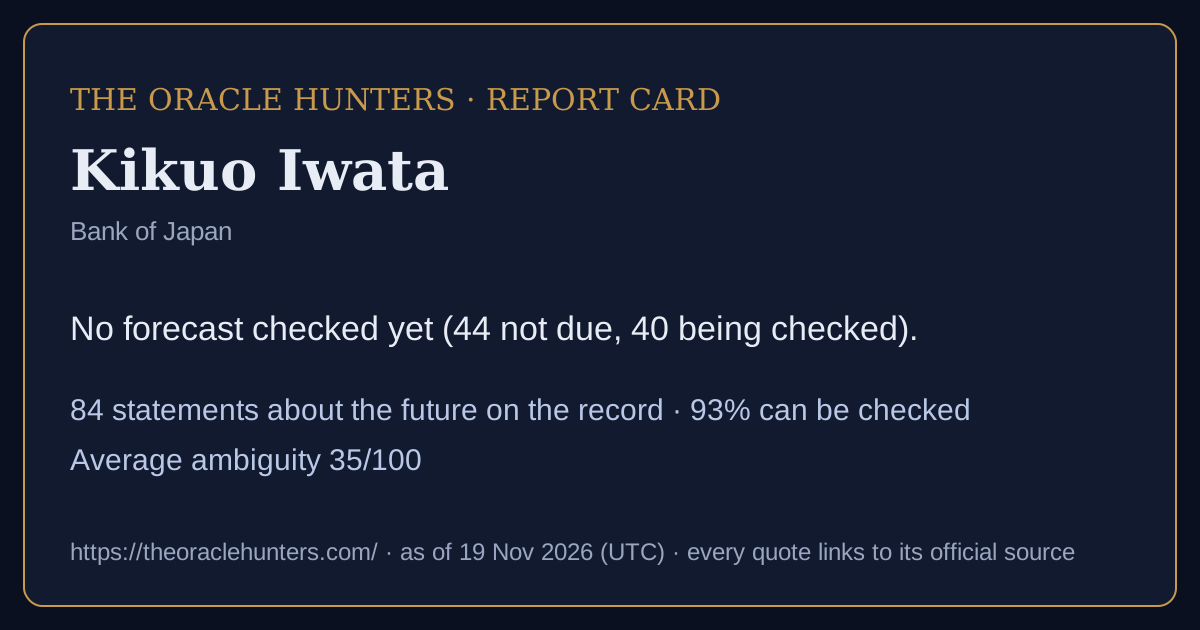
Track record: No forecast checked yet (44 not due, 40 being checked).
84forecasts & commitments on the record
93%can be checked as stated
35average ambiguity (0-100)
0goalpost moves recorded
0confirmed U-turns
Timeline
came true partly did not not due / being checked / too vague
Calibration score: shown after 10 checked forecasts with a stated likelihood (now 0).
How they speak about the future: based on data 76, educated guess 4, stated on authority 4.
Kinds of claim: forecast 67, mixed claim 10, scenario (if… then) 4, commitment 3. · Download this report card as a picture
In the nine words
πρόγνωσιςInference from evidence75 · 89%προαναγγελίαPublic pre-announcement3 · 4%πρόνοιαPreparing for the future3 · 4%εἰκασίαConjecture1 · 1%μαντείαInspired knowledge1 · 1%φρόνησιςPractical wisdom1 · 1%
How to read this
Each box is one sentence a public figure or institution said about the future, word for word, with a link to the official text. Can be checked means it names what will happen, by when, and how likely - so it can be compared with official figures later. Too vague to check means it does not. Ambiguity (0-100) is how many different ways the sentence can be read. When the date passes, the forecast is compared with official data and marked came true, partly or did not come true. Labels judge the sentence, never the person. Full guide and glossary.On the record (84)
This is the Bank's strong commitment that it will continue expanding the monetary base until the year-on-year rate of increase in the actual CPI exceeds 2 percent and stays above that level in a stable manner.
With a view to achieving further growth in Japan's economy, I strongly expect that the government will set an appropriate pace for fiscal austerity, as I described earlier, and that it will carry out growth strategy -- such as competition policy -- appropriately and powerfully.
Bearing this mechanism in mind, the January 2018 Outlook Report shows that the medians of the Policy Board members' forecasts of the year-on-year rate of change in the CPI excluding fresh food are 0.8 percent for fiscal 2017, 1.4 percent for fiscal 2018, and on a basis excluding the effects of the consumption tax hike, 1.8 percent for fiscal 2019 …
In fiscal 2019, business fixed investment is likely to decelerate, mainly reflecting Olympic Games-related demand peaking out, and household spending is likely to turn to a decline in the second half of the fiscal year due to the effects of the scheduled consumption tax hike.
Although the growth pace is projected to decelerate, the economy is expected to continue expanding, with the projected real GDP growth rate at 0.7 percent for fiscal 2019, as an increase in exports on the back of the growth in overseas economies underpins the economy .
According to the January 2018 World Economic Outlook (WEO) Update released by the International Monetary Fund (IMF), the global GDP growth rates for both 2018 and 2019 are expected to register relatively high growth of 3.9 percent, exceeding the long-term average since the 1990s (Chart 2).
This is the Bank's strong commitment that it will continue expanding the monetary base until the year-on-year rate of increase in the observed CPI exceeds 2 percent and stays above that level in a stable manner.
Against this backdrop, although uncertainty about future developments in inflation expectations warrant attention, Japan's inflation rate is likely to gradually increase toward the price stability target of 2 percent.
Under these circumstances, Japan's economy is likely to continue expanding and keep growing at a pace above its potential, mainly through fiscal 2018.
Looking ahead, from fiscal 2017 through fiscal 2018, improvement in overseas economies and the government's large-scale stimulus measures that were formulated last year are expected to clearly have positive effects on the economy.
Some economists argue that there may be no need to aim at higher inflation than the current level as Japan's economic growth rate has been increasing, or that 1 percent -- instead of 2 percent -- is appropriate for Japan's price stability target level since the inflation rate does not accelerate easily in Japan.
The latest World Economic Outlook (WEO) released by the International Monetary Fund (IMF) projects that the global economic growth rate will increase, registering 3.1 percent in 2016, 3.5 percent in 2017, and 3.6 percent in 2018 (Chart 2).
As the background to these developments, we can point to anticipation of firms undertaking fixed investment from a relatively longer perspective, such as that (1) for growth areas, in view of the 2020 Tokyo Olympics, and (2) in labor-saving machinery and equipment in order to deal with labor shortages.
As the output gap improves -- as will likely be seen in a further decline in the unemployment rate -- and medium- to long-term inflation expectations rise thereafter, the rate of change is expected to increase toward 2 percent in the second half of the projection period.
With regard to the outlook for prices, the year-on-year rate of change in the consumer price index (CPI) for all items less fresh food is likely to be slightly negative or about 0 percent for the time being mainly due to the effects of the decline in energy prices.
The first point is that the negative contribution of the decline in energy prices to the annual CPI inflation rate for all items less fresh food is expected to dissipate and almost no effects of this are projected to be seen in early 2017.
In this situation, exports are projected to remain more or less flat for the time being, due to downward pressure exerted by the slowdown in overseas economies and the past appreciation of the yen, but to moderately increase from the turn of fiscal 2017 as the effects of the slowdown in overseas economies and the appreciation of the yen are …
Real GDP is likely to continue growing at a pace above the potential growth rate through the projection period -- that is, through fiscal 2018 -- at around 1 percent.
It will examine risks to economic activity and prices, and take additional easing measures in terms of three dimensions - quantity, quality, and the interest rate - without hesitation if it is judged necessary for achieving the price stability target.
With a view to achieving the price stability target of 2 percent at the earliest possible time, the Bank will conduct a comprehensive assessment of the developments in economic activity and prices under "QQE" and "QQE with Negative Interest Rate" as well as these policy effects at the next MPM.
The Bank will purchase ETFs so that their amount outstanding will increase at an annual pace of about 6 trillion yen (almost double the previous pace of about 3.3 trillion yen)
Real GDP forecasts made in April 2016 factor in the expected front-loaded increase and subsequent decline in demand prior to and after the consumption tax hike that had been planned to take place in April 2017.
Given these projections, the baseline scenario is that the timing of the year-on-year rate of change in the CPI reaching around 2 percent will be during fiscal 2017.
The Bank will continue with 'QQE with a Negative Interest Rate,' aiming to achieve the price stability target of 2 percent, as long as it is necessary for maintaining that target in a stable manner.
The first is a clear commitment under which the Bank will achieve the price stability target of 2 percent in terms of the year-on-year rate of change in the consumer price index (CPI) at the earliest possible time, with a time horizon of about two years.
As shown in the Outlook for Economic Activity and Prices (hereafter the Outlook Report) released at the end of October, the outlook in terms of the median of the Policy Board members' forecasts of the real GDP growth rate was 1.2 percent for fiscal 2015 and 1.4 percent for fiscal 2016.
Turing to the outlook, Japan's economy through fiscal 2016 is likely to continue growing at a pace above its potential, which is estimated to be around 0.5 percent or lower recently.
On this basis, the year-on-year rate of increase in the CPI including energy is projected to reach around 2 percent around the second half of fiscal 2016, taking into account such developments as those in crude oil futures prices.
In the Bank's current outlook for prices, the timing in which the year-on-year rate of change in the CPI (all items less fresh food) reaches around 2 percent is projected to be around the second half of fiscal 2016.
As shown in the October 2015 World Economic Outlook (WEO) published by the International Monetary Fund (IMF), global growth for this year is projected to decline somewhat to 3.1 percent, but for 2016, it is projected to moderately accelerate on the whole and register 3.6 percent (Chart 2).
The short-term effects of the decline in crude oil prices are expected to dissipate gradually from the second half of fiscal 2015, assuming that crude oil prices will rise moderately from around the recent level, though the timing of this depends on developments in crude oil prices.
In the Bank's April 2015 Outlook for Economic Activity and Prices (hereafter the Outlook Report), the Policy Board members' forecasts of the real GDP growth rate were around 2 percent for fiscal 2015, around 1.5 percent for fiscal 2016, and in the range of 0.0-0.5 percent for fiscal 2017 (Chart 5).
Thereafter, through fiscal 2017, the economy is projected to maintain its positive growth, although with a slowing in its pace to around a level somewhat below the potential growth
Against this backdrop, Japan's economy is likely to continue growing at a pace above its potential from fiscal 2015 through fiscal 2016.
Although the timing of reaching around 2 percent depends on developments in crude oil prices, it is projected to be around the first half of fiscal 2016, assuming that crude oil prices will rise moderately from the recent level.
According to the April 2015 World Economic Outlook (WEO) released by the International Monetary Fund (IMF) last month, global economic growth is projected to accelerate moderately on the whole: after registering 3.4 percent in 2014, it is projected to be 3.5 percent in 2015 and 3.8 percent in 2016 (Chart 2).
2 percent around the middle of the projection period; that is, in or around fiscal 2015.
Clear commitment that the BOS "will achieve the price stability target of 2% at the earliest possible time, with a time horizon of about 2 years."
The weighted average Is calculated based on the following assumption: survey responses chosen by households as their expected inflation rates --"-5% or below," "from -5% to -2%," "from -2% to 0%," "from 0% to +2%," "from 12% to 15%," and "+5% or above" --indicate inflation rates of -5%, -3.5%, -1%, 11%, 13.5%, and 15%, respectively.
Sendai City will host next month the United Nations World Conference on Disaster Risk Reduction, the cumulative number of participants of which is expected to be more than 40,000, and has announced itself as a candidate for the 2016 Summit Meeting.
However, as developments in actual prices and inflation expectations will mutually feed back, if there is downward pressure on actual prices, even for a short term, we should take a risk into account that it will delay the conversion of the deflationary mindset.
That for fiscal 2016 will likely be more or less unchanged from the October forecast.
In addition, with the declining birthrate, the proportion of people aged 65 years and older is expected to rise to nearly 30 percent by 2020.
Given this assessment of the regional economy, I hope that the extension of the Hokuriku Shinkansen line to Kanazawa in March 2015 will further boost economic activity in the region on both the tourism and the business front.
While the year-on-year rate of change in scheduled cash earnings had been on a downtrend reflecting the increase in the share of part-time workers in total employment, scheduled cash earnings stopped declining in May this year and started to increase in June.
Looking at the median of the Policy Board members' forecasts in the interim assessment of the Outlook Report at the July MPM, projections for the year-on-year growth rate in the CPI (excluding fresh food) are plus 1.3 percent for fiscal 2014, plus 1.9 percent for fiscal 2015, and plus 2.1 percent for fiscal 2016, after excluding the direct effects of …
and medium- to long-term inflation expectations rising, the year-on-year rate of change in the CPI is expected to follow an uptrend again and reach about 2 percent around the middle of the current projection period from fiscal 2014 through 2016, that is, in or around fiscal 2015.
This is also confirmed by the World Economic Outlook Update published in July by the International Monetary Fund: global economic growth, which slowed to 3.2 percent in 2013, is projected to accelerate gradually to 3.4 percent in 2014 and 4.0 percent in 2015 (Chart 6).
Looking at the median of the Policy Board members' forecasts, real GDP is projected to grow at 1.0 percent in fiscal 2014, 1.5 percent in fiscal 2015, and 1.3 percent in fiscal 2016 (Chart 5).
On the other hand, if the potential growth rate rises as a result of structural reforms under the growth strategy, the output gap might temporarily worsen, leading to downward pressure on prices.
Showing the newest 50 - the ledger has all 84.
Also said - not checkable as stated (2 newest)
Remarks about the future with no date, figure or likelihood that could be checked. They are kept on the record and shown here, but not scored.
We will maintain close cooperation with the Financial Services Agency and relevant organizations.
The Bank of Japan will continue to promote financial education through the activities of the council.