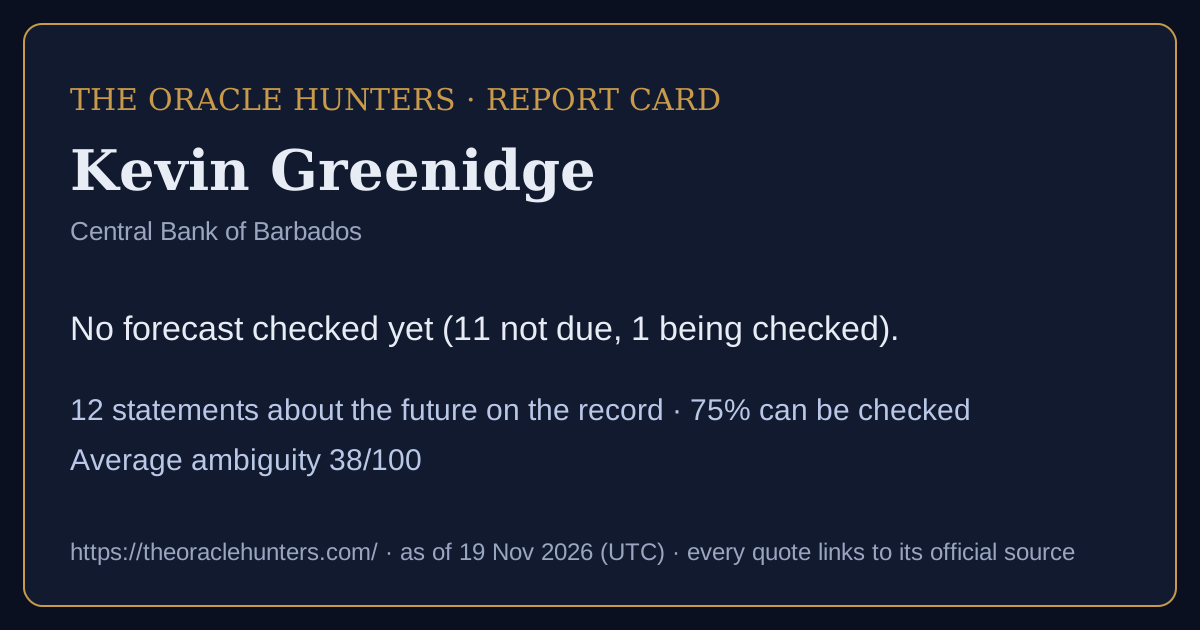
Kevin Greenidge
Central Bank of Barbados
Track record: No forecast checked yet (11 not due, 1 being checked).
12forecasts & commitments on the record
75%can be checked as stated
38average ambiguity (0-100)
0goalpost moves recorded
0confirmed U-turns
Timeline
came true partly did not not due / being checked / too vague
Calibration score: shown after 10 checked forecasts with a stated likelihood (now 0).
How they speak about the future: based on data 12.
Kinds of claim: forecast 11, mixed claim 1. · Download this report card as a picture
In the nine words
How to read this
Each box is one sentence a public figure or institution said about the future, word for word, with a link to the official text. Can be checked means it names what will happen, by when, and how likely - so it can be compared with official figures later. Too vague to check means it does not. Ambiguity (0-100) is how many different ways the sentence can be read. When the date passes, the forecast is compared with official data and marked came true, partly or did not come true. Labels judge the sentence, never the person. Full guide and glossary.On the record (12)
The decision to maintain the policy rate reflects the Bank's assessment that the current policy stance remains appropriate to help limit later or second round effects from the external price shock and support inflation levels within the target range of between 4.0 and 6.0 per cent over the medium term.
In this context, the Bank anticipates that the current account balance will fall within a range of a deficit of 0.5 per cent of GDP to a surplus of 0.5 per cent for FY2025/26, compared with a surplus of 3.0 per cent of GDP recorded in FY2024/25.
Real GDP is also projected to grow on average by 1.0 to 2.0 per cent over the medium term.
With the gradual recovery of the economy, for FY2026/27 and FY2027/28, real GDP growth is forecast to be within the range of 1.0 to 3.0 per cent.
On the 15th of May, the Statistical Institute of Jamaica (STATIN) reported that headline inflation at April 2026 was 4.3 per cent, within the Bank's target range and in line with the outturn at March 2026.
Inflation in Jamaica is therefore forecast to trend upward over the June and September 2026 quarters beyond the 6.0 per cent upper limit of the Bank's target range.
- November 2024 debt for climate swap, nearly US$300 million, guarantees from multilateral partners, about US$110 million savings over ten years for the South Coast Water Reclamation Project, with sustainability linked targets and disaster and pandemic clauses.
Consider this striking reality: approximately US$5.4 billion in excess cash currently sits idle in central banks across our region - low or non-earning investments that could instead fuel transformative growth.
These programmes have been fully disbursed, and the Central Bank is currently collaborating with the Government of Barbados to negotiate a third round of funding from the IDB for USD 50 million, which will have an expanded focus of:
By the end of September 2023, we recorded a primary surplus of $274.9 million (2.1 percent of GDP), with a target of $218 million, and an overall fiscal deficit of $61.1 million (or -0.5 percent of GDP).
As the economy continues to grow, our debt-to-GDP will decline further, and we are on track to reach a ratio of 60 percent by FY 2035/36.
We expect growth of between 4 and 4.5 percent this year, and this expansion should moderate to about five percent in the medium term.
Also said - not checkable as stated (12 newest)
Remarks about the future with no date, figure or likelihood that could be checked. They are kept on the record and shown here, but not scored.
Members should expect careful lending decisions, sound liquidity management, strong internal controls and boards that understand the risks they oversee.
Barbadians knew this principle long before the first credit union: the meeting turn, where each person put in what they could and trusted the others to do the same.
A young enterprise may need patient equity before it can safely carry debt, and credit unions can help members understand that difference without becoming venture-capital funds.
Members should attend meetings, read financial reports, ask questions, vote in elections and take an interest in the institution's future.
People need to know how to budget, avoid unsustainable debt, build emergency savings, plan for retirement, understand investment risk and distinguish an attractive offer from a sound financial decision.
We must raise productivity and competitiveness, maintain credible public finances, strengthen domestic and regional financial markets, move climate resilience from aspiration to implementation, and invest in the people who will carry the transformation forward.
But I also felt it important to speak to you directly, even through a screen, because the subject you have placed before this conference could not be more timely.
The second, BERT 2022, moved from stabilisation to transformation, asking how Barbados could build a more resilient, more productive, and more climate-aware economy.
In practical terms, climate could no longer sit at the side of economic management; it had to move to the centre.
The point is that climate resilience has to move from the language of environment ministries into the language of finance ministries, central banks, regulators, investors, and insurers.
We must finance adaptation without simply adding more debt to already vulnerable countries.
And if we do it together, the Caribbean and the Pacific, we will be more than resilient.