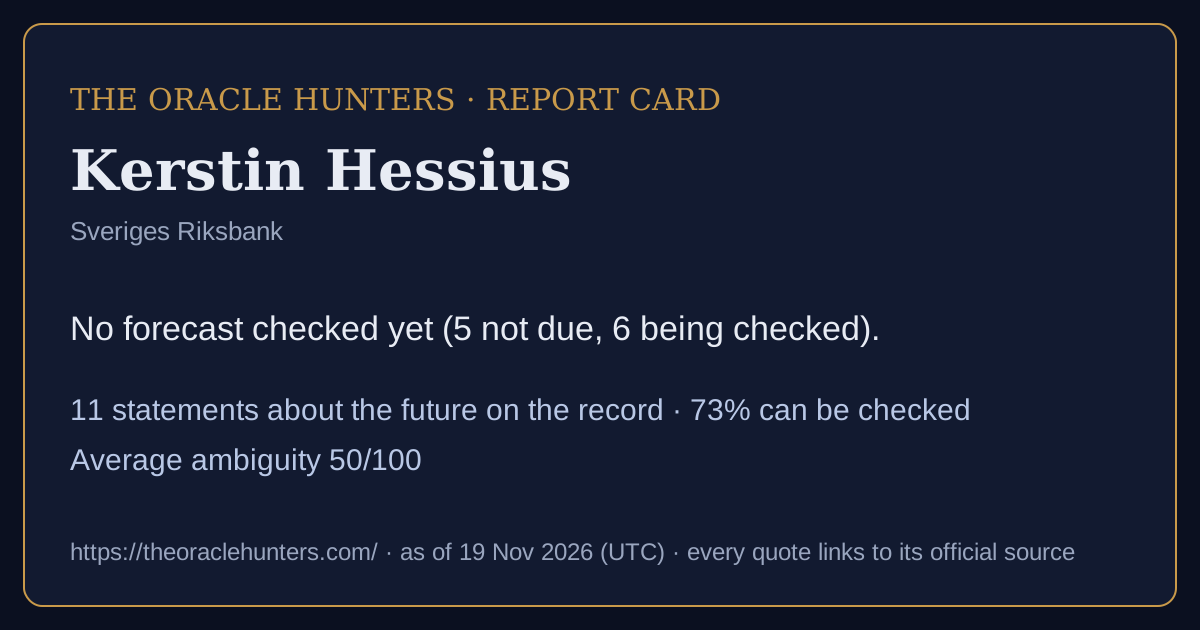
Kerstin Hessius
Sveriges Riksbank
Track record: No forecast checked yet (5 not due, 6 being checked).
11forecasts & commitments on the record
73%can be checked as stated
50average ambiguity (0-100)
0goalpost moves recorded
0confirmed U-turns
Timeline
came true partly did not not due / being checked / too vague
Calibration score: shown after 10 checked forecasts with a stated likelihood (now 0).
How they speak about the future: stated on authority 5, based on data 3, educated guess 3.
Kinds of claim: forecast 8, scenario (if… then) 3. · Download this report card as a picture
In the nine words
μαντείαInspired knowledge5 · 45%πρόνοιαPreparing for the future3 · 27%πρόγνωσιςInference from evidence3 · 27%
How to read this
Each box is one sentence a public figure or institution said about the future, word for word, with a link to the official text. Can be checked means it names what will happen, by when, and how likely - so it can be compared with official figures later. Too vague to check means it does not. Ambiguity (0-100) is how many different ways the sentence can be read. When the date passes, the forecast is compared with official data and marked came true, partly or did not come true. Labels judge the sentence, never the person. Full guide and glossary.On the record (11)
Moreover, if the stimulation provided by fiscal policy is very powerful, this could lead to expectations of an increased risk that the inflation target cannot be upheld, which would then lead to rising inflation expectations and higher risk premiums on Swedish interest-bearing papers.
However, in the past three years growth has amounted to more than 4% on average, which means that the OECD regards some of the factors discussed above as temporary in nature and expects growth to slacken as these factors die away.
Public finances have improved considerably, from a deficit of 5% of GNP in 1991 to an expected surplus of around 1% this year.
In other words, I think that it is a wiser basic strategy to concentrate on making sure that the economy does not overheat - which leads to recessions - than to count on large hypothetical improvements in future productivity which, if they do not materialise, will involve loss of credibility and a drastic slowing down of the economy similar to …
If central banks took action to stop asset prices falling below a certain level, the players in financial markets might attach less importance to a rigorous analysis of economic fundamentals.
The repo rate is currently 2.9% and monetary policy is expansive, which may cause real GDP to increase faster than the economy can cope with in the long run.
Most observers, including the Riksbank, have substantially revised their forecasts for GDP growth for this year and for following years.
Although in my judgement the risk of liquidity problems in the run-up to the coming year-end is small, it is of course never possible to rule out the possibility that technical hitches might lead to temporary problems.
Judging by comments on the market, there are expectations that the period of low activity in the market at the end of this year could turn out longer than usual.
On this view, one possible explanation for why the interest rates on loans and investments that run over into next year have risen could therefore be a higher liquidity premium, i.e. a rise in the price that reflects how easily a security can be sold on the market.
At the beginning of this year the Executive Board of the Riksbank therefore clarified the inflation target in some respects, stating that, under certain specific circumstances, the Riksbank may have grounds for interpreting the CPI target more flexibly.
Also said - not checkable as stated (12 newest)
Remarks about the future with no date, figure or likelihood that could be checked. They are kept on the record and shown here, but not scored.
These internet employment agencies probably reduce the search costs and facilitate the matching process - reducing what is known as friction unemployment.
This means that strong suppliers will be able to push out weaker ones more quickly and sub-contractors' margins will in general be put under pressure - the producer surplus will decline for the benefit of the consumers and prices will fall.
The stiffer competition among those who remain will be the driving force behind continued growth in productivity.
The more efficient production process and markets are both examples of boosts to productivity that will temporarily increase growth.
However, when the technological revolution has subsided, the boost in growth will also subside.
I therefore intend to take up the other possible angle of approach sometimes mentioned, that IT could raise growth permanently.
What does this mean for how much and how often monetary policy should react to changes in the economic outlook?
In general terms, it can be said that the need for action should be based on the outlook for domestic demand, the stringency of fiscal policy and international trends.
Sooner or later these imbalances will need to be corrected.
Therefore, the general view nowadays is that central banks should not try to use interest rate policy to control asset price trends by seeking to burst any bubbles that may form.
However, most people, including the Executive Board of the Riksbank, agree that the current repo rate will have to be raised sooner or later, although opinions differ as to when and how much.
A further means of enhancing confidence and reducing vulnerability is to establish contingency plans, i.e. measures that will be resorted to should problems still arise in spite of all preparations.