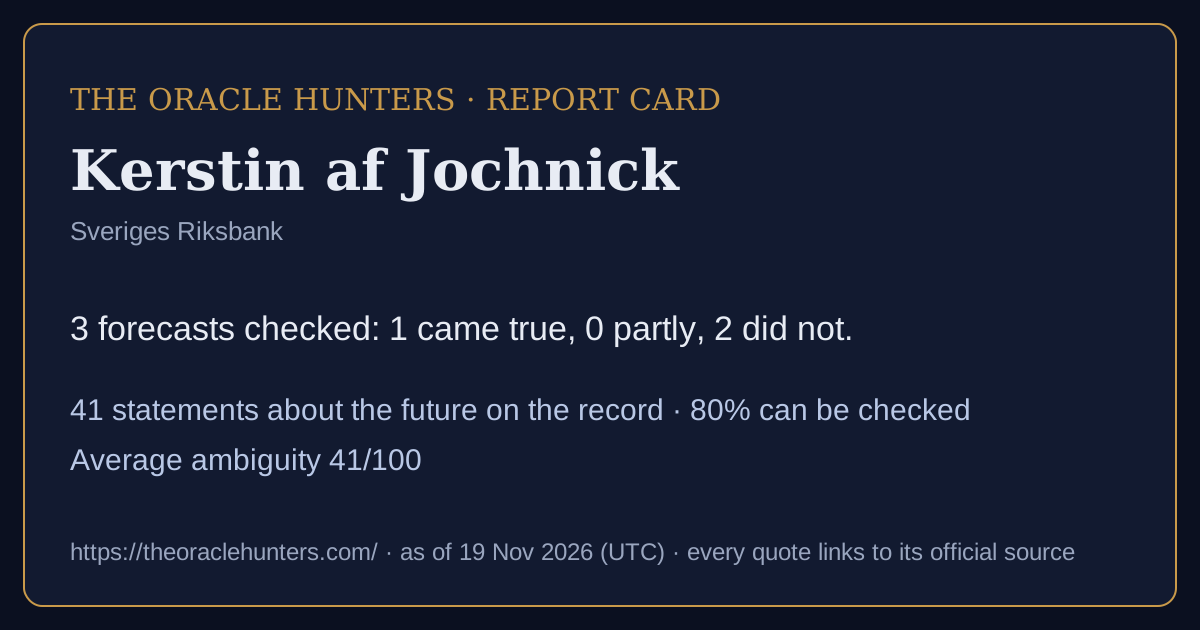
Kerstin af Jochnick
Sveriges Riksbank
Track record: 3 forecasts checked: 1 came true, 0 partly, 2 did not.
41forecasts & commitments on the record
80%can be checked as stated
41average ambiguity (0-100)
0goalpost moves recorded
0confirmed U-turns
Timeline
came true partly did not not due / being checked / too vague
Calibration score: shown after 10 checked forecasts with a stated likelihood (now 3).
How they speak about the future: based on data 27, educated guess 8, stated on authority 6.
Kinds of claim: forecast 23, scenario (if… then) 10, mixed claim 6, commitment 2. · Download this report card as a picture
In the nine words
πρόγνωσιςInference from evidence24 · 59%πρόνοιαPreparing for the future10 · 24%μαντείαInspired knowledge5 · 12%προαναγγελίαPublic pre-announcement2 · 5%
How to read this
Each box is one sentence a public figure or institution said about the future, word for word, with a link to the official text. Can be checked means it names what will happen, by when, and how likely - so it can be compared with official figures later. Too vague to check means it does not. Ambiguity (0-100) is how many different ways the sentence can be read. When the date passes, the forecast is compared with official data and marked came true, partly or did not come true. Labels judge the sentence, never the person. Full guide and glossary.Checked
This means that CPIF inflation is expected to reach 2 per cent in 2015.
Did not come true. Said: inflation around 2% in 2015. Official figure for Sweden: -0.0% (World Bank open data). Missed. Off by 2.0 points. official data · checked 14 Nov 2026 · automatic check against official data (rules v3)
We therefore made the assessment that GDP growth in Sweden will rise gradually in the coming years and reach just over 3.5 per cent in 2015.
Came true. Said: economic growth above 3.5% in 2015. Official figure for Sweden: 4.4% (World Bank open data). On target. official data · checked 14 Nov 2026 · automatic check against official data (rules v3)
We therefore assessed that GDP in the United States will grow by just over 3 per cent on average in 2014 and 2015.
Did not come true. Said: economic growth above 3% in 2014. Official figure for United States: 2.5% (World Bank open data). Missed. Off by 0.5 points. official data · checked 14 Nov 2026 · automatic check against official data (rules v3)
On the record (41)
As you may know, in addition to lowering the interest rate to negative levels, we have also purchased significant volumes of Swedish government bonds to a nominal value of approximately SEK 350 billion - to make monetary policy even more expansionary.
Thereafter, the forecast indicates that the interest rate will be increased by about 0.5 percentage points per year.
Even though inflation outcomes have been slightly lower than expected, we still expect CPIF inflation a year or so ahead to be around 2 per cent.
In the right-hand figure, we see that, in the end of the forecast period, the fourth quarter of 2021, the repo rate is expected only to have reached a level of 1 per cent.
According to our forecast in December, the next interest rate increase is expected during the second half of this year.
We have communicated that we will reinvest principal payments and coupons 'until further notice', but we have brought forward reinvestments of large principal payments that are due during the first half of this year to obtain a more even reinvestment profile over time.
If, for instance, confidence in a bank were weakened so that depositors feared they would not be able to get their money back, the bank might be subjected to a bank run that it is unable to manage on its own.
The new floor will in practice mean that no bank is allowed to have risk-weighted assets below a percentage of what they would have been if the Basel Committee's standardised methods had been used.
If, and I would like to emphasise if , Sweden retains its national special requirements in the future, the banks' CET 1 capital requirements will increase by more than 50 per cent, or around SEK 300 billion.
Without saying anything about what a future floor for risk-weighted assets may look like, I will simply assume in my example that no bank's risk-weighted assets may be less than 75 per cent of what they would have been if the Basel Committee's standardised methods had been used.
SEK 550 billion may seem a lot, but in relation to the banks' total assets it corresponds to just over 4 per cent.
One conclusion of this analysis may be that today's CET 1 capital requirement of 18 per cent of risk-weighted assets for the major Swedish banks in total needs to be changed in future.
To understand how this may affect the major banks' future capital requirements, we need to know that more than half of the SEK 510 billion in CET 1 capital requirement that I mentioned earlier is comprised of so-called special national requirements.
Government bond purchases will continue until the end of June 2016.
The risk otherwise is that we will create new problems that may lead to low growth further on and new difficulties for monetary policy to reach the inflation target.
If there were to be an economic slowdown for any reason, this could be significantly strengthened when indebted households are forced to cut back on consumption and other expenditure, particularly if housing prices were also to fall in connection with this.
A high level of indebtedness among households and rapidly rising housing prices could make the Swedish economy vulnerable if there were to be a slowdown in economic activity for some reason.
GDP growth in the euro area in the second quarter, compared with the same quarter last year, was 1.2 per cent according to our forecast.
During 2015 and 2016, the restraints will be
At the end of the year, the Riksbank is expected to have purchased nominal government bonds for a total of SEK 135 billion.
This corresponds to around 20 per cent of the outstanding stock of nominal government bonds and around 4 per cent of GDP. 1 If the ECB continues to buy government bonds at the same rate as so far, their purchases at the end of the year will correspond to around 7 per cent of the stock and, there too, to …
The results for 2014 (which have not yet been established) were still positive, but if interest rates rise in the way that the National Institute of Economic Research forecasts, it will be some time before the Riksbank can show a profit again.
Given that we now have a repo rate close to zero and we are discussing which unconventional measures might be appropriate if inflation does not rise towards two per cent, it is good that the Riksbank has created the possibility and knowledge to manage a bond portfolio.
In conclusion, I intend to comment on the current situation with very low international interest rates, and what will happen if (or rather when) interest rates begin to rise.
The Riksbank assesses that cash will remain a means of payment for the foreseeable future, although it will probably decline in significance. 3 The replacement of the Swedish banknotes and coins that will take place between autumn 2015 and summer 2017 increases uncertainty over how much cash will be in circulation during the coming years.
(We will reveal the size of the reported profit at the beginning of February.) In the long run, the largest part of the Riksbank's profits are paid back to the government in the form of dividends, and over the past 25 years the Riksbank has paid in more than SEK 210 billion to the Treasury.
It looks as though the bank will have losses in the years 2015-2018 amounting to around SEK 5 billion a year.
In addition to increasing the resilience of the banking system, higher capital adequacy requirements could also contribute to slowing down household indebtedness as the banks' funding would become more expensive if they had to have more capital, which could lead to higher lending rates and reduced credit granting.
If housing prices were to fall, this could affect the banks' possibilities to fund Swedish mortgages.
If we were to experience a fall in housing prices during a recession and thus similar problems to those experienced by other countries, it is likely that we would suffer both a decline in demand in the economy and that the banks would experience greater difficulty and greater cost in obtaining market funding.
However, from the beginning of next year, we assess that the krona will no longer contribute to holding down import prices and they will then rise faster.
In the United States, conditions for a continued recovery were good, although growth was expected to be slow this year.
However, the slow recovery means that GDP will not reach the same level as prior to the decline in 2009 until 2015.
This means that CPIF inflation is expected to reach 2 per cent in 2015.
Did not come true. Said: inflation around 2% in 2015. Official figure for Sweden: -0.0% (World Bank open data). Missed. Off by 2.0 points. official data · checked 14 Nov 2026 · automatic check against official data (rules v3)
We therefore made the assessment that GDP growth in Sweden will rise gradually in the coming years and reach just over 3.5 per cent in 2015.
Came true. Said: economic growth above 3.5% in 2015. Official figure for Sweden: 4.4% (World Bank open data). On target. official data · checked 14 Nov 2026 · automatic check against official data (rules v3)
We therefore assessed that GDP in the United States will grow by just over 3 per cent on average in 2014 and 2015.
Did not come true. Said: economic growth above 3% in 2014. Official figure for United States: 2.5% (World Bank open data). Missed. Off by 0.5 points. official data · checked 14 Nov 2026 · automatic check against official data (rules v3)
The Memorandum of Understanding regarding support to the Spanish banks makes it clear that the Spanish government is expected to carry on with its work on reducing its budget deficit to just below 3 per cent.
Monetary policy was already expansionary, and our forecast was that inflation would attain the target of 2 per cent and that the real economy would reach sustainable levels within the forecast period.
The statistics released so far support the impression that GDP will decline this year.
Our forecast in July was that GDP will fall somewhat this year and then rise again in 2013.
Growth may not increase significantly in Sweden until next year.
Also said - not checkable as stated (12 newest)
Remarks about the future with no date, figure or likelihood that could be checked. They are kept on the record and shown here, but not scored.
In the initial stage of a crisis - when the Riksbank needs to make a decision on liquidity support of several billion in the course of a day or so, or in the worst case a few hours - it is not possible to start analysing the bank that is in distress and what links it may have to other …
A financial crisis or unrest in the financial system means, as I mentioned earlier, that we will find it more difficult to affect the economy through monetary policy, as the transmission mechanism changes.
A broad responsibility for financial stability and increased flexibility in the use of the instrument also mean that the evaluation of the Riksbank's work in this field may need to be strengthened.
The Riksbank is therefore investigating whether we should issue a digital krona, or e-krona, so that there will continue to be a means of payment issued by the Riksbank.
The monetary policy conducted can affect the risk of a financial crisis, and we must also take this into account.
Another way of putting it is that those borrowing and lending must consider how much of the amount lent they expect to be 'eaten up' by inflation.
This spring, Goodfriend and King's assessment will provide an excellent basis for the discussion of monetary policy and the issues that a modern central bank must manage.
We will do this over the spring, before submitting our consultation response in April.
I will therefore focus today on the reasons for the new monetary policy ground broken by the Riksbank in 2015.
However, there was agreement among the Executive Board on the need to cut the repo rate to bring inflation up to the target within the forecast period.
Prior to the next monetary policy meeting, we will of course continue to monitor developments in Russia and Ukraine, and we will analyse what they may mean for economic prospects abroad.
7 One must bear in mind that the inflation forecasts in the Figure are calculated on the basis of the current reporate paths.