Kazuyuki Masu
Bank of Japan
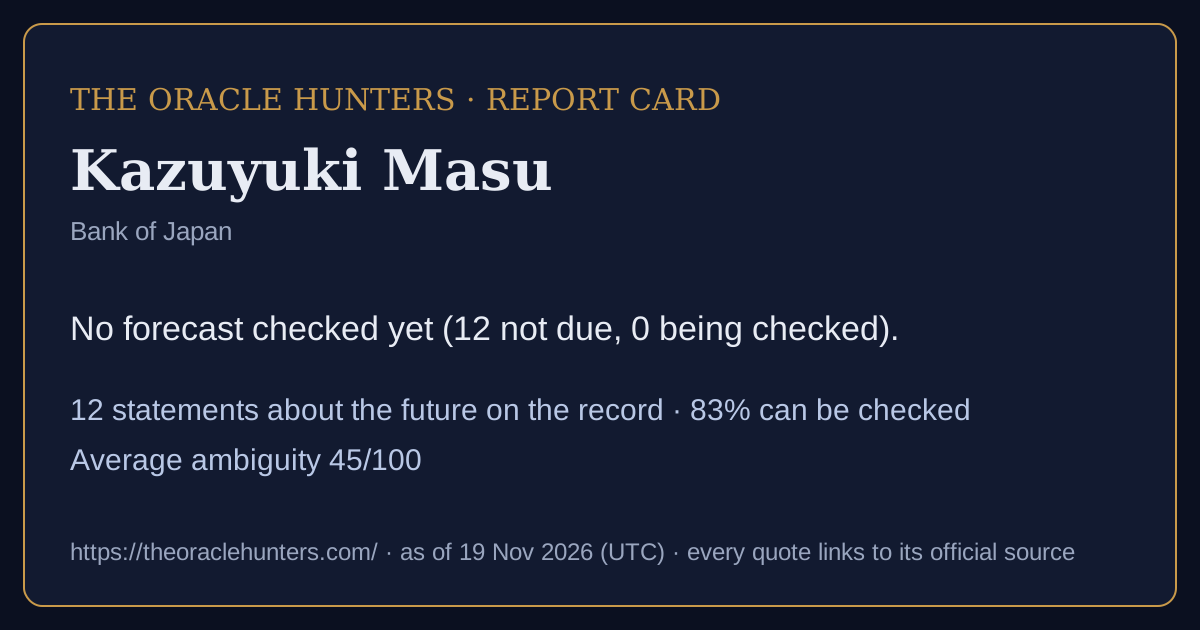
Track record: No forecast checked yet (12 not due, 0 being checked).
12forecasts & commitments on the record
83%can be checked as stated
45average ambiguity (0-100)
0goalpost moves recorded
0confirmed U-turns
Timeline
came true partly did not not due / being checked / too vague
Calibration score: shown after 10 checked forecasts with a stated likelihood (now 0).
How they speak about the future: based on data 12.
Kinds of claim: mixed claim 7, forecast 5. · Download this report card as a picture
In the nine words
How to read this
Each box is one sentence a public figure or institution said about the future, word for word, with a link to the official text. Can be checked means it names what will happen, by when, and how likely - so it can be compared with official figures later. Too vague to check means it does not. Ambiguity (0-100) is how many different ways the sentence can be read. When the date passes, the forecast is compared with official data and marked came true, partly or did not come true. Labels judge the sentence, never the person. Full guide and glossary.On the record (12)
Given that the growth rate in the number of employed persons for Fukui Prefecture is roughly 10 percent below the national average, I believe the business leaders participating in the meeting today might be feeling an acute sense of labor shortage.
If the inflation rate moderates to around the Bank's target level of 2 percent while wage hikes of around 3 percent continue, the rate of change in real wages will remain positive.
The Bank's annual JGB purchases amounted to as much as 135 trillion yen at their peak four years ago but, from fiscal 2027, the level will be about 2 trillion yen per month, or roughly 24 trillion yen annually.
Given that the underlying inflation rate is very close to 2 percent, as I explained earlier, and that financial conditions have been accommodative, the Bank will continue to raise the policy interest rate and adjust the degree of monetary accommodation.
While the Bank will continue to raise the policy interest rate and adjust the degree of monetary accommodation in response to developments in economic activity and prices as well as financial conditions, what is most vital from now on is to ensure that the underlying inflation rate does not significantly exceed 2 percent.
The expression "to halt the reduction" may sound a little confusing, but it simply means that the Bank will keep its amount of JGB purchases constant for the time being, from fiscal 2027.
Thus, given that the annual issuance of government securities, including JGBs and short-term treasury discount bills, amounts to 180 trillion yen, the proportion of the Bank's JGB purchases to the total issuance will fall substantially.
If inflation moderates to around the target level of 2 percent while wage hikes of around 3 percent continue, the rate of change in real wages will remain positive.
However, if the year-on-year rate of change in the price of processed food that does not use rice as an ingredient remains high at 5 percent, the assumption that inflation will subside if rice prices simply stabilize would turn out to be too simplistic.
As shown in the right panel of Chart 15, since the pace of reduction by March 2027 has already been fixed, the Bank's JGB holdings, which peaked out at nearly 590 trillion yen, will be reduced by almost 20 percent by then.
At the peak, the Bank's annual JGB purchases amounted to over 130 trillion yen, but this level will be cut down to slightly less than 30 trillion yen in fiscal 2027.
The Bank will need to rigorously examine the pace of its JGB purchases after March 2027 while monitoring market conditions.