Kazuo Ueda
Bank of Japan
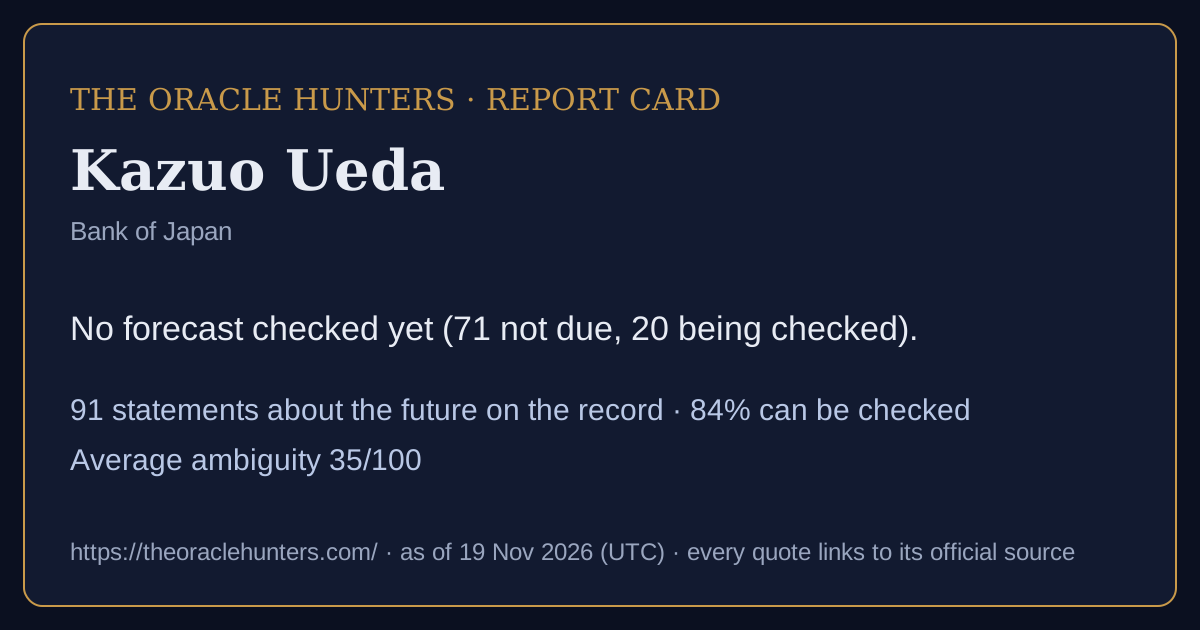
Track record: No forecast checked yet (71 not due, 20 being checked).
91forecasts & commitments on the record
84%can be checked as stated
35average ambiguity (0-100)
0goalpost moves recorded
0confirmed U-turns
Timeline
came true partly did not not due / being checked / too vague
Calibration score: shown after 10 checked forecasts with a stated likelihood (now 0).
How they speak about the future: based on data 66, educated guess 16, stated on authority 9.
Kinds of claim: forecast 66, scenario (if… then) 14, mixed claim 9, commitment 2. · Download this report card as a picture
In the nine words
πρόγνωσιςInference from evidence64 · 70%πρόνοιαPreparing for the future14 · 15%μαντείαInspired knowledge7 · 8%εἰκασίαConjecture4 · 4%προαναγγελίαPublic pre-announcement2 · 2%
How to read this
Each box is one sentence a public figure or institution said about the future, word for word, with a link to the official text. Can be checked means it names what will happen, by when, and how likely - so it can be compared with official figures later. Too vague to check means it does not. Ambiguity (0-100) is how many different ways the sentence can be read. When the date passes, the forecast is compared with official data and marked came true, partly or did not come true. Labels judge the sentence, never the person. Full guide and glossary.On the record (91)
- Meanwhile, with a sense of labor shortage continuing to be strong, underlying CPI inflation is expected to increase gradually, coming to a level that is generally consistent with the price stability target between the second half of fiscal 2026 and fiscal 2027.
The Bank has already announced that, at the June 2026 MPM, it will conduct an interim assessment of the current reduction plan and discuss a guideline for its JGB purchases from April 2027.
In terms of predictability, the current reduction plan, decided in June 2025, makes it clear in advance that the monthly purchase amount of JGBs will be cut down by about 200 billion yen each calendar quarter through January-March 2027.
From fiscal 2027 onward, Japan's economic growth rate is likely to rise moderately again, with the adverse effects of high crude oil prices being projected to wane.
As a result, the monthly purchase in March 2027 will be 2.1 trillion yen, which is equivalent to about one-third of monthly purchases before the start of the reductions, and the amount outstanding of the Bank's JGB holdings will decrease by around 16-17 percent from the amount before the start of the reductions.
Given such developments, underlying CPI inflation -- which excludes the effects of temporary factors -is expected to increase gradually, coming to a level that is generally consistent with the price stability target of 2 percent between the second half of fiscal 2026 and fiscal 2027.
However, if the economy moves into a state where moderate price rises continue, the real value of cash and deposits will tend to decrease, while investments with an eye to the future will be increasingly important.
## Moves toward Wage Increases Next Year
If firms' managements begin to take into consideration the assumption that prices will continue to rise at a rate of 2 percent, the mechanism in which both wages and prices rise moderately can be expected to become more robust and more sustainable throughout Japan.
Based on these recent data and anecdotal information, it is highly likely that the mechanism in which both wages and prices rise moderately will be maintained next year and beyond.
Although food price developments are expected to gradually stabilize as mentioned earlier, if new temporary factors pushing up prices arise or if the pass-through of increased personnel expenses and distribution costs to selling prices strengthens, the rise in food prices could persist for longer than expected.
The fact that the minimum wage for fiscal 2025 rose by more than 5 percent year on year -- the highest rate on record -- is also highly likely to encourage wage hikes among a wider range of firms.
Against this backdrop, the Japanese Trade Union Confederation (Rengo) announced last week its basic policy for next year's annual spring labor-management wage negotiations, setting the target wage increase rate at 5 percent or more, which is the same as in the previous year.
In particular, it will be important to confirm the momentum of initial moves toward next year's annual spring labor-management wage negotiations.
Looking ahead, the year-on-year rate of increase in the CPI for all items excluding fresh food is likely to decelerate temporarily to a level below 2 percent through the first half of fiscal 2026, with the waning of the effects of the rise in food prices, and partly due to the effects of government measures to address rising prices, such …
Thereafter, however, the IMF continued to make upward revisions, projecting in its latest October WEO that the global economy will maintain growth above 3 percent in both 2025 and 2026.
- With the price stability target of 2 percent, the Bank will conduct monetary policy as appropriate, in response to developments in economic activity and prices as well as financial conditions, from the perspective of sustainable and stable achievement of the target.
The tariff policies have created uncertainty for the global economy, including the U.S. labor market and price developments, and the unprecedentedly high tariff rate of 15 percent will exert downward pressure on Japan's economy.
The fact that a tariff rate of 15 percent has now been set will lead to reducing uncertainty surrounding U.S. tariff policies.
related to food -- will increase along with actual inflation and, in the second half of the projection period of the Outlook Report, will reach a level that is generally consistent with the price stability target of 2 percent.
For this reason, the Bank's baseline scenario in the July Outlook for Economic Activity and Prices (Outlook Report) is that the year-on-year rate of increase in the CPI for all items excluding fresh food is likely to fall below 2 percent at some point through the next fiscal year.
Looking at profit projections for this fiscal year in the table on the right, profits of firms in manufacturing are now expected to fall by 8.6 percent, which is around the same level as in the previous survey in June.
Given these factors, the Bank projects that, although underlying CPI inflation will be sluggish temporarily due to the deceleration in the economy, it will then rise again toward the price stability target of 2 percent.
Drawing from the experience of the reductions so far and taking into account the opinions from market participants, the Bank will discuss, at the next MPM, a guideline for its purchase amount of JGBs from April 2026.
Moreover, at the Monetary Policy Meeting (MPM) to be held this month, the Bank will conduct an interim assessment of the current plan and discuss a guideline for its JGB purchases from April 2026 and announce the results.
In terms of predictability, the current plan makes it clear in advance that the purchase amount of JGBs will be cut down by about 400 billion yen each calendar quarter through January-March 2026.
Conversely, if there are disruptions in global logistics, putting upward pressure on import prices, attention needs to be paid to the possibility that cost-push pressures could affect prices and even wages.
However, the scale of the tariffs announced by the U.S. administration since early spring of this year was considerably larger than what many people had expected, and the environment surrounding economic activity and prices at home and abroad is changing significantly.
However, we continue to expect underlying inflation to gradually move toward 2 percent over the second half of our forecast horizon.
As we will see shortly, this period has coincided with a gradual rise in inflation expectations.
To the extent that incoming data allows us to gain more confidence in the baseline scenario, as economic activity and prices improve, we will adjust the degree of monetary easing as needed to ensure the achievement of the sustainable 2 percent inflation target.
However, given that underlying inflation is closer to 2 percent than a few years ago, we need to be careful about how food price inflation will impact underlying inflation.
With the price stability target of 2 percent, the Bank will conduct monetary policy as appropriate, in response to developments in economic activity and prices as well as financial conditions, from the perspective of sustainable and stable achievement of the target.
If Japanese firms had been able to fully capitalize on the benefits of this expansion by, for example, developing attractive products, they could have raised export prices and increased export volumes, offsetting to some extent the negative impact of higher import prices.
The shaded area indicates the 20-80 percentile band of the expected growth rate.
The first is that, in the current phase of transition toward achieving the 2 percent target in a sustainable and stable manner, the Bank will maintain accommodative financial conditions by keeping the policy interest rate lower than the neutral interest rate -- a level that is neutral to economic activity and prices -- and will thereby firmly support the economy.
The Bank will firmly support the positive actions of firms from the monetary policy side through achieving the price stability target of 2 percent in a sustainable and stable manner.
If this growth rate continues for 20 years, the nominal GDP level will rise by 80 percent.
This outlook will be presented in the Outlook for Economic Activity and Prices to be released in late January next year.
Meanwhile, the minimum wage for this fiscal year increased by more than 5 percent year on year, the largest increase on record, and is expected to continue to rise, which would prompt wages in general to rise as well.
developments, and it has become more likely that the economy will achieve a soft landing, in which the inflation rate declines toward 2 percent while a significant slowdown in the economy is avoided.
Since these developments will likely continue to gain momentum, the Bank projects in the latest Outlook Report that real GDP will continue to grow at a rate of around 1 percent in the next fiscal year and beyond, as shown in Chart 3.
As shown in Chart 5, the International Monetary Fund (IMF) projects in its latest World Economic Outlook (WEO) that the global economy will sustain growth in the range of 3.0-3.5 percent through 2025, which is more or less unchanged from its previous projection in July.
That said, underlying inflation is likely to continue rising moderately and, in the second half of the projection period through fiscal 2026, to be at a level that is generally consistent with the price stability target of 2 percent.
Looking at the outlook for prices, the year-on-year rate of increase in the CPI for all items excluding fresh food is likely to be 2.5 percent for fiscal 2024 and then be at around 2 percent for fiscal 2025 and 2026.
The Bank considers that, if underlying inflation rises in line with its outlook, it will be appropriate to
The Bank raised the policy interest rate by around 0.15 percent, deciding to "encourage the uncollateralized overnight call rate to remain at around 0.25 percent." This decision was based on the aforementioned assessment that Japan's economic activity and prices had been generally in line with the Bank's outlook and that underlying inflation had risen moderately.
The Bank will conduct monetary policy as appropriate, aiming to achieve the price stability target of 2 percent in a sustainable and stable manner, while taking account of upside and downside risks to economic activity and prices, and I believe that this stance will bring about positive effects on the national economy as a whole.
If the Federal Reserve's decision leads to a soft landing for the U.S. economy, in which the inflation rate declines toward 2 percent while a significant slowdown in the economy is avoided, this will likely have a positive impact on Japan's economy.
The Bank will conduct an interim assessment of the plan at the June 2025 MPM .
Showing the newest 50 - the ledger has all 91.
Also said - not checkable as stated (12 newest)
Remarks about the future with no date, figure or likelihood that could be checked. They are kept on the record and shown here, but not scored.
There was a stronger recognition that trying to fully compensate for inflation associated with higher oil prices through nominal wage increases could produce another inflationary spiral.
If expectations are very low and wages are stagnant, even a large cost shock may not raise underlying inflation.
In the mid2000s, the regime had shifted to a deflationary one, and the oil price surge could not change it.
What are the important initial conditions that will matter for the evolution of the economy from here?
The policy implication of all this seems to be that central banks should not look at oil prices in isolation.
Going forward, the Bank will continue to enhance its central banking operations while deepening insights into new technologies such as AI and blockchain, properly fulfilling its role as the anchor of trust in a new financial ecosystem.
Assuming application of these technologies in the areas of finance and payments, the FinTech Center conducted joint research with the European Central Bank (ECB), identifying opportunities and possible challenges that blockchain could bring to financial market infrastructures.
It is hoped that integrating AI and blockchain will allow the provision of enhanced financial services that utilize transaction and settlement data accumulated on the blockchain.
In addition to achieving price stability, many central banks, in their capacity, are expected to provide central bank money such as cash and central bank current account deposits -- the payment instrument supporting economic activity -- while safeguarding payment stability.
Unless the deposits at different banks are connected through central bank deposits, there is a risk that people will perceive this as variation in the value of deposits among banks, as was the case during the wildcat banking era in 19th-century United States.
This could be achieved by either settling assets with tokenized central bank money on the blockchain or by connecting the existing system for central bank money with a new system for transactions on the blockchain.
In making this decision, the key factors were developments in the U.S. economy and the impact of tariff policies as well as moves to raise wages in light of next year's annual spring labor-management wage negotiations.