Karnit Flug
Bank of Israel
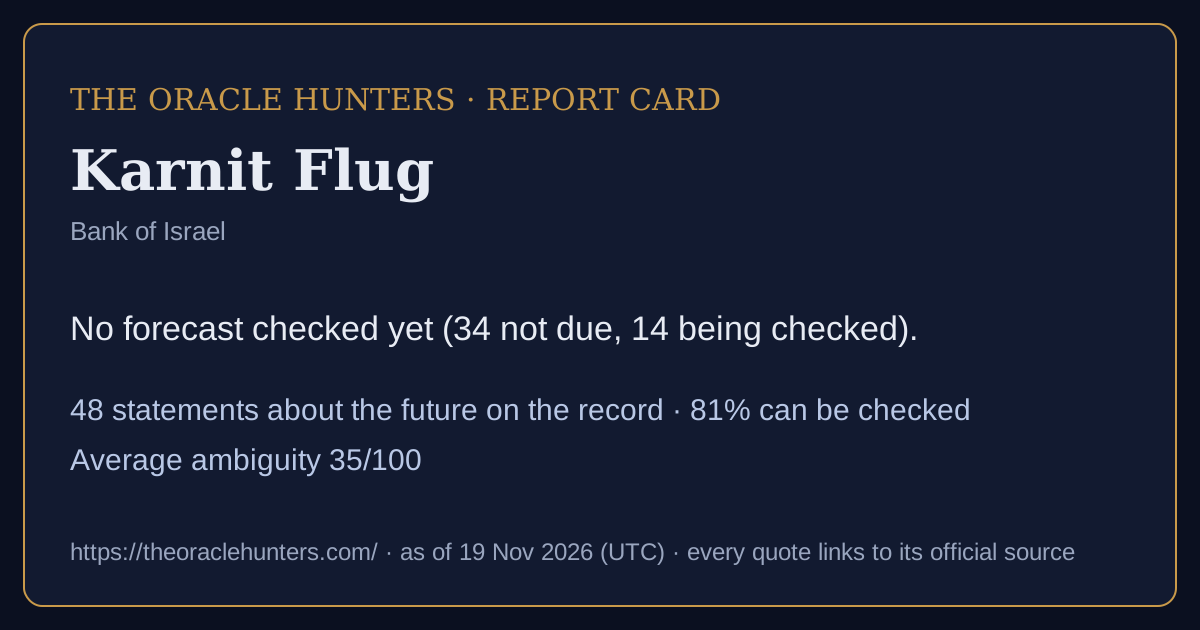
Track record: No forecast checked yet (34 not due, 14 being checked).
48forecasts & commitments on the record
81%can be checked as stated
35average ambiguity (0-100)
0goalpost moves recorded
0confirmed U-turns
Timeline
came true partly did not not due / being checked / too vague
Calibration score: shown after 10 checked forecasts with a stated likelihood (now 0).
How they speak about the future: based on data 32, stated on authority 10, educated guess 6.
Kinds of claim: forecast 24, mixed claim 10, scenario (if… then) 9, commitment 5. · Download this report card as a picture
In the nine words
πρόγνωσιςInference from evidence26 · 54%πρόνοιαPreparing for the future9 · 19%μαντείαInspired knowledge5 · 10%προαναγγελίαPublic pre-announcement5 · 10%εἰκασίαConjecture3 · 6%
How to read this
Each box is one sentence a public figure or institution said about the future, word for word, with a link to the official text. Can be checked means it names what will happen, by when, and how likely - so it can be compared with official figures later. Too vague to check means it does not. Ambiguity (0-100) is how many different ways the sentence can be read. When the date passes, the forecast is compared with official data and marked came true, partly or did not come true. Labels judge the sentence, never the person. Full guide and glossary.On the record (48)
The plan set active targets for the planning system that will enable the construction of 1.5 million housing units between 2014 and 2040, in accordance with the need shown by models based on demographic trends.
Despite its low level at the point of departure in 1995, its pace of growth was lower than what could have been expected given the fact that in general, the increase in productivity is greater in economies that begin from a lower point, if only because of their ability to adopt technologies that exist in countries at the technological forefront.
At the beginning of 2016, the IMF forecast that world growth would increase by 4 percent.
Looking forward, based on the updated situational assessment, the Research Department's assessment is that the interest rate is expected to begin increasing in the last quarter of 2017.
According to the forecast, inflation is expected to return to within the target range in 2017, but the range of uncertainty surrounding the timing of that return to the range is broad.
By the end of 2017, the breadth of outcomes ranges from growth of slightly more than 2 percent to about 4.5 percent.
It indicates a gradual slowdown in private consumption after an exceptional increase this year, growth in public consumption of more than 4 percent this year and 1.5 percent in the next two years, in line with the two-year budget, and a gradual acceleration of exports supported by a gradual recovery that the international organizations project in world trade.
The forecast indicates expected growth of 3.5 percent this year (as we said, the past is still before us), 3.2 percent in 2017 and 3.1 percent in 2018.
The government will need to choose between cutting expenditure, which will make it difficult to achieve the long-term goals I will detail later, and increasing tax revenue, whether through the cancellation of exemptions or through raising tax rates.
The Bank of Israel's first assessments regarding 2017 indicate that the automatic pilot for expenditures, meaning the increase in expenditures required as a result of government commitments and expected demographic developments, is NIS 14 billion higher than the expenditure ceiling - similar to the Ministry of Finance's estimate that was published this week.
Should the government make the necessary adjustments to meet the expenditure ceiling, then according to initial forecasts of tax receipts, the government is expected to meet the deficit target of 2.5 percent of GDP.
The Monetary Committee adopted a very accommodative monetary policy this year as well, leaving the interest rate at an historic low of 0.1 percent, and announced that in its assessment the interest rate will remain low for a considerable time.
- In order to deal with these, the government will have to improve the level of public services, to invest in infrastructures, and to support growth.
The responsibility for maintaining a stable financial system rests with the Bank of Israel and we will fulfill that responsibility; but it also rests with the government and other regulators.
Maintaining stability means that when we deposit our salaries with the bank, we can sleep at night and can feel sure that we will be able to use that money when we need to; that when we save for our children, we can be confident that those savings will be available to them when they grow up; and when a …
If we add to that the widespread assessment that the growth of global trade will also be moderate in the coming years, then without a policy focused on increased productivity, the standard of living that the Israeli economy can provide to its citizens is expected to become more distant from that at the forefront of advanced economies.
However, it is important to remember that there is uncertainty surrounding the forecast - as there is with any forecast - as presented graphically in the fan chart (which presents the range of projections with a likelihood of 66 percent).
During the past year, the forecast for global trade was revised downward by 2 percentage points for each of the years 2015 and 2016, which obviously has an impact on the forecast for Israeli exports, and therefore on the growth of the economy in general.
The forecast projects continued moderate growth of 2.8 percent in 2016, and some acceleration in the following year.
- The risks in the gray market may spill over to the financial market, both due to regulatory arbitrage (gaps in regulatory requirements) that will lead to a decline in standards in the financial system, and from a prudential standpoint, particularly if the entities in the gray market grow and become a significant part of the credit market.
If we look at a retiree at age 67 with a deduction of 19.5 percent, the replacement rate will be about 100 percent, which ensures the maintenance of the same lifestyle after retirement.
If we look at women who retire at age 62, whose pension savings generate an average real yield of 4 percent per year, and who save 17.5 percent of their salaries, the replacement rate will be 71 percent.
If there is a change in the patterns of educational attainment among this population, so that the education attained is relevant to the labor market to an extent that is similar to the rest of the population, the change may be reduced to about half, meaning 0.1 percentage points per year.
Based on research by Eyal Argov of the Bank of Israel Research Department, if there is no change in the ultra-Orthodox population's patterns of attaining education that is relevant to the labor market, the trend of slowdown in the human-capital growth rate is expected to reduce per capita GDP growth by around 0.2 percentage points per year in the coming …
In contrast, if the process that has begun - of an increase in the participation rates of these groups - will persist, the negative impact on growth can be reduced by about a third, to 0.4 percentage points per year.
Thus, if there won't be a continuation of the process of rising participation rates of the Arab and ultra-Orthodox populations, the combined demographic changes are expected to reduce future annual growth by around 0.6 percentage points.
The estimated combined impact of both these trends is that they will reduce growth in Israel by 0.4-0.8 percentage points, relative to the growth seen in the decade prior to the crisis.
Some countries whose past contribution to growth of world trade was very high are going through a growth reorientation process toward domestic market oriented growth, and therefore for given global growth we will see a more moderate increase in world trade.
The decline in GDP during the third quarter is obviously also a result of Operation Protective Edge, and we can expect that the figures for the final quarter of the year will already show a return to the growth rates that have characterized the economy in recent years, of slightly below 3 percent.
In contrast, if the average real yield is 2 percent and the contributions are 17.5 percent, the replacement rate will be just 66 percent.
In contrast, if the yield is 4 percent per year and pension contributions are 19.5 percent of monthly salary, the replacement rate will be 76 percent.
An international comparison of retirement arrangements shows that in Israel, the retirement age for women is relatively low, and even after it is raised to 64, as is supposed to happen in 2017, it will be significantly lower than in most European countries, some of which are also in a gradual process of raising it.
Inflation and inflation expectations are within the target range, in the lower portion of the range, and inflation is expected to decline to below the target range in the coming months.
Technological advancement and innovation have not bypassed the payment means field, or even traditional means of payment: The new banknote series - the first denomination of which, NIS 50, is expected to enter the market by the end of the year - includes innovative security means, such as marks which become visible under ultraviolet light and micro lettering.
With that, the continued rapid growth in the number of mortgages and in their weight in the bank's credit portfolio are a risk factor, and if additional measures are required, we will not hesitate to take them.
Growth in Israel moves in line with, and higher than, that of the other advanced economies, and we expect that both the correlation and the gap will continue this year as well (slide 2).
However, if we make a radical assumption, that the participation rates of those sectors will remain at current levels, demographic trends on their own are expected to reduce the employment rate by 7 percent in the long term.
employment rates - are expected to deduct 1.3 percentage points from the annual growth rate.
There is also a change expected in the age distribution - Israel's population is relatively young, compared with advanced economies, but there is an aging trend by us as well, and the share of those 65 years and older, currently around 10 percent, is expected to reach 17 percent.
To the extent that we will be able to do more in increasing the efficiency of the tax exemption system and enhancing tax collection, we will be able to increase overall tax revenues without increasing tax rates.
Thus, it is important that we continue to invest in increasing the participation and productivity of the Arab and ultra-Orthodox sectors; otherwise, not only will we not remain in place, but we will even widen the gap vis-à-vis the advanced economies.
On the assumption that world economic growth recovers as expected, we expect continued growth of 3.4 percent in 2014, but it is important to mention that excluding the effects of natural gas production, lower growth is expected, and since natural gas production does not make a significant contribution in the short term to growth in employment, we expect growth in …
Improvements in productivity and the rate of growth will necessarily bring with them an improvement in the purchasing power of the Israeli worker, in particular if the growth will be distributed more equally.
It is not a simple choice, primarily because we will not be able to allow ourselves large deficits and a growing public debt - those will endanger the financial stability of the economy, and negatively impact growth and quality of life in the long term.
If we choose a large government which will provide public services with high quality and quantity, will invest in infrastructure, and will be actively involved in supporting engines of growth, we will have to bear a higher tax burden.
The expected demographic trends do not support a high rate of growth in the coming years, and we will need to act to offset the effects on growth of those trends in order to continue to grow at a satisfactory rate.
If there are no changes in employment patterns, these demographic trends will reduce the annual growth rate by about 1.3 percent, every year.
If we know how to maximize the potential for increased growth and how to reduce the gaps, we will all - Jews and Arabs - be able to enjoy the fruits of this process.
Also said - not checkable as stated (12 newest)
Remarks about the future with no date, figure or likelihood that could be checked. They are kept on the record and shown here, but not scored.
I have heard the argument that in some issues the decisions reflect political priorities as opposed to pure economic welfare maximization decisions, and therefore should be left to the politicians, or that they may undermine the central banks' credibility or independence.
We should take the starting point into account, and asses what is the likelihood that a change will get us closer to some 'ideal institutional design' (if such exists).
So, we've had frictions in the past and will probably have them in the future, and we should be able to withstand them.
While we were discussing the new Bank of Israel Law, Stan was initially of the view that the role of an economic advisor to the government puts the bank in a constantly contentious position Vis a Vis the government and may undermine the banks' independence in its core responsibility.
Indeed, the argument against the CB's role in economic policy advice because it enhances the friction between the Bank and the government and thus may undermine the Bank's independence in its core responsibilities is not unique to the role of economic advisor.
In that regard, it may even contribute to the public support of an independent central bank.
We may assume that this also has to do with the non-use of transport development plans.
This can be done in such a way that the strategic trends presented and approved by the government will constitute the vision with which fiveyear plans and annual work plans will be formulated.
There are a number of layers: setting targets; designing policy that will be consistent with the long-term planning; and no less important, avoiding policy measures that will make it difficult to attain the strategic targets in the future.
Of course, the most important test will relate to the formulation and implementation of detailed plans, and achieving the targets over time.
This is one of the areas where the importance of a strategic plan is clear-a plan that formulates targets, defines work plans for achieving them, and allocates budgets is essential in order to achieve an education system that is tasked with providing values, abilities and skills that will enable its graduates to deal-as workers and in
It is important that a government unit be established that will specialize in the management and monitoring of PPP tenders and contracts.