Karen Silk
Central bank (via BIS)
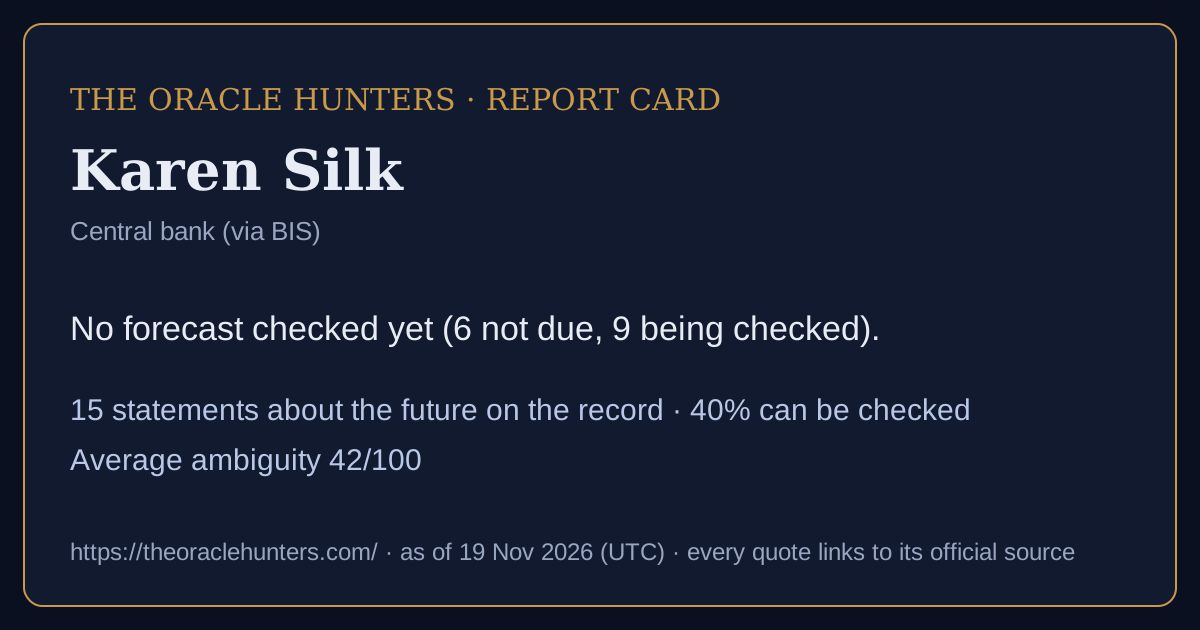
Track record: No forecast checked yet (6 not due, 9 being checked).
15forecasts & commitments on the record
40%can be checked as stated
42average ambiguity (0-100)
0goalpost moves recorded
0confirmed U-turns
Timeline
came true partly did not not due / being checked / too vague
Calibration score: shown after 10 checked forecasts with a stated likelihood (now 0).
How they speak about the future: based on data 10, stated on authority 3, educated guess 2.
Kinds of claim: forecast 12, scenario (if… then) 2, mixed claim 1. · Download this report card as a picture
In the nine words
πρόγνωσιςInference from evidence10 · 67%μαντείαInspired knowledge3 · 20%πρόνοιαPreparing for the future2 · 13%
How to read this
Each box is one sentence a public figure or institution said about the future, word for word, with a link to the official text. Can be checked means it names what will happen, by when, and how likely - so it can be compared with official figures later. Too vague to check means it does not. Ambiguity (0-100) is how many different ways the sentence can be read. When the date passes, the forecast is compared with official data and marked came true, partly or did not come true. Labels judge the sentence, never the person. Full guide and glossary.On the record (15)
Market participants may hold fewer or lessor quality liquid assets on their balance sheet in pursuit of return if they believe the central bank will always step in to provide low-cost liquidity during periods of stress.
Lastly, the settlement cash level will decline from current abundant levels to an ample level, possibly as early as the second half of next year.
While noting the uncertainty, our internal projections suggest it is possible we may reach an ample settlement cash level in the second half of 2025.
Our latest New Credit Flows survey shows that around 75 percent of new home loan flows currently carry interest periods of 1-year or less and circa 70 percent of existing home loans will be repriced within the next 9 months.
As shown in the chart, from the first OCR increase in October 2021 to the last one in May 2023, the biggest four banks in New Zealand, on average, saw their net interest margins increase by about 35-40 basis points.
Bank funding spreads, however, have gradually increased this year, and this is expected to continue as excess liquidity is drained from the banking system with the progressive wind down of additional monetary policy tools.
We expect to release a summary of the submissions and key decisions document before the end of the year.
Mismatch ratios, which are naturally more volatile, are also currently near record highs supported in the last couple of years by strong retail deposit growth and the Funding for Lending scheme which will begin to roll off at the end of this year, through to the end of 2025.
We will publish an issues paper on private innovations in money early next month, seeking feedback on the content by March 2023.
It is only if the amount of settlement cash falls below a sufficient level that it will have a material impact on short-term interest rates.
22 See debtmanagement.treasury.govt.nz/investor-resources/202223-new-zealand-government-bond-programme-set-nz25-billion specifically: 'From 2022/23 onwards, sales by the Reserve Bank of New Zealand (RBNZ) of NZGBs held under the Large-Scale Asset Purchase (LSAP) Programme, to New Zealand Debt Management (NZDM), are incorporated in the forecasts at a rate of NZ$5 billion per fiscal year.
This is expected to occur after the April 2023 nominal bond maturity: New Zealand Government Securities Funding Strategy 2022/23: Edition 1 (treasury.govt.nz)
The final maturity for the FLP will be toward the end of 2025.
As announced in May this year, the Reserve Bank intends to retain a floor system going forward. 24 There are two key reasons to retain this system.
At the February 2022 MPS, the MPC announced that the Reserve Bank will not reinvest the proceeds of any upcoming LSAP bond maturities, and will also sell down $5 billion in government bonds per fiscal year to New Zealand Debt Management (NZDM). 21 The combination of these sales and maturities mean that the Reserve Bank's LSAP holdings will be wound …
Also said - not checkable as stated (12 newest)
Remarks about the future with no date, figure or likelihood that could be checked. They are kept on the record and shown here, but not scored.
Firstly, we should intervene only in circumstances where the Reserve Bank's remits are likely to be compromised.
Second, we will apply a principles-based approach to the provision of liquidity to financial markets.
However, our interventions should be limited to scenarios where our remits are likely to be compromised.
Should data indicate that conditions are evolving differently to those expected, or if we judge that the balance of risks to the inflation outlook have changed, then we are able to adjust our approach to reflect this.
However, given bank funding spreads have already begun to normalise, this offset will likely be much smaller than was the case during the tightening cycle, which will reduce the need to factor this into OCR decisions to the same degree in the years ahead.
We will continue to assess and respond to risks, on both sides of the ledger.
We will not be commenting on the target level of reserves agreed as that information is considered market sensitive but will note that achieving it is a process that will occur over a number of years.
While we will not comment on what the composition will look like in the future, we expect he mix of portfolios to carry flexibility and be influenced by market conditions over time.
It is correct that a central bank's balance sheet is an instrument of policy, not an instrument of profit and therefore any time there is a change in the size or composition of the balance sheet, it will be in support of policy.
Today my focus will be on the RBNZ's balance sheet as a tool to support financial stability and | will outline some of the recent steps we've taken to strengthen the RBNZ's balance sheet for that purpose.
Central banks in this context can also play a role as "market-maker-of-last-resort", providing market liquidity through facilities designed to provide targeted and temporary liquidity where it might otherwise be absent, largely in times of stress or crisis.
In extreme circumstances, such as inancial crises, it may also be necessary for the RBNZ to intervene for financial stability purposes, providing liquidity and confidence to the market.