Kara Owen
Foreign & Commonwealth Office · GBR
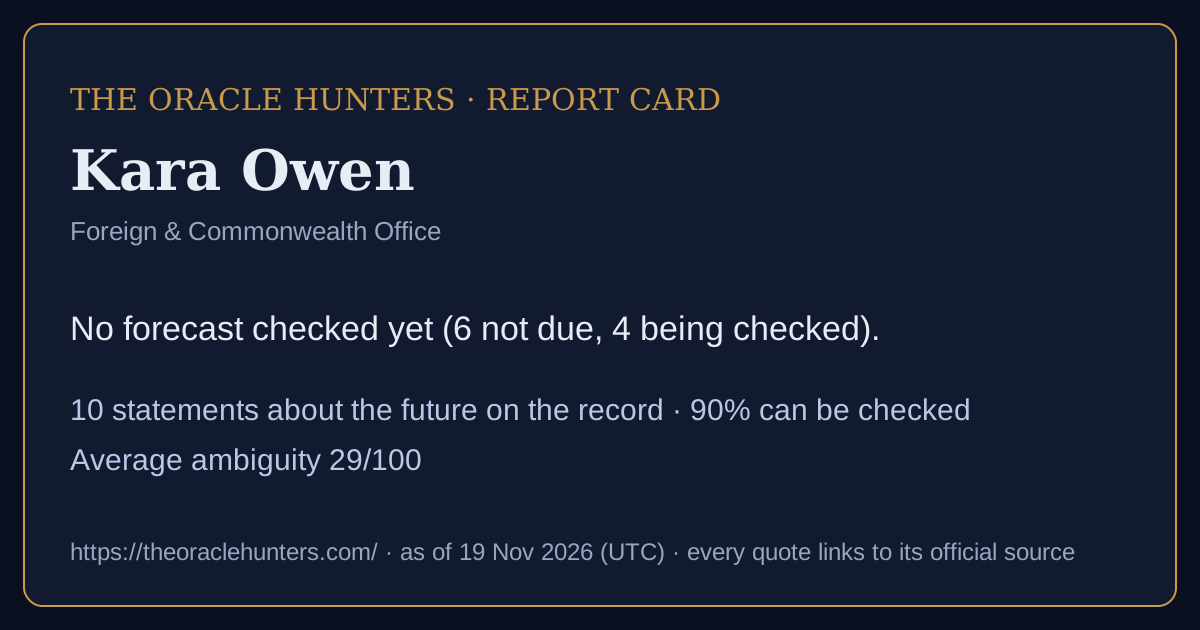
Track record: No forecast checked yet (6 not due, 4 being checked).
10forecasts & commitments on the record
90%can be checked as stated
29average ambiguity (0-100)
0goalpost moves recorded
0confirmed U-turns
Timeline
came true partly did not not due / being checked / too vague
Calibration score: shown after 10 checked forecasts with a stated likelihood (now 0).
How they speak about the future: based on data 9, stated on authority 1.
Kinds of claim: forecast 7, mixed claim 2, commitment 1. · Download this report card as a picture
In the nine words
πρόγνωσιςInference from evidence8 · 80%μαντείαInspired knowledge1 · 10%προαναγγελίαPublic pre-announcement1 · 10%
How to read this
Each box is one sentence a public figure or institution said about the future, word for word, with a link to the official text. Can be checked means it names what will happen, by when, and how likely - so it can be compared with official figures later. Too vague to check means it does not. Ambiguity (0-100) is how many different ways the sentence can be read. When the date passes, the forecast is compared with official data and marked came true, partly or did not come true. Labels judge the sentence, never the person. Full guide and glossary.On the record (10)
In China, Fitch described the 178% annual rise in offshore wind installations between 2019 and 2020 as the most important factor in reducing the use of coal and a trend that will continue following the country’s commitment to reaching Net Zero by 2060.
A project called Suncable is in development to supply up to 20% of Singapore’s energy from Australian solar power when it reaches here in 2027.
Even the worst-hit economies of The Philippines and Thailand expected to return to strong growth this year as the recovery kicks in.
Despite the COVID-induced reduction in our aid budget, the Prime Minister has confirmed that we will spend $21.6 billion [£11.6 billion] over the next five years, in tackling climate change.
As one of the world’s top financial centres, it’s really well positioned to benefit from the $2 trillion of investment that will be needed each year to achieve Net Zero by about 2050.
COVID has only temporarily stunted that, with a regional drop in output of 0.7% in 2020 which the Asian Development Bank says will return to nearly 7% again this year.
At the macro level, McKinsey estimate that up to US$28 trillion (or 26%) could be added to the global GDP in 2025 by closing the representation gap between men and women in the economy.
I’m also pleased to say, that under this strategy, we recently announced that all cotton buds, plastic straws and stirrers will be banned in England from April 2020, with Wales and Scotland also taking a similar approach.
We released our Clean Growth Strategy in 2018, mapping out how we will decarbonise our economy in the UK.
We also know that clean growth and the adoption of a circular economy framework doesn’t have to come at a huge cost and offers considerable economic benefits – we estimate that UK businesses could benefit by up to £23bn (around $50bn SGD) per year through low cost or no-cost improvements in the efficient use of resources (DEFRA).
Also said - not checkable as stated (11 newest)
Remarks about the future with no date, figure or likelihood that could be checked. They are kept on the record and shown here, but not scored.
Today we will explore how we can bring a gender lens to investments that target the climate crisis and a climate lens to gender-smart investments.
I know many of you will be familiar with applying a climate lens to your businesses and investments – it forms a central pillar of ESG reporting.
Moreover, those hit hardest by the climate crisis will be those who are already the most disadvantaged.
I hope the discussion today will be fruitful and it marks an important step in developing long term partnerships in this area between the UK and Southeast Asian countries.
27 years into my foreign policy career, one of the issues I’ve seen the most change on has been the understanding that to make genuine and sustained progress on the most difficult issues facing humanity – health, conflict and climate – decision makers need to take gender into account.
And we hope that we will find new ways to support the peaceful uses of space while recognising that this is an environment that is increasingly congested – and one in which new technologies are constantly coming online.
We therefore need to do all we can to reduce the risk of such incidents.
Others, such as powerful lasers, could have both military and civilian uses.
We must act now and create an ambitious and radical transformation across our economies to avoid a climate catastrophe in the next decade.
In a similar vein to Singapore, we will run our Green is Great Britain and Northern Ireland Week on the 4th-8th November, in conjunction with our “Year of Green Action Campaign” (YOGA)
I’m also delighted to be here at the official kick–off to Singapore’s Week of Climate Action, which many of you here will be involved in to varying capacities.