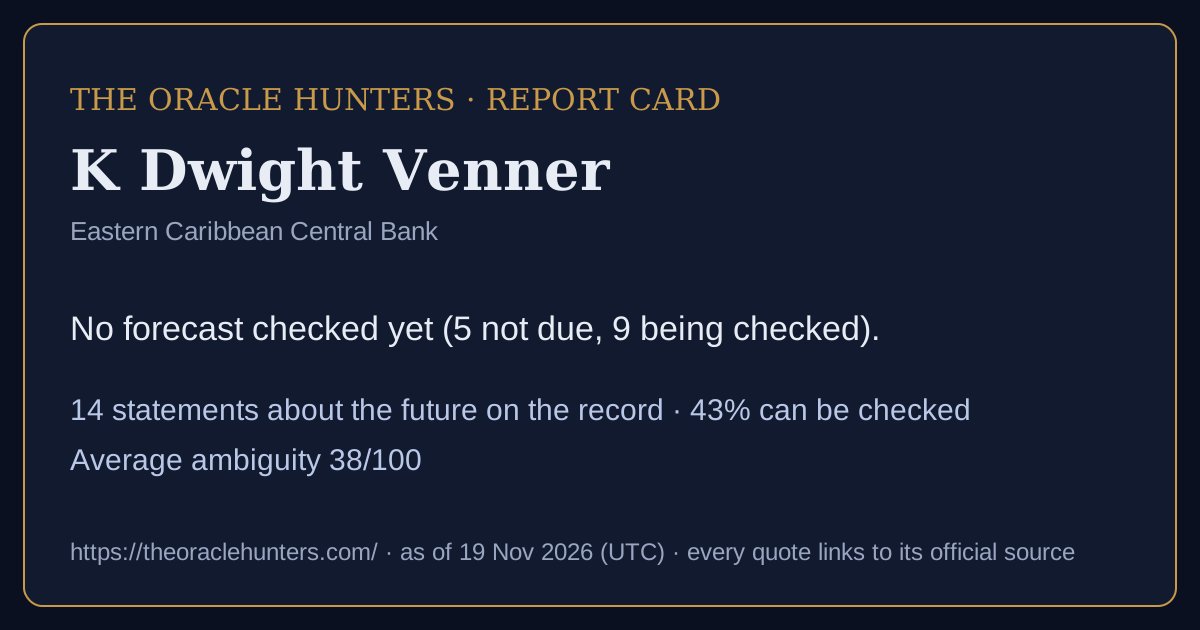
K Dwight Venner
Eastern Caribbean Central Bank
Track record: No forecast checked yet (5 not due, 9 being checked).
14forecasts & commitments on the record
43%can be checked as stated
38average ambiguity (0-100)
0goalpost moves recorded
0confirmed U-turns
Timeline
came true partly did not not due / being checked / too vague
Calibration score: shown after 10 checked forecasts with a stated likelihood (now 0).
How they speak about the future: based on data 11, educated guess 3.
Kinds of claim: forecast 11, scenario (if… then) 2, mixed claim 1. · Download this report card as a picture
In the nine words
πρόγνωσιςInference from evidence11 · 79%πρόνοιαPreparing for the future2 · 14%φρόνησιςPractical wisdom1 · 7%
How to read this
Each box is one sentence a public figure or institution said about the future, word for word, with a link to the official text. Can be checked means it names what will happen, by when, and how likely - so it can be compared with official figures later. Too vague to check means it does not. Ambiguity (0-100) is how many different ways the sentence can be read. When the date passes, the forecast is compared with official data and marked came true, partly or did not come true. Labels judge the sentence, never the person. Full guide and glossary.On the record (14)
The socioeconomic transformation will require a rate of growth of between 5 and 7 percent over a period of at least ten years to double per capita incomes in the OECS.
The year 2012 will be critical as the ECCU strives to consolidate its efforts to strengthen its economies and position itself to take advantage of the opportunities from the anticipated global economic recovery.
The Cricket World Cup 2007 (CWC) could be the event that catapults us into action.
We are a very short time away from a year that will go into the before and after category, that is 2007.
The current financial year 2006/2007 will bring new challenges for the Bank and its member countries.
One major event that will bring all of these issues together and focus our attention in 2006 will be the Cricket World Cup due to be staged in 2007.
This is necessary because we will have to manage our economies, which will be subject to a significant upturn in growth in 2006/2007 to bring them into soft landings and sustained growth in the period to 2010.
The objectives set by the OECS Heads of Government in 2002 of growth, 6 percent; unemployment of less than 6 per cent; poverty of less than 6 per cent; the maintenance and improvement of the Human Development Indices and economic transformation could be placed in the context of individual targets by each country.
If the currency is devalued, the ability to purchase goods from abroad will be decreased and the prices of all goods will go up due to inflation.
Also, on the other hand, if wages and prices increase faster than productivity we will become less competitive.
The tourism industry would seem to be the major catalyst for growth, which would be most effective if the linkages could be made with agriculture and light manufacturing.
The current financial year 2004/2005 will be one of great challenges for the Bank and its member countries.
The Bank in its programme for the fiscal year 2004/2005 will carefully monitor these factors and pay particular attention in its research programme to the following -
I have quoted at length from our colleague Lloyd, to remind you of the tremendous institution we have created over the last 35 years and to alert you to the challenges ahead which will reach their zenith in the year 2007.
Also said - not checkable as stated (12 newest)
Remarks about the future with no date, figure or likelihood that could be checked. They are kept on the record and shown here, but not scored.
The private sector will need to reconstruct itself to be the driving force in this initiative.
The challenge for us is: How do we break out of the current low output/high debt scenario and choose between the four outcomes which could confront us in the future?
Of major importance however will be what we refer to at the ECCB as the seven great modernizations which represent the fundamental platform for achieving our goals.
The more specific challenges relate to the nurturing of entrepreneurship and the development of an innovative outward looking private sector which is a medium to long term project, but must be started immediately.
The absence of an industrial revolution in our countries may have precluded a different trajectory in our economic growth.
The construction sector and the related professions such as architecture could benefit tremendously from innovations which are tested in our environment and which could have possibilities in other countries with a similar climate and topography.
The banking system will have to be a major target for restructuring, especially since it controls over 75 percent of the loanable funds in the economy.
The private sector will also have to reinvent itself to change its structure from being one-third formal, two-thirds informal and 90 percent concentrated on wholesale, retail, real estate and construction activities.
In short, integration will now become an open subject at the national and regional levels and should therefore gain more support.
The questions which now confront us are: What are the political tradeoffs which must be made to arrive at the form of integration implied by the new treaty and which could lead to the successful socioeconomic development of the member countries?, and What can the political traffic bear either now or in the not too distant future?
Leaving aside for the moment the orthodox stages of integration which ascend from a free trade area to a full blown political union, other forms of integration may present themselves if our backs are to the wall.
As the ECCU prepares for the transformation phase of the restructuring of its economies, starting in 2013, the ECCU Eight Point Stabilisation and Growth Programme must be consolidated into a strategic action plan with clearly defined and measurable goals.