K C Chakrabarty
Reserve Bank of India
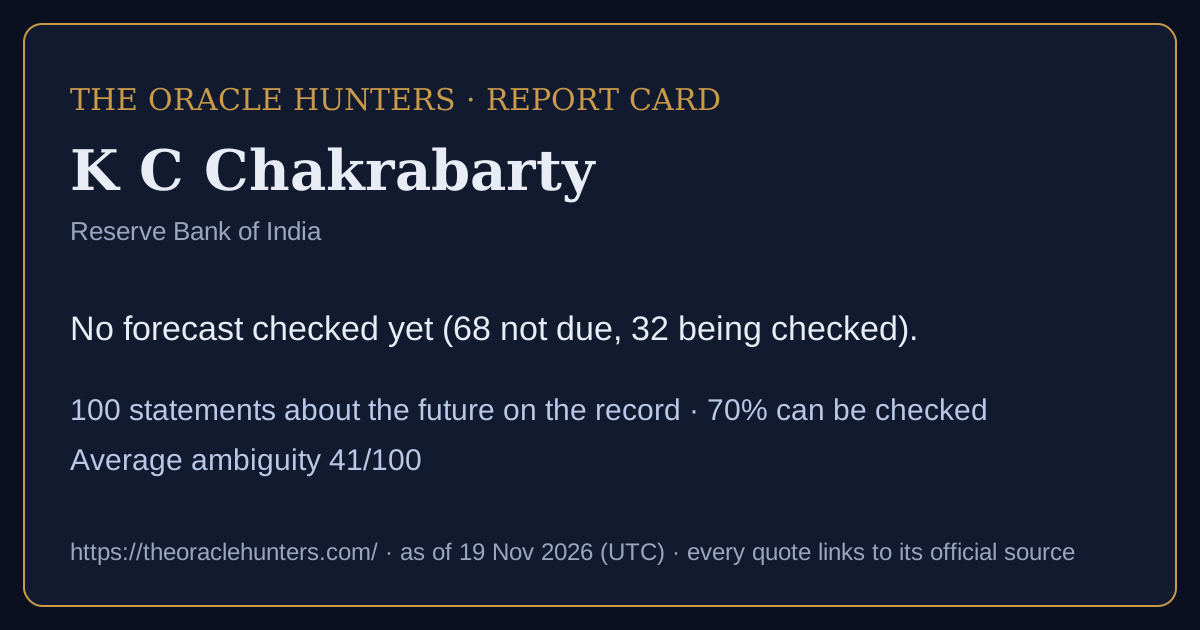
Track record: No forecast checked yet (68 not due, 32 being checked).
100forecasts & commitments on the record
70%can be checked as stated
41average ambiguity (0-100)
0goalpost moves recorded
0confirmed U-turns
Timeline
came true partly did not not due / being checked / too vague
Calibration score: shown after 10 checked forecasts with a stated likelihood (now 0).
How they speak about the future: based on data 83, educated guess 13, stated on authority 4.
Kinds of claim: forecast 78, mixed claim 13, scenario (if… then) 7, commitment 2. · Download this report card as a picture
In the nine words
πρόγνωσιςInference from evidence83 · 83%πρόνοιαPreparing for the future7 · 7%εἰκασίαConjecture6 · 6%προαναγγελίαPublic pre-announcement2 · 2%μαντείαInspired knowledge2 · 2%
How to read this
Each box is one sentence a public figure or institution said about the future, word for word, with a link to the official text. Can be checked means it names what will happen, by when, and how likely - so it can be compared with official figures later. Too vague to check means it does not. Ambiguity (0-100) is how many different ways the sentence can be read. When the date passes, the forecast is compared with official data and marked came true, partly or did not come true. Labels judge the sentence, never the person. Full guide and glossary.On the record (100)
The global projections for the next three years have been worked out at 160 billion, 166 billion and 173 billion banknotes, respectively.
The CRILC is expected to act as a repository of large credits containing system-wide exposure of individuals and entities having exposure (both fund and non-fund based) of more than Rs. 50 million.
I would like to urge the banks and the CICs to also put in place a system to collect credit data of exposures which are even below Rs.50 million, so that they could have reliable information about all the borrowers in the financial system.
All these evils will mitigate if we, as bankers, focus on financial innovations to support economic growth.
In terms of the Report of the Private Sector Investment for MSME Sub Group under Working Group for the 12th Five Year Plan (2012-2017) the credit gap as a percentage to total demand is estimated at 56% in 2013-14 for the MSME sector as may be seen from the table.
If good ideas could be incubated and acted upon, India would soon return to the higher growth trajectory and gain its rightful place in the world order.
It is expected that ensuring access to institutional finance to all individuals will itself increase the GDP by 1.5 per cent.
This, of course, is not, an exhaustive list of ideas, but only an illustration of how easily we can and we shall get our growth back.
The National Manufacturing announced by the Government of India proposes to increase the sectoral share Manufacturing in GDP to 25% over the next decade. 1
The range of projections for the growth in real GDP at factor cost by various agencies (being quoted in the media) is quite wide, between 4.25 per cent and 5.5 per cent.
In this regard, it may be mentioned that SEBI data shows that investment by Venture Capital Funds (VCFs) and Foreign Venture Capital Investors (FVCIs), which had peaked at about 3.1 per cent of GDP at current market prices in Q3 of 2010(Jul-Sept), has started declining since then (Chart 4).
India being a poor country and in need for foreign exchange, the import of gold of more than $56 billion will not help in controlling the CAD and bringing down the inflation.
I am glad that the Institute has chosen 'Sustaining Growth Amidst Adversity' as the theme for this year's Conference, a theme which could not be more apt considering the widespread concerns about the decline in growth momentum in the economy.
Also the use of mobile platforms for accessing internet has been staggering: in China, 65 percent of mobile-phone users regularly access the Internet via their phones, while in India, mobile-only web browsers are expected to comprise 55 percent of the total Internet user base by 2015.
For most of your members who have cut their teeth in an era when IDBI was a DFI with limited competition and a small universe of customers to deal with, the transition to commercial banking might be difficult, but remember, if you wish to survive as an institution in this new avatar, you must be willing to change.
The proportion of bank credit going to agriculture and SSI sectors has seen a steady decline from 30.03% in 1994 to 17.95% in 2013.
According to a World Bank Report on Private Participation in Infrastructure (PPI), India has been the top recipient of PPI activity since 2006 and has implemented 43 new projects, which attracted total investment of US$20.7 billion in 2011.
Therefore, let us assume that if a project was initially funded by a bank at 16%, what makes it willing to restructure the loan and agree for a much lower interest rate when the very fact of restructuring indicates greater credit risk in the account.
It may be observed that while the number of fraud cases has shown a decreasing trend from 24791 cases in 2009-10 to 13293 cases in 2012-13 i.e. a decline of 46.37%, the amount involved has increased substantially from Rs 2037.81 crore to Rs. 8646.00 crore i.e. an increase of 324.27%.
There will be significant addition to India's labour pool and even as the median age bucket rises, it will still be at a relatively young 30-34 age bracket by 2026.
Estimates suggest that about half of the demand for water will be unmet by 2030.
As per World Bank, at current rate, the 1.2 billion people in India will exhaust their fresh water supplies by 2050.
It is also estimated that approximately 55 million tonnes of Municipal Solid Wastes are generated in urban areas of India annually, which otherwise could be a valuable potential source for power generation for an energy deficient country.
Today, all stake holders - Government, industry, business, banks and consumers - have increasingly started realizing that if India and Indian businesses have to maintain a high growth momentum in the medium to long run, they have to focus on various facets of sustainability and I am sure, this Conference will serve to underscore this vital aspect.
As per the Economic Survey 2012-13, India's per capita carbon emissions in 2031 will be about 4 tonnes, which will still be lower than the global per capita emission in 2005 of 4.22 tonnes and about 75 per cent lower than the 2010 levels of the top three emitters.
Chidambaram has proposed in this year's Union Budget that an all-women public sector bank will soon be set up, which will predominantly employ and lend to women.
Supervisory practices will also need to imbibe additional lessons from the financial crisis which are emerging in the form of new regulatory and supervisory benchmarks like Basel III, revised Core Principles for Effective Bank Supervision, increased focus on systemically important banks, etc., if they are to remain robust and relevant in a changing banking environment.
Growth of the Indian economy for 2012-13 is projected at 5 per cent - significantly below the 9 per cent growth rate envisaged during the Twelfth Plan and well below our desired goal of double digit growth rate.
Second, the growing global emphasis on fair treatment to customers, financial inclusion and improved Know Your Customer (KYC) practices will require banks to reorient their business models, their data and information systems, and, in fact, the very mindset of banking, if banks have to remain relevant, going forward.
Let me emphasize that evading this debate will not solve our problems as unless banking is made available to everyone and universal financial inclusion is attained, the development agenda of the country will be incomplete and we will not see the kind of economic growth that we want to see.
According to available data, 90-95% of rickshaw pullers rent rickshaws on a daily basis and pay rentals as high as ₹.25 - 50 per day, which could, thus, add up to ₹1500 per month, for a rickshaw costing ₹10000 - 12000.
You may recall that this year, we are celebrating the 150th birth anniversary of Swami Vivekananda, one of the greatest spiritual leaders of India.
It will add significantly to its labor pool and, even as the median age bucket rises, it will still be at a relatively young 30-34 age bracket by 2026.
Growth in India has clearly slowed down since then to 6.5 per cent in 2011-12 and a likely 5.8 per cent in 2012-13, with significant downside risks.
China's population will start to shrink after reaching a peak of about 1.4 billion by 2025 A.D.
There is no doubt in my mind that if the economic growth engine has to churn out a powerful performance, banks would, necessarily, have to be the prime mover.
Growth in 2011-12, the final year of the Eleventh Plan, which was originally projected at around 9.0 per cent, continuing the strong rebound from the crisis, was eventually recorded at 6.5 per cent.
The Indian economy, which had accelerated since the reforms, recording a growth of more than 9% before the crisis, has slumped to 5.5% in the first quarter of 2012-13, with sequential downward revisions in estimated growth rate, which is now expected to clock around 5.8% in 2012-13.
A Boston Consulting Group study ' Indian Banking 2020 - Making the Decade's Promise Come True' estimates that the income group below the middle class with annual household income of Rs 90000 to Rs 2.00 lakh per annum will constitute the largest group of customers, increasing from an estimated 75 million households in 2010 to 120 million in 2020, constituting …
The report adds that Maharashtra, Gujarat and Andhra Pradesh will be amongst the most developed states in the country by 2020 and would, together, contribute 32 per cent of the overall GDP.
The Approach Paper to the 12th Plan estimates that infrastructure investment will need to increase from about 8.0 per cent of GDP in the base year (2011-12) of the Plan to about 10.0 per cent of GDP in 2016-17.
The implementation period of Basel III capital requirements, including capital conservation buffer and regulatory deductions, will begin from January 1, 2013 and will be fully implemented by March 31, 2018, before the timeline (January 1, 2019) indicated in Basel III rules.
Nair Committee has recommended that foreign banks may also be mandated to achieve overall priority sector target of 40 per cent of ANBC and focused priority sector target of 7 per cent of ANBC for lending to micro enterprises, at par with domestic banks.
If we can bring the excluded population into the purview of banking services, we could raise household and overall domestic savings further, and can, thus, fulfill one of the necessary conditions for achieving double-digit growth.
As the economy grows at a steady rate of around 7-8%, incomes rise and demographic dividends start accruing, the Banking industry is expected to take a quantum leap forward.
If the envisaged growth rate of 9 per cent per annum during the Twelfth Plan is to be achieved and banks have to remain competitive and continue to improve their margins, they would need to look at the new drivers of growth.
Public sector banks which account for nearly three fourths of the one million people working in Indian banks face the prospect of retirement of nearly 55 per cent of their people in the next decade.
The report goes on to predict that even under a worse case scenario when NPAs are assumed to grow by 150 per cent and the NPA ratio reaches 7 per cent, the system as a whole would remain resilient inasmuch as its CRAR would remain at 11 per cent, though some of the banks may come under duress.
The stress, however, could however arise from a need for the banks to adjust the unamortized portion of Pension and Gratuity liabilities in the opening balance sheet on April 1, 2013 on transition to IFRS.
A recent IBA-FICCI-BCG report, titled "Being five-star in productivity-Roadmap for excellence in Indian banking" has projected that the domestic banking industry is set for an exponential growth in the coming years with its asset size poised to touch USD 28,500 billion by the turn of the 2025 from the current asset size of USD 1,350 billion (2010).
Showing the newest 50 - the ledger has all 100.
Also said - not checkable as stated (12 newest)
Remarks about the future with no date, figure or likelihood that could be checked. They are kept on the record and shown here, but not scored.
In fact, the need of the hour is that counterfeiting should be tackled as a criminal activity with active co-ordination and collective might of all stakeholders-the vendors, Central Banks, law enforcement agencies, etc. Finding a long-term solution to this menace may also require close cross-border cooperation between various countries.
Another challenge with the likely potential to evolve into a reputational risk for RBI is the shortage/ 'perceived' shortage of coins and the lack of understanding on the exact role of the central bank in its distribution.
The vendors are also expected to co-operate with the national governments and Central Banks to avoid production of counterfeits by developing country-specific security features and bringing about improvisation in raw materials like paper, ink, thread, etc. Any failure of the vendors in this regard could result in total loss of business with individual countries making efforts to indigenize.
In keeping with the magnitude of the banknotes that are put into circulation, the corresponding need to import other machinery for processing, detection and destruction of the bank notes is also humongous.
I intend to use the presence of these global suppliers and vendors and the opportunity to speak at this platform today to highlight some of these concerns, which I feel must be bothering other Central Banks which rely on imports for their currency management, especially in the emerging markets.
In the subsequent paragraphs we shall be presenting the entire governance structure of our financial inclusion programme, the progress achieved so far and issues and challenges that need to be tackled to make it a success.
Our belief is that such partnerships with banks could be a game changer as far as financial inclusion is concerned.
Under our financial inclusion framework, we expect the banks to ensure that all the financial needs of the customers are met by offering them, at a minimum, the following four basic products:
This approach is expected to enable banks to minimize the cost of providing financial services in far flung areas of the country, which is the key for success of our financial inclusion initiatives.
The recent introduction of direct benefit transfer, based on validation of the identity of the beneficiary through Aadhaar, will help facilitate delivery of social welfare benefits by direct credit to the bank accounts of beneficiaries, thereby preventing leakages and wastages in the system.
This will create an environment of competitiveness amongst banks and in the process will benefit the unbanked population.
A study in August 2005 on 'The Evolution of Credit bureaus in Asia-Pacific' had recognised that there are challenges relating to data quality and consumer identification issues that CICs in India (at that point only CIBIL was in existence) will need to overcome.