Jwala Rambarran
Central Bank of Trinidad and Tobago
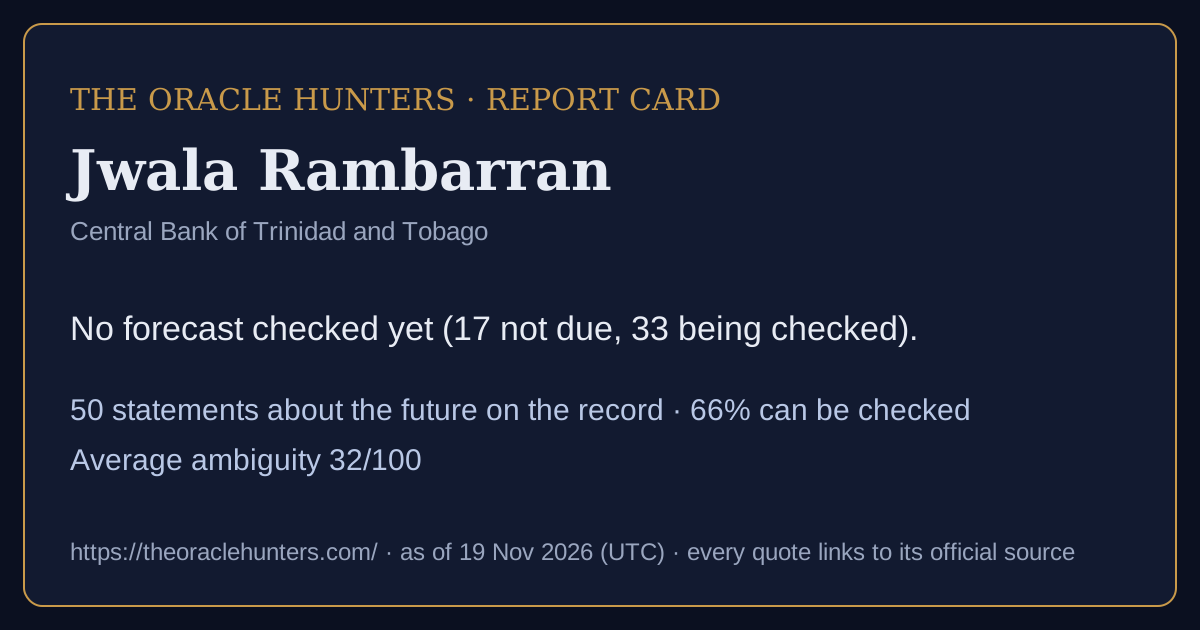
Track record: No forecast checked yet (17 not due, 33 being checked).
50forecasts & commitments on the record
66%can be checked as stated
32average ambiguity (0-100)
0goalpost moves recorded
0confirmed U-turns
Timeline
came true partly did not not due / being checked / too vague
Calibration score: shown after 10 checked forecasts with a stated likelihood (now 0).
How they speak about the future: based on data 45, stated on authority 4, educated guess 1.
Kinds of claim: forecast 43, mixed claim 4, scenario (if… then) 2, commitment 1. · Download this report card as a picture
In the nine words
πρόγνωσιςInference from evidence44 · 88%μαντείαInspired knowledge3 · 6%πρόνοιαPreparing for the future2 · 4%προαναγγελίαPublic pre-announcement1 · 2%
How to read this
Each box is one sentence a public figure or institution said about the future, word for word, with a link to the official text. Can be checked means it names what will happen, by when, and how likely - so it can be compared with official figures later. Too vague to check means it does not. Ambiguity (0-100) is how many different ways the sentence can be read. When the date passes, the forecast is compared with official data and marked came true, partly or did not come true. Labels judge the sentence, never the person. Full guide and glossary.On the record (50)
Next year, for the first time in eight years, we are likely to see a hike in the Fed funds rate, probably in summer of 2015.
The peril that has the potential to test us the most in 2015 will come from those storm clouds gathering over increases in US interest rates.
With general elections due in 2015, construction activity is likely to remain strong even if Government slows down its heavy capital expenditure programme which plays a critical path in providing fiscal stimulus to the economy.
- First, we expect energy production to return to more reasonable levels next year, providing a firmer boost to economic growth.
What if the Fed raises interest rates faster and more than expected next year and causes tremendous volatility in global currency, stock and bond markets?
Looking ahead, higher public spending through the expansionary 2014/2015 Budget is already adding to elevated liquidity levels (currently nearly $8 billion) and may further push up core inflationary pressures.
As financial services professionals it may be of interest to you, to know that almost 15 per cent of Central Bank's new employees since I assumed office are in the area of financial supervision and another 10 per cent are in economic research.
From 2015, we will offer three De La Rue scholarships.
- On this basis the Central Bank expects real GDP growth to strengthen to at least 2.5 percent in 2014.
Awards for on-shore bid rounds will lead to increased exploration activity in these blocks in late 2014 or early 2015.
As of mid-May 2014, the stock of foreign exchange reserves is almost US$ 10.5 billion, more than enough to cover over one year of imports.
After a few years of sub-par performance, Trinidad and Tobago's economy delivered fasterthan-expected growth of almost 2 percent in 2013.
Economic performance in the United States was weaker than expected in the first quarter of 2014, even though it outpaced that of Europe and Japan, both of which are struggling to cross a moderate 1 per cent annualised growth threshold.
Some of you may be aware that, in January 2015, Trinidad and Tobago will be the first Caribbean jurisdiction to undergo the Fourth Round Mutual Evaluation utilizing the revised Financial Action Task Force's (FATF) Forty Recommendations.
Awards for these bid rounds will lead to increased exploration activity in these blocks in late 2014 or early 2015.
expected to consume just about 2 per cent of export earnings from 1 ½ per cent prior to the bond issue.
External debt is projected to rise slightly to a still very manageable 9 per cent of GDP from about 8 per cent of GDP prior to the bond issue.
We expect economic growth to strengthen to 2 ½ percent in 2014.
Output in the upstream and downstream energy industries is expected to return to more normal levels in 2014, providing a strong boost to overall
Moreover, it is important to note that the 2013/2014 budget, which was approved by Parliament, projected that almost $3 billion of the near $6.4 billion deficit would be financed through foreign borrowing including commercial borrowing.
The Honourable Minister of Finance and the Economy is expected to lay the Insurance Bill before a Joint Select Committee of Parliament before the end of the year.
Unless government significantly picks up the pace of capital spending, its overall budgetary stance could prove only mildly expansionary at the end of the fiscal year, which is just three months away.
Ansa McAl's $400 million state of the art clay plant, which is expected to be the single largest investment in the construction this year.
By 2040, two in three people are expected to live in cities and the developing world will be home to 29 of the biggest megacities with populations of ten million or more.
By 2020, the combined economic output of three leading developing countries alone - Brazil, China and India - will surpass the combined GDP of Canada, France, Germany, Italy, the United Kingdom and the United States.
In 2013, three countries are projected to hold exceptionally high public debt at over 90 per cent of GDP, while another seven countries are projected to have heightened debt vulnerabilities, averaging in the range of 50 to 90 per cent of GDP.
The IMF estimates that real GDP growth in the Caribbean is likely to bounce back to around 3 per cent over the medium term, from a cumulative flat performance in 2009 - 2012.
If this trend continues, the median price for a 3-bedroom house could reach about $1.3 million by the end of this decade.
The total mortgage funding required to meet the annual demand for housing units is projected at around $30 billion by the end of this decade.
Spending within the market hit US$12 million in 2010 and is expected to reach over US$20 million by 2015.
Another six countries are projected to have heightened debt vulnerabilities, averaging in the range of 50 to 90 percent of GDP, in 2013.
By this measure, four countries in the Caribbean are projected to hold exceptionally high public debt in 2013: Jamaica (140 percent), St. Kitts &
Perhaps this will be the first chapter on the post-2015 development story of new financing arrangements for small vulnerable Caribbean economies, whose future might be partly based on the choices you make at this workshop.
Barring any weather-related setbacks or a new round of commodity price shocks, inflation is projected to remain below double digits in 2013.
If executed as envisaged, the 2012/2013 budget could stimulate a firm recovery in construction activity and, by extension, economic growth through certain public construction projects and tax incentives for construction of residential and commercial buildings.
Overall, global prospects have weakened and in its October 2012 World Economic Outlook, the IMF lowered its forecasts for world economic growth to just over 3½ per cent in 2013 (from an earlier estimate of almost 4 per cent for 2013).
In the United States, the Federal Reserve announced additional measures in September 2012 to ease monetary policy by expanding its asset purchases until a substantial improvement in the labor market is seen, and emphasized that its exceptionally low level of federal funds rates are likely to be in place until mid-2015.
External debt is projected to increase from just over 8 per cent of GDP to about 10 per cent over FY 2013.
Based on these underlying assumptions and the turnaround in the third quarter, the Central Bank is maintaining its projection for real GDP growth of around 1 per cent for all of 2012, and growth is expected to strengthen to 2 ½ per cent in 2013.
With slowing export demand partly due to contagion effects from the European sovereign debt crisis and their economies adjusting to policy tightening conducted over 2010-2011, growth in Brazil, Russia, India, China and India is expected to be lower in 2012 and 2013.
The U.S. Congressional Budget Office has warned that an automatic fiscal withdrawal in 2013 could push the U.S. economy back into recession, unless legislation is adopted to prevent it.
Four countries in the Caribbean will continue to accumulate exceptionally high public debt, averaging in excess of 90 percent of GDP in 2013: Jamaica (140 percent), St. Kitts &
Another six countries are projected to have heightened debt vulnerabilities, averaging in the range of 50 to 90 percent of GDP, in 2013.
Nevis, and St. Vincent & the Grenadines are expected to run sizeable external current account deficits, averaging more than 20 percent of GDP during 2012-2013.
After posting a cumulative contraction of around 3 percent in 2009-2010, and modest growth of just over 1 percent in 2011, the Caribbean is expected to grow by close to 2 percent in 2012, and strengthen to about 2 ½ percent in 2013.
Otherwise the 30 percent withholding tax will be applied.
To properly comply with these new reporting requirements, a foreign financial institution will have to enter into a special agreement with the IRS by June 30, 2013.
In this way, the Bank will remain ahead of the financial stability curve, regaining and rebuilding public trust and confidence.
We expect to lay the revised Credit Union Bill in Parliament around the middle of 2013.
The Congressional Budget Office has warned that spending cuts and tax rises due to take place in 2013 could push the US economy back into recession.
Also said - not checkable as stated (12 newest)
Remarks about the future with no date, figure or likelihood that could be checked. They are kept on the record and shown here, but not scored.
Tonight, we will also see another aspect of Shiva as both the creator and the destroyer.
Each new mode of transportation took a toll on existing jobs and industries…and will continue to do so.
Attempts to soften the harsher aspects of creative destruction by trying to preserve unsustainable jobs or protect uncompetitive industries will not advance our economic diversification process.
We must exercise our power in a fair and just manner, with knowledge of what actions are best for the overall health of Trinidad and Tobago's economy.
This year, we decided to continue with our exploration of the Ramayana because it is my one intention that anyone attending our cultural programs should walk away with a greater appreciation and new found respect for whatever artform we are showcasing.
Shravan Kumar's story is applicable to Central Bank's own story, as you will soon see.
Sage Valmiki trained Luv and Kush to be masters in archery so that no one on earth could defeat them in war.
There is a skills deficit here at home and continuous learning will be your currency in the job market.
These global forces will fundamentally change the profile of jobs in finance in the coming decade and beyond.
It may interest you to know that 70 per cent of GATE funding is concentrated in just a few areas - Management, Educational Services, Data Processing/IT, Engineering, Health Services, Natural and Pure Sciences, and Accounting.
One of the programmes of this new training agency will be a Certificate in Central Banking that will provide our entry level staff with broad-based knowledge and understanding of monetary policy, financial supervision and reserve management.
However, someone must be called upon to account for the bank failure and, of course, that 'someone' will be us, the central bankers.