Juyeol Lee
Bank of Korea
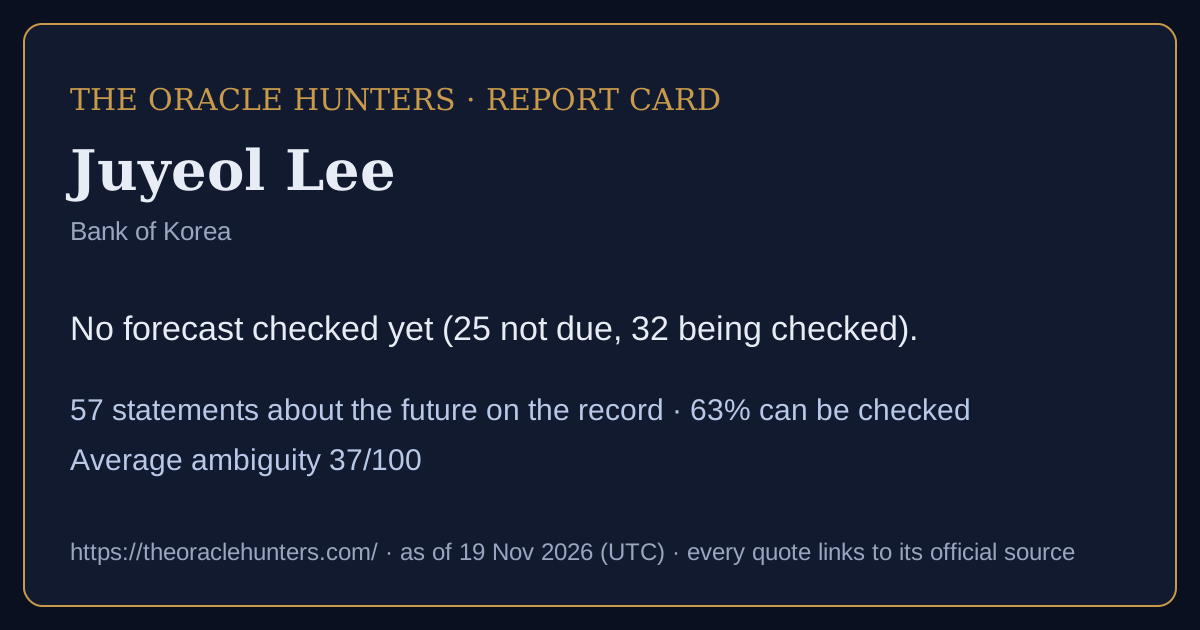
Track record: No forecast checked yet (25 not due, 32 being checked).
57forecasts & commitments on the record
63%can be checked as stated
37average ambiguity (0-100)
0goalpost moves recorded
0confirmed U-turns
Timeline
came true partly did not not due / being checked / too vague
Calibration score: shown after 10 checked forecasts with a stated likelihood (now 0).
How they speak about the future: stated on authority 43, educated guess 8, based on data 6.
Kinds of claim: mixed claim 27, forecast 21, scenario (if… then) 8, commitment 1. · Download this report card as a picture
In the nine words
μαντείαInspired knowledge42 · 74%πρόνοιαPreparing for the future8 · 14%πρόγνωσιςInference from evidence5 · 9%προαναγγελίαPublic pre-announcement1 · 2%εἰκασίαConjecture1 · 2%
How to read this
Each box is one sentence a public figure or institution said about the future, word for word, with a link to the official text. Can be checked means it names what will happen, by when, and how likely - so it can be compared with official figures later. Too vague to check means it does not. Ambiguity (0-100) is how many different ways the sentence can be read. When the date passes, the forecast is compared with official data and marked came true, partly or did not come true. Labels judge the sentence, never the person. Full guide and glossary.On the record (57)
This year will likely be another challenging one for our economy in terms of both the domestic and external environment.
I hope that this year will be the last year of the pandemic.
The domestic economy is expected to continue steady growth this year as well, on the back of favorable exports and investment.
Let me talk now about the main tasks that the Bank of Korea will need to focus on this year.
This year will likely be another challenging year for our economy.
This year, it is expected that the global economy and trade will improve gradually, and the Korean economy will recover modestly.
Unless we move beyond the past paradigm of growth relying on accumulation of physical capital, we will not be able to escape low growth even after overcoming the crisis.
Since it is forecast that our economy will grow at a pace below the potential level, and that demand-side inflationary pressures will not be high, we will need to maintain our accommodative monetary policy stance.
This year, our economy is expected to improve, albeit at a moderate pace, as the sluggishness in the global trade starts to gradually ease and the semiconductor sector steadily recovers.
Meanwhile, the Bank of Korea will enforce a 52-hour workweek policy starting next month.
As inflation has remained far below its target level, we will need to examine on a regular basis how the inflation target is managed and explain in detail to enhance economic agents' understanding of inflation conditions.
In our monetary policy operations, we will work to ensure that stable growth is sustained and inflation converges to its target over a medium-term horizon, while paying close attention to financial stability.
We will also need to complete, without delay, the establishment of the Next Generation BOKWire+, which is scheduled to commence operations in 2020.
We will need to carry out policies to expand our engines for growth in a systematic and consistent manner over a longer-term horizon.
This year the Korean economy appears likely to maintain a pace of growth similar to last year's.
We must also push ahead as planned with the construction of our next generation BOK Wire+, targeted to begin operation next year, bearing in mind that it will be the foundation of our nation's payment and settlement system of the future.
Given the forecast that our economy will continue to grow at a rate in the middle- to upper-2% range, and that the demand-side inflationary pressures will not be large, we will need to maintain our accommodative monetary policy stance.
Let me talk now about the main tasks that the Bank of Korea will need to focus on in its operations this year.
We will maintain our inflation target at 2%, but from this year will not set a fixed period for achieving it, as is also the practice in other major advanced economies.
We will need to strengthen our analyses of new forms of risk to financial stability and the changes in our monetary policy operating conditions that can occur due to digital innovations such as distributed ledger technology and Fintech.
We will have to closely analyze whether there have been any structural changes in the underlying price flows, and in the relationship between growth and prices, and properly set the inflation target and the period for re-examining it.
From this standpoint, we will have to carefully judge whether it is necessary to adjust the accommodative monetary policy stance further, while closely checking future economic growth and inflation trends, changes in the monetary policies of major countries and the consequent financial stability conditions.
In the second half of this year we will have to consider the inflation target to be applied from next year.
Taking into account the changes in the relationship between growth and prices, as well as the importance of the central bank's role in financial stability, we will have to deliberate deeply on measures to facilitate efficient operation of our inflation targeting system.
As we continue our monetary policy accommodation to support our economy's trend of growth, and closely examine changes in real economic and financial stability conditions, we will need to judge carefully the necessity of any adjustment in the degree of accommodation.
We will have to systematically analyze any changes in the inflation dynamics, such as the trends of inflation and the relationship between growth and prices, and carefully examine whether there might not be points needing improvement in relation to the inflation target level, the method of setting the target, our responsibility for policy explanation, etc.
Given the forecast that the demand side inflationary pressures will not be high, even though the economy's solid trend of growth will continue this year as well, it will be desirable to maintain our accommodative monetary policy stance for the time being.
We will need to conduct our monetary policy so as to ensure that sustainable growth continues and consumer price inflation can be stabilized at the target level over a medium-term horizon.
Let me talk now about the main tasks that the Bank of Korea will have focus on carrying out this year.
This year the Korean economy appears likely to maintain its trend of solid growth, thanks for
During this year we will have to again examine the operating conditions of our inflation targeting system, which will be newly set with effect from 2019.
Even if we succeed in shifting the growth paradigm, and in rebalancing the economy, a failure in responding to population aging will make the escape from possible structural low growth difficult.
Going forward we will have to break out of the paradigm of extensive growth based on the expansion of production factor inputs, and move to one of intensive growth driven by innovation.
Notably, if measures to expand fiscal expenditures to create jobs and for other purposes are implemented by the new government, then the pace of growth will accelerate even further.
Despite the recent accelerating pace of growth, we will need to maintain our accommodative
We will need to overcome these structural problems wisely in order to sustain our recent growth momentum over the medium- to long-term.
As these trends continue, it is expected that the economic growth rate for this year will exceed the forecast in April.
It is my sincere hope that this year's very opportune Bank of Korea Conference will serve as a fruitful venue for looking back on the last decade since the Global Financial Crisis, for gaining insights into the next decade before us, and for generating constructive policy ideas.
If this kind of multilateral cooperation can be achieved, I believe that the usefulness of GDP will be considerably increased and well-being could be measured in a more balanced way.
If we leave our economy's structural vulnerabilities unresolved, citing the unfavorable conditions currently before us, then the recovery of our growth potential will become even more difficult to attain.
If we look around, however, at conditions here at home as well as abroad, there are potential risk factors lurking everywhere that could limit the pace of growth.
Second, given the long period of monetary easing undertaken to this time, we will need to pay even more attention to financial stability.
But if more and more people become able to assimilate and utilize various digital technologies, such as artificial intelligence and big data, then I think such technological advancements will insteadpositively affect employment and growth.
There are substantial concerns that the Korean economy could face huge difficulties this year.
In addition, in order to secure the appropriate time horizons for deciding on our monetary policies, and to strengthen the linkage between monetary policy and our economic forecasts, we plan to reorganize the framework for Monetary Policy Board meeting operation, with effect from next year.
- I hope that you will fully demonstrate your strong competence and potential again this year, to show that the Bank of Korea is indispensable to the development of our national economy.
This year, under the new inflation target, in order to sustain the trend of recovery of economic growth we will maintain our accommodative monetary policy stance, while also paying attention to financial stability.
Since it is likely that the high volatility in our financial and FX markets will continue this year, we have to thoroughly monitor international financial market conditions and capital flow trends, and if necessary implement our comprehensive Contingency Plan to ensure market stability, in a timely manner.
We also need to conduct an in-depth study of how Internet-only Banks, whose launch is scheduled for this year, will evolve in the future, and what changes they will bring to the monetary policy transmission channels and bank management environment.
The general consensus is that the probability of household debt threatening our economy's stability is not high for now, but if its current rapid growth persists it could work to constrain household consumption and destabilize the financial system.
Showing the newest 50 - the ledger has all 57.
Also said - not checkable as stated (12 newest)
Remarks about the future with no date, figure or likelihood that could be checked. They are kept on the record and shown here, but not scored.
First, we will continue to appropriately adjust the degree of monetary policy accommodation in line with improvement in economic conditions.
In this respect, we should take an especially close look at the possibility of the inflation trend lasting longer than anticipated due to the interaction between recent rises in prices and inflation expectations.
As for the unprecedented accommodative measures we have taken so far, we must think in advance about how and when we will normalize, in careful consideration of future developments of the pandemic, economic conditions, and the effectiveness and possible negative side effects of the measures.
Therefore, monetary policy will need to remain accommodative until the economy is projected to maintain a stable recovery trend.
However, having a number of possibly conflicting policy goals could make it difficult to maintain consistency in monetary policy operations, and therefore we will need to refer to research outcomes and past experiences at home and abroad, while listening carefully to experts, to come up with an optimal solution that fits the conditions we are facing.
We must remain cool-headed in every judgment we make, and do the best we can in our jobs, so that the decisions we make today will later be regarded as successful in helping overcome this crisis and in preparing for the post-corona era.
Monetary policy should remain accommodative until the economy is expected to emerge from the coronavirus-triggered crisis and show a trend of recovery.
We must also fundamentally change the way we work, by introducing the latest digital technology, innovating with respect to our administrative and personnel management systems, and redefining our culture, so that every employee will be able to grow together with the organization.
The Korean economy is forecast to record negative growth in the first half of this year with the sharp drops in consumption and exports.
However, many hurdles are expected on the road to a full recovery from the real economic crisis created by the COVID-19 pandemic.
We will have to conduct our monetary policy so as to support economic recovery and to ensure that inflation stabilizes at the target level over a medium-term horizon.
In this process, we will determine whether to adjust the degree of monetary accommodation, based on an assessment of wide-ranging factors such as external risk developments, domestic macroeconomic trends, and any changes in financial stability conditions.