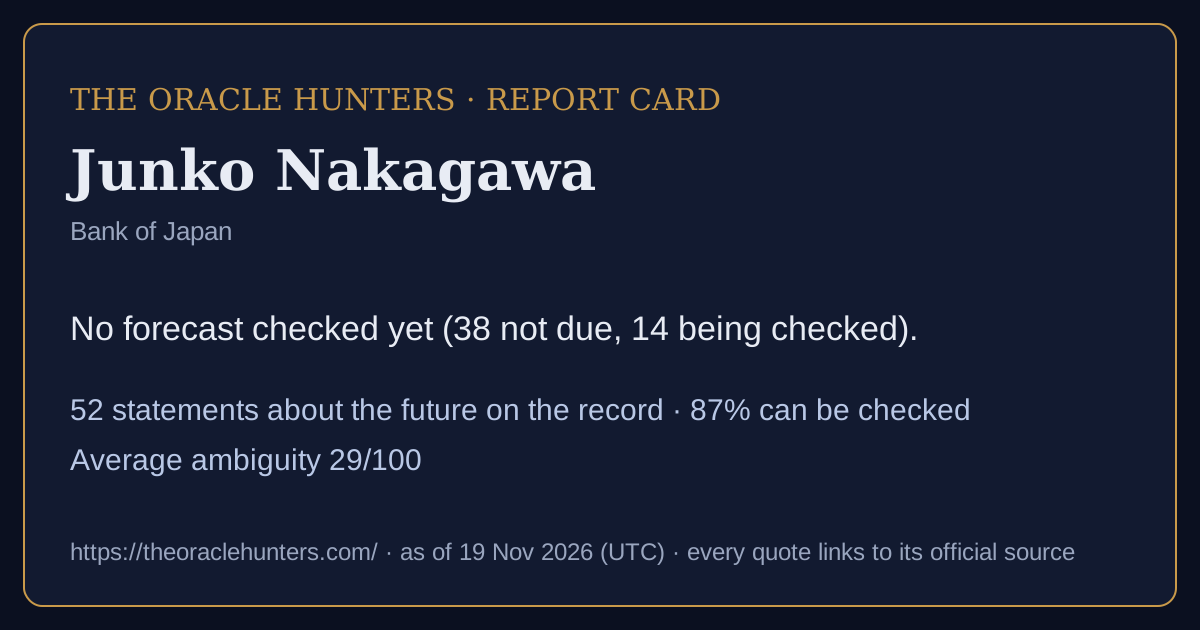
Junko Nakagawa
Bank of Japan
Track record: No forecast checked yet (38 not due, 14 being checked).
52forecasts & commitments on the record
87%can be checked as stated
29average ambiguity (0-100)
0goalpost moves recorded
0confirmed U-turns
Timeline
came true partly did not not due / being checked / too vague
Calibration score: shown after 10 checked forecasts with a stated likelihood (now 0).
How they speak about the future: based on data 43, educated guess 9.
Kinds of claim: forecast 42, scenario (if… then) 8, mixed claim 2. · Download this report card as a picture
In the nine words
πρόγνωσιςInference from evidence43 · 83%πρόνοιαPreparing for the future5 · 10%φρόνησιςPractical wisdom3 · 6%εἰκασίαConjecture1 · 2%
How to read this
Each box is one sentence a public figure or institution said about the future, word for word, with a link to the official text. Can be checked means it names what will happen, by when, and how likely - so it can be compared with official figures later. Too vague to check means it does not. Ambiguity (0-100) is how many different ways the sentence can be read. When the date passes, the forecast is compared with official data and marked came true, partly or did not come true. Labels judge the sentence, never the person. Full guide and glossary.On the record (52)
On the other hand, if firms find it difficult to pass on costs to selling prices, mainly due to weakened demand, their profits could face downward pressure.
On the other hand, if countries around the world implement expansionary fiscal policies in response to the outcome of tariff negotiations and tariff policies, global economic growth could turn out to be stronger than expected.
The Bank will conduct an interim assessment of the plan at the June 2026 MPM.
of its monthly outright purchases of JGBs, so that the purchase amount will be about 2 trillion yen in the January-March quarter of 2027; the amount will be cut down, in principle, by about 400 billion yen each calendar quarter until the January-March quarter of 2026, and by about 200 billion yen each calendar quarter from the April-June quarter of …
The year-on-year rate of change in the CPI for all items excluding fresh food is projected to be 2.7 percent for fiscal 2025, 1.8 percent for fiscal 2026, and 2.0 percent for fiscal 2027, also
In terms of the median of the Policy Board members' forecasts, the real GDP growth rate is projected to be 0.7 percent for fiscal 2025, 0.7 percent for fiscal 2026, and 1.0 percent for fiscal 2027.
If firms, in response to tariff policies, have to focus much more on cost cutting over passing on cost increases to selling prices, moves to reflect price rises in wages could weaken.
Specifically, the Bank will reduce the planned amount of its monthly purchases of JGBs so that it will be about 2 trillion yen in January-March 2027; the amount will be cut down, in principle, by about 400 billion yen each calendar quarter until January-March 2026, and by about 200 billion yen each calendar quarter from April-June 2026.
Likewise, the rate of change in the CPI for all items excluding fresh food and energy is projected to be 2.8 percent for fiscal 2025, 1.9 percent for fiscal 2026, and 2.0 percent for fiscal 2027.
The year-on-year rate of change in the CPI for all items excluding fresh food is projected to be 2.7 percent for fiscal 2025, 1.8 percent for fiscal 2026, and 2.0 percent for fiscal 2027, in terms of the median of the Policy Board members' forecasts.
The real GDP growth rate is projected to be 0.6 percent for fiscal 2025, 0.7 percent for fiscal 2026, and 1.0 percent for fiscal 2027, in terms of the median of the Policy Board members' forecasts.
Specifically, it is projected that the growth rate for 2025 and 2026 will decelerate to the range of 2.5-3.0 percent, and the rate for 2027 will return to around 3 percent, which is broadly in line with the average growth rate since 1980.
At the MPM starting at the end of April, the Bank will release its projections for fiscal 2027 for the first time.
In the second half of the projection period -- in other words, toward the end of fiscal 2026 -- underlying inflation is likely to be around the 2 percent level, which is generally consistent with the price stability target.
Likewise, the rate of change in the CPI for all items excluding fresh food and energy is projected to be 2.2 percent for fiscal 2024, and 2.1 percent for both fiscal 2025 and fiscal 2026.
The year-on-year rate of change in the CPI for all items excluding fresh food is projected to be 2.7 percent for fiscal 2024, 2.4 percent for fiscal 2025, and 2.0 percent for fiscal 2026, in terms of the median of the Policy Board members' forecasts.
The real GDP growth rate is projected to be 0.5 percent for fiscal 2024, 1.1 percent for fiscal 2025, and 1.0 percent for fiscal 2026, in terms of the median of the Policy Board members' forecasts.
In the January 2025 World Economic Outlook (WEO) Update , the International Monetary Fund (IMF) projected that the growth rate of the global economy would be in the range of 3.0-3.5 percent for both 2025 and 2026, which is broadly in line with the average growth rate since 1980.
At the June 2025 MPM, the Bank will conduct an interim assessment of the plan for the reduction of its JGB purchases; in principle, it intends to maintain the current reduction plan, while it may modify the plan if deemed necessary after reviewing the developments in and functioning of the JGB markets.
While the effects of the pass-through to consumer prices of cost increases led by the past rise in import prices are expected to wane, the rate of increase in the CPI (all items less fresh food) is projected to be affected by factors such as the government's measures and the dissipation of their effects through fiscal 2025.
The International Monetary Fund (IMF) projects that the global economy will grow at 3.2 percent for 2024 and 3.3 percent for 2025.
Likewise, the rate of change in the CPI (all items less fresh food and energy) is projected to be 1.9 percent for both fiscal 2024 and fiscal 2025, and 2.1 percent for fiscal 2026.
In terms of the median of the Policy Board members' forecasts in the July 2024 Outlook Report, the year-on-year rate of change in the CPI (all items less fresh food) is projected to be 2.5 percent for fiscal 2024, 2.1 percent for fiscal 2025, and 1.9 percent for fiscal 2026.
As presented in the Outlook for Economic Activity and Prices (Outlook Report) decided by the Bank at the July 2024 Monetary Policy Meeting (MPM), the real GDP growth rate is projected to be 0.6 percent for fiscal 2024, and 1.0 percent for both fiscal 2025 and fiscal 2026, in terms of the median of the Policy Board members' forecasts.
Nevertheless, if real income does not grow but rather turns out to be lower than expected, there is a risk that demand will wane through deterioration in consumer sentiment, thereby exerting downward pressure on economic activity and prices.
In October 2023, with extremely high uncertainties surrounding economies and financial markets at home and abroad, the Bank considered that strictly capping the upper bound for 10-year JGB yields at 1.0 percent would have strong positive effects, but could also entail large side effects.
Likewise, the year-on-year rate of change in the CPI (all items less fresh food and energy), which had continued to climb at relatively high rates until January, is projected to be 3.8 percent for fiscal 2023 and 1.9 percent for both fiscal 2024 and fiscal 2025.
Given this context, in terms of the median of the Policy Board members' forecasts in the January 2024 Outlook Report, the year-on-year rate of change in the CPI (all items less fresh food) is projected to be 2.8 percent for fiscal 2023, 2.4 percent for fiscal 2024, and 1.8 percent for fiscal 2025 (Chart 11).
As presented in the Outlook for Economic Activity and Prices (Outlook Report) decided by the Bank at the January 2024 Monetary Policy Meeting, the real GDP growth rate is projected to be 1.8 percent for fiscal 2023, 1.2 percent for fiscal 2024, and 1.0 percent for fiscal 2025, in terms of the median of the Policy Board members' forecasts (Chart …
If, on the other hand, downside risks to Japan's economic activity and prices materialize, the current framework of yield curve control is designed to ensure that monetary easing effects will be maintained through a decline in long-term interest rates.
Meanwhile, there is also a possibility that the opposite will occur, if moves to rush the passthrough of cost increases to selling prices pause, supported by the projected high corporate profits.
If rises in observed and expected inflation rates continue and create synergy effects, this could lead inflation to become higher than expected.
Given this context, the medians of the Policy Board members' forecasts for the year-on-year rate of change in the CPI (all items excluding fresh food) are 2.5 percent for fiscal 2023, 1.9 percent for fiscal 2024, and 1.6 percent for fiscal 2025 (Chart 10).
As presented in the Outlook for Economic Activity and Prices (Outlook Report) decided by the Bank at the July 2023 Monetary Policy Meeting (MPM), the medians of the Policy Board members' forecasts for the real GDP growth rate are 1.3 percent for fiscal 2023, 1.2 percent for fiscal 2024, and 1.0 percent for fiscal 2025 (Chart 10).
In its July 2023 World Economic Outlook Update , the International Monetary Fund (IMF) projected that the global economic growth rate would slow from an estimated 3.5 percent in 2022 to 3.0 percent in both 2023 and 2024 (Chart 1).
If the behavior and mindset based on the assumption that wages will not increase easily remain deeply entrenched, there is a risk that moves to increase wages will not strengthen as much as expected and prices will in turn be under downward pressure.
If firms' inflation expectations become higher, the pass-through of cost increases could accelerate further.
As presented in the Outlook for Economic Activity and Prices (Outlook Report) decided by the Bank at the January 2023 Monetary Policy Meeting (MPM), the medians of the Policy Board members' forecasts for real GDP growth rates are 1.7 percent for FY2023 and 1.1 percent for FY2024 (Chart 12).
Under these circumstances, the medians of the Policy Board members' forecasts for the year-on-year rate of change in the CPI for all items excluding food are 1.6 percent for FY2023 and 1.8 percent for FY2024, down from the forecast of 3.0 percent for FY2022 (Chart 12).
In its January 2023 World Economic Outlook (WEO) Update , the International Monetary Fund (IMF) projected that the global economic growth rate would slow from an estimated 3.4 percent in 2022 to 2.9 percent in 2023.
In terms of the baseline scenario of the outlook for prices, the medians of the Policy Board members' forecasts presented in the July Outlook Report for the year-on-year rate of change in the CPI less fresh food are 2.3 percent for FY2022, 1.4 percent for FY2023, and 1.3 percent
In light of these developments in the corporate and household sectors, the Bank's Policy Board members' baseline scenario presented in the July Outlook Report forecasts a real GDP growth rate of 2.4 percent for FY2022, 2.0 percent for FY2023, and 1.3 percent for FY2024;
However, as it was expected to take time to achieve the 2 percent target, the Bank conducted an assessment in March 2021 with a view to implementing further effective and sustainable monetary easing.
Japan's economy is projected to continue growing at a pace above its potential growth rate, which is estimated to be at 0.0-0.5 percent (Chart 1).
While a slowdown had been anticipated as a risk, given that global growth was projected at 3.6 percent for both years in the April WEO, a significant downward revision has been made in a short period of time.
With respect to the outlook for the global economy, the International Monetary Fund (IMF) projected in its July 2022 World Economic Outlook (WEO) Update that global growth rates for 2022 and 2023 would be 3.2 percent and 2.9 percent, respectively.
In light of these factors, the Bank's Policy Board members' baseline scenario presented in the January 2022 Outlook for Economic Activity and Prices (Outlook Report) forecasts a real GDP growth rate of 2.8 percent for FY2021, 3.8 percent for FY2022, and 1.1 percent for FY2023 (Chart 7).
- Interest rate: 0% -- The measure will fall under Category Ⅲ (applied interest rate: 0%) in the Interest Scheme to Promote Lending
However, in March 2021 the Bank conducted an assessment of the measures taken until then to conduct further effective and sustainable monetary easing, as it was expected to take time to achieve the 2 percent target (Chart 12).
Moreover, from April onward, the year-on-year rate of change in the CPI for all items less fresh food may momentarily rise to a level close to 2 percent if the effects of the reduction in mobile phone charges dissipate.
Showing the newest 50 - the ledger has all 52.
Also said - not checkable as stated (2 newest)
Remarks about the future with no date, figure or likelihood that could be checked. They are kept on the record and shown here, but not scored.
To be able to conduct appropriate policy at each point in time, the Bank will continue gathering information, without any preconceptions, before reaching a decision.
While using the indicators that I just explained, the Bank will continue to examine the underlying trend in prices.